(Botanik, Kräuterbuch) BRUNFELS, Otto.  Auf Merkliste setzen
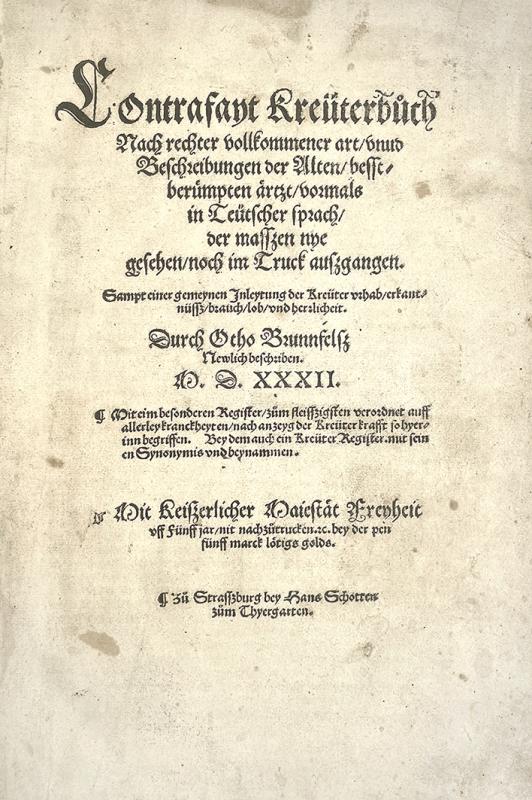
Contrafayt Kreüterbuch. Nach rechter vollkommener art vnvd (! vnnd) Beschreibungen der Alten, besstberümpten ärzt, vormals in Teutscher sprach, der masszen nye gesehen, noch in Truck auszgangen… Newlich beschriben.- Strassburg, Hans Schotten [Johann Schott] 1532. Folio (330 x 210 mm). [32], I - CCCXXII, [2], [14] pp. with 176, mostly, full-page woodcuts, initials, and one coat-of-arms of Strasbourg, all in contemporary hand-coloring. Contemporary calf binding over wooden boards with plate and roller stamps, corner fittings, and two clasps. The binding features numerous portraits of rulers as well as allegorical depictions, extensively monogrammed „HB.”, dated 1534. Spine repaired, partially slightly stained, a few pages with old repairs, otherwise a nice copy.
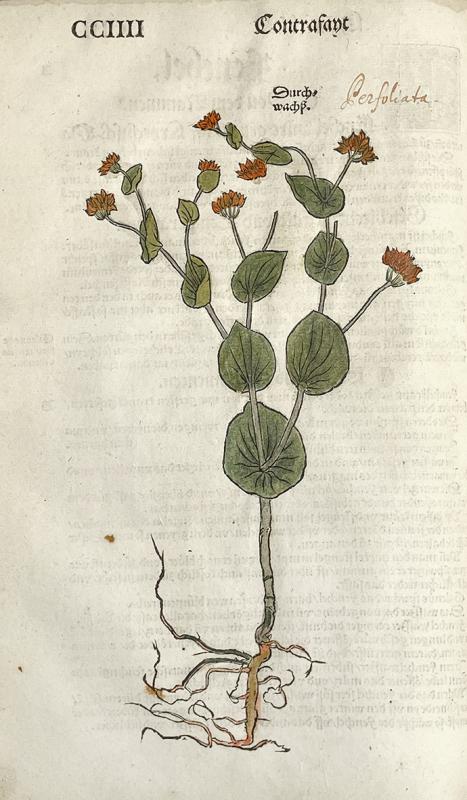
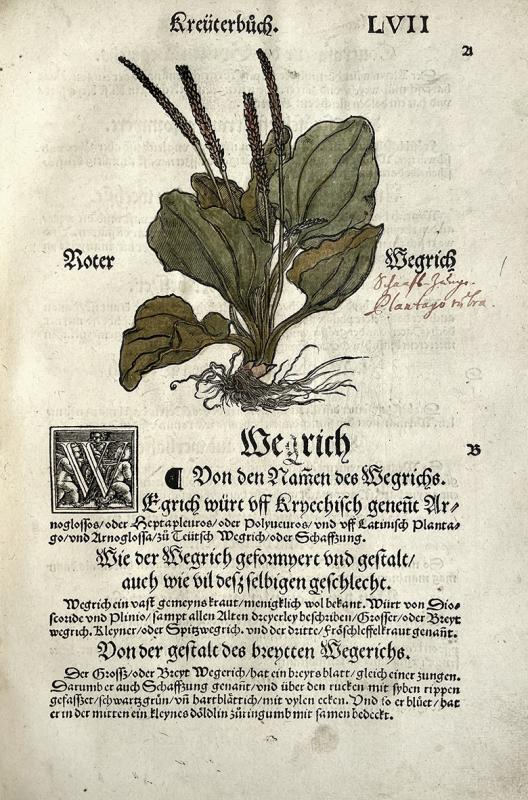
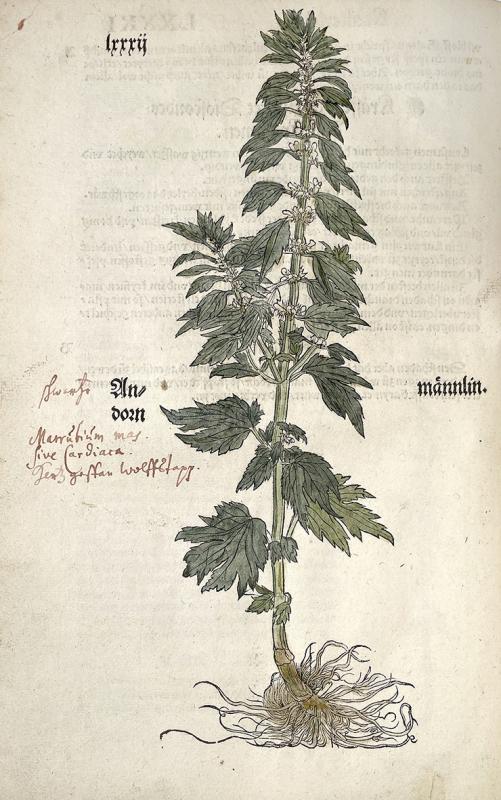
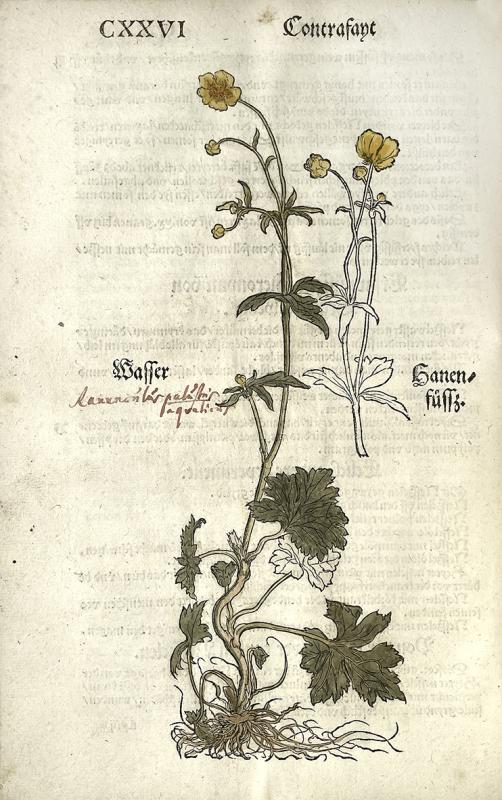
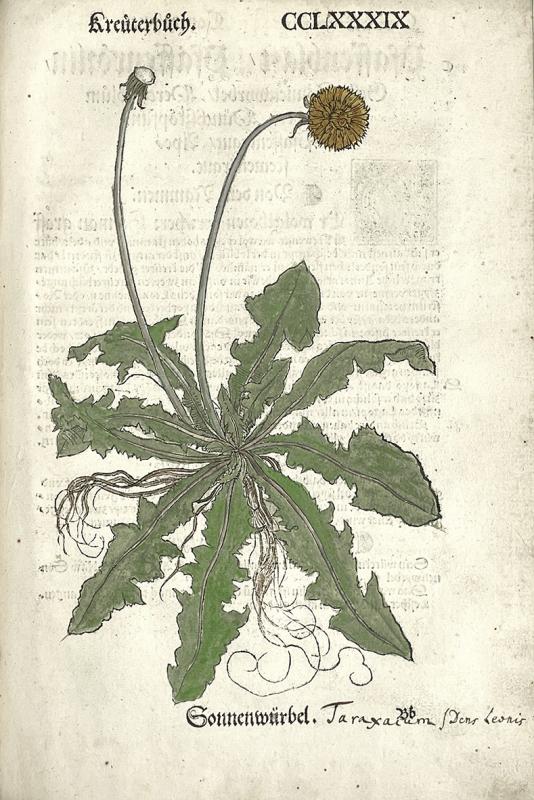
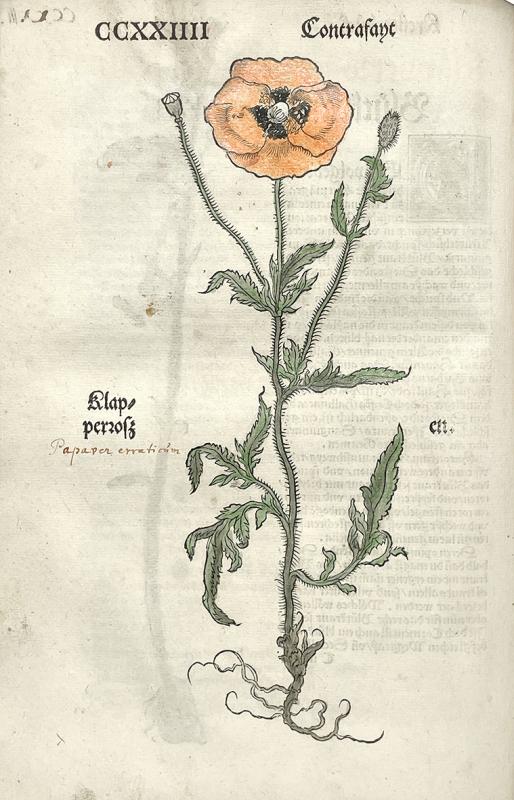
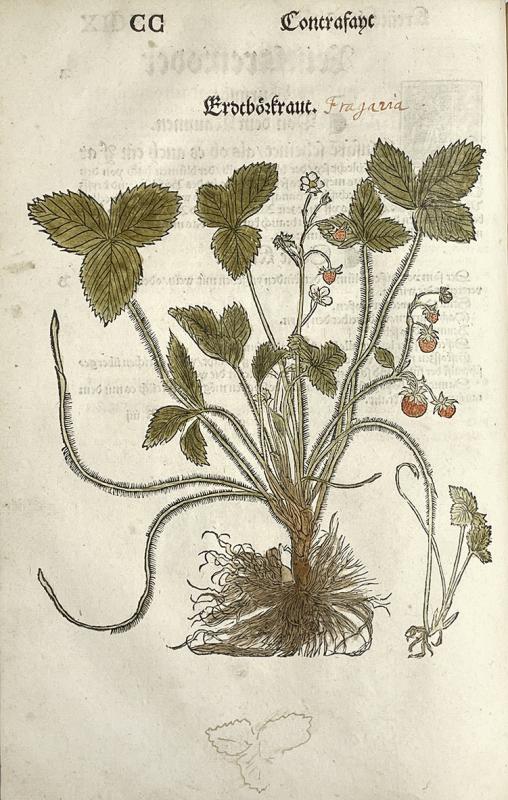
Rare first German edition in nice contemporary coloring: „It is usually accepted that the publication by Schott of Strasbourg in 1530 of the first volume of Otto Brunfels’s Herbarum… inaugurated a new era in botanical illustration…“ (Blunt pp. 45) THE FIRST BOTANICAL BOOK TO CONTAIN REALISTIC AND ACCURATE ILLUSTRATIONS. Referred to as "the first great mind in modern botany" (Hunt), Brunfels' most revolutionary contribution was his choice of artist to accurately portray these "living portraits of plants." The magnificent woodcuts executed by Weiditz were taken from watercolors drawn directly from nature and delineate botanical details well beyond their known function in the taxonomic literature of the time. This German edition differs from the earlier Latin version (1530) and is not a translation of the Latin text but rather includes new descriptions of plants as well as several new illustrations, following the preface, a new introduction on the “origin, identification, use, praise, and splendor of herbs.” In 33 chapters, Brunfels presents knowledge of plants based on previous herbals, the origins of some plant names, and specific medicinal effects. He advocates the use of simple medicines (simplicia) derived from native medicinal plants and opposes the costly, multi-ingredient medicines (composita) of many physicians of his time, who drew upon Arabic medicine and, above all, Avicenna. Regarding the early printed illustrated herbals, Brunfels judges that they were all “embellished and nothing of substance was produced.” Noteworthy is his admission that the ancient authors “did not know everything either” and that Dioscorides and Galen referred to the flora of Greece and Italy, “not to German lands.” Brunfels then describes 130 plant species in this volume, including several first descriptions. In the Latin edition, whose first chapters are not illustrated, he classified the plants according to their medicinal uses, for the first time not, as had been the case previously, according to the alphabetical order of their names. In the German edition, the plants are initially arranged by family and distinguished according to male and female specimens. Brunfels defines “family” as similar appearance or related medicinal effects; he considers strong growth and vigorous, dark colors to be masculine. However, the descriptions were later arranged in the order in which the artist’s drawings were received. The description follows this pattern: “The name of the herb, its form, its season (of collection) and place (location), its complexion, its properties, and uses” based on ancient and contemporary sources. Brunfels supplements the presentation of the plants with instructions for collecting, storing, and preparing the drugs. Drugs refer to dried plants used for pharmaceutical purposes. Brunfels’ attempt to simplify the nomenclature by consolidating the Latin, Greek, and Arabic plant names from older literature nevertheless caused confusion in the terminology, as transalpine plants are still, without exception, given names that Dioscorides had used for the Mediterranean flora, leading to errors. The selection is limited to native herbs; exotic species were omitted, and plants without ancient names he called “herbae nudae.” Weiditz also provided illustrations of native plants whose medicinal use Brunfels could not verify. The compilation of the text drew primarily on ancient sources such as Dioscorides and Pliny, as well as Italian works by authors like Platearius and Simon of Genoa; he rarely included references from folk medicine. Among his contemporaries, he most frequently cited Hieronymus Brunschwig. An index of German herb names and a six-column index of diseases provide a guide to the text. A separate second volume was published after the author’s death in 1537 by Michael Herr (M. Herus) who completed the unfinished manuscript. The descriptions are shorter, and there are fewer quotations from the classics. The first volume of the German edition contains 175 plant illustrations from 172 plates in the text. 84 woodcuts were taken from Volume one and 46 from Volume two of the Latin edition; 45 illustrations are new. Some woodcuts were used twice. Most woodcuts are about 250 mm high, but there is an alternation between the 100 full-page illustrations and the 75 smaller illustrations (between 100 and 120 mm high), which are placed on the left or right page. The illustrations are integrated into the text or appear before or after their description. Since illustrations were increasingly omitted toward the end of the book due to a lack of source material, these were added in the posthumously published second volume in 1537. The print quality of the German edition is inferior. The illustrator was Hans Weiditz (before 1500 – 1537), a student of Dürer, who is referred to as “Ioannes pictor Guidictius” in the introductory verses by Johannes Sapidus. Brunfels also refers to him in the 32nd chapter of the preface as the “highly renowned master Hans Wyditz of Strasbourg,” who “drew and copied” the illustrations for the book. The title page, featuring a woodcut border, also contains a brief summary of the contents. It depicts Adonis’s garden at the top with Venus, Silenus, and the youths Chromis and Mnasilus, and the Garden of the Hesperides at the bottom with Heracles, flanked by the Dioscuri and Apollo. The woodcut initials were carved in the style of the smaller version of Hans Holbein’s Boy’s Alphabet. Shading is rarely found in the borderless, contoured plant illustrations. Weiditz conveys a sense of physicality more through overlapping forms. In 1930, Walther Rytz discovered some of the preliminary drawings from 1529 in the herbarium of Felix Platter (1536 – 1614), a student of Rondelet in Montpellier, at the University of Bern. The 77 pen-and-ink drawings in bistre - watercolored or colored with opaque paints, mostly cut along the contours and mounted on cardboard - often featuring secondary figures, enlarged details of flowers and seeds, or drawn veins and ribs that were omitted in the woodcut, are now preserved at the Burgerbibliothek in Bern. The designs are usually scaled down on the woodblocks and feature a few modifications. The woodcuts emphasize contours and are executed with a uniformly fine, thin line, sparse shading, and minimal hatching for modeling. For greater clarity, the plants are depicted in flat relief. They are - as has been customary since antiquity - depicted as complete organisms, with stems, leaves, and roots. The plates also feature enlarged details such as side branches, flowers, and spores as secondary elements. In the preface, Brunfels apologizes for shortcomings, as the woodcutters had reportedly ruined and destroyed the plates, and he also admits that he had little influence over the selection. Heinrich Röttinger mentions a continuous coloring scheme. The second volume from 1537 contains text woodcuts, some of which are taken from the Latin edition, are new or slightly modified; however, they were no longer drawn by Hans Weiditz but, as in the third Latin volume, are partly by the monogramist I. K., perhaps Jakob Kallenberg, to whom a total of 275 woodcuts may be attributed, as well as by other engravers who worked from Weiditz’s drawings. The smaller initials take up the theme of the Dance of Death.- VD 16 B 8503; Nissen BBI 258; Ritter 289; Schmidt 125; Röttinger, Weiditz pp. 77; Heilmann 184; Klebs/Becher 70; Isphording no. 35; Stafleu/Cowan 855; Lit.: Th. Arch. Sprague. The Herbal of Otto Brunfels. In: Journal of the Linnean Society of London, Botany. Band 48, Nr. 320, 1928, S. 79–124 (Kräuterbuch, Herbal, Herbarium, Renaissance, handkoloriert, incunable of botany, PMM )
12000,- EUR
inkl. 7% USt./incl. 7% VAT
Sachgebiete: Alte Drucke 16. Jahrhundert , Botanik, Kräuterbücher, Naturwissenschaften, Renaissance
Kontakt zum