(Mineralien; Naturgeschichte) SCHWENCKFELD, Caspar.  Auf Merkliste setzen
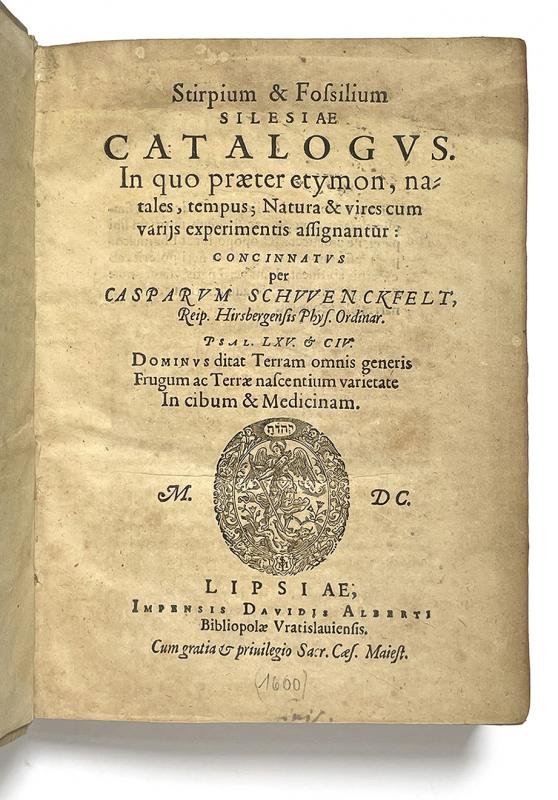
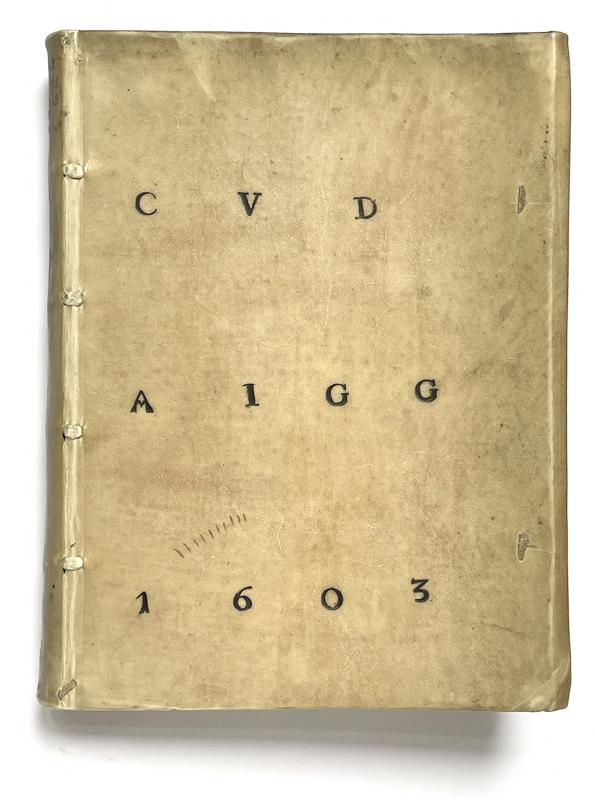
Stirpium & Fossilium Silesiae Catalogus. In quo praeter etymon, natales, tempus; Natura & vires cum varijs experimentis affignantur: Concinnatus per Casparv Schvvenckfelt, … Cvm Indice Remediorvm. Dominvs ditat Terram onmis generis Frugum ac Terrae nascentium varietate… Lipsiae, Impensis Davidis Alberti, Bibl. Vratislauiensis, (Michael Lantzenberger for David Albert), 1600. 4to. (195 x 144 mm) (40), 407, (1, blank), (15), [1] blank (Sign.: a-e4 A-Z4 2A-2Z4 3A-3G4; 232 leaves) Pigskin binding with handwritten title on spine, octavo. Signs of age, some staining, endpapers with handwritten entries. Gilt printed monogram „C. V. D. A. I. G. G.“ on cook cover.
First scientific description of nature in Silesia, containing the first floristic and paleontological study of the region: very scarce German early work on the botanical and subterranean wonders of Silesia. The preliminary pages contain a short section describing the geography of the area. This is followed by part one, which provides a comprehensive classified catalog of the botanical varieties of the area, including flowers, ferns, trees, agriculture etc. The plants are listed alphabetically according to their Latin names. The second part, with its own sectional title page, is a detailed descriptive catalog of Silesia's fossils and minerals. It incorporates a general table outlining the classification scheme followed by a description of the fossils in four books. The system is an adaptation after Agricola, and divides minerals and fossils into Terrae, Lapides, Succi and Metallica. The Silesian physician and naturalist Caspar Schwenckfeldt (1563 - 1609, not the earlier reformer), is considered one of the first natural historians to describe a local flora & fauna incl. minerals. His "Stirpium" (1600) and "Theriotropheum" (1603) together form one of the oldest natural history monographs of a certain region. In the 17th and 18th centuries, his works were among the best known natural science books in Europe appreciated by Aldrovandi and Gessner. The preliminary pages contain a short section describing the geography of the area. Schwenckfeldt was born in Greiffenberg (Silesia), took his medical degrees at Basel (under Theodor Zwinger, Felix Platter, Johann Nicolaus Stupanus), and practized as a physician at Hirschberg, and since 1605 at Görlitz. He also cared for the Spa guests in the nearby Bad Warmbrunn and visited the surrounding mountains, including the Riesengebirge. Provenance: The monogram on the cover „C. V. D. A. I. G. G.“ (see HAAB Weimar; books in the Faust collection) could be read as: “Cuius vulturis dente amissus, is gignit gaudium,“ (Wer auf Gier verzichtet, dem gebiert dieses Freude). The “vulture” here stands for the thief or the unreliable borrower of the book. It is a humorous but clear warning not to steal or keep the book. Such “book curses” or admonitions were particularly popular in scholarly libraries before the 18th cent. Or it could be read as: Christian Von Des Anhalt In Gnade Geboren, which refers to Prince Christian I of Anhalt - Bernburg (1568 – 1630), a prominent diplomat and military commander of the early 17th century and a founding member of the Fruchtbringende Gesellschaft.- Hoover 737; Pritzel 8542; Freilich sale 488 (attr. to the wrong person); Ferchl 493; Pogg. II, 877; Cobres I, 245; Schuh online; VD17: 23:000447Q. ( Mineralien, Flora, Fauna, Schlesien, Fossilien, Geologie, Polen, Poland )
4600,- EUR
inkl. 7% USt./incl. 7% VAT
Sachgebiete: Alte Drucke 16. Jahrhundert , Geologie, Paläontologie , Schlesien
Kontakt zum