(Schlesien, Naturgeschichte) SCHWENCKFELD, Caspar.  Auf Merkliste setzen
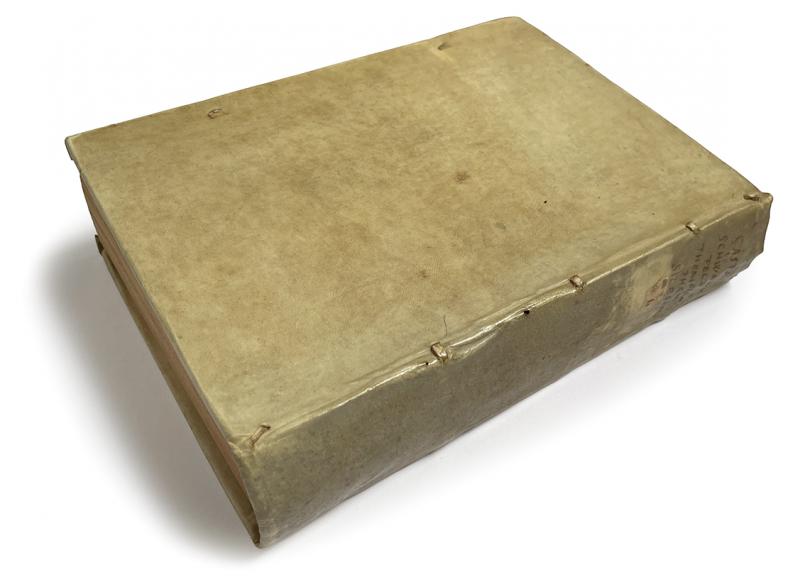
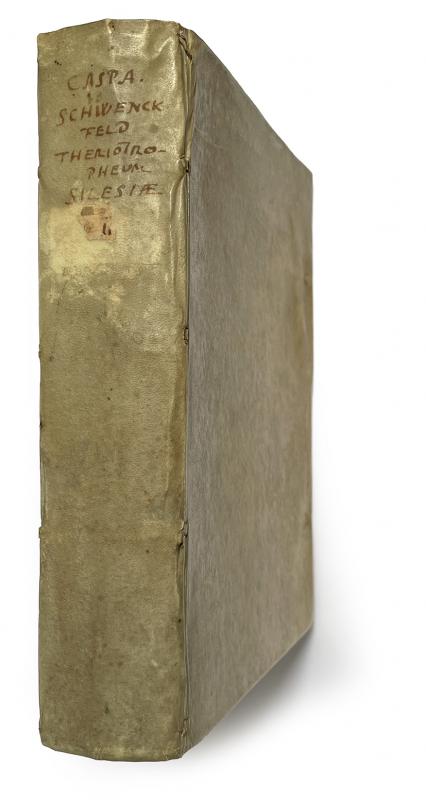
Theriotropheum Silesiae, in quo animalium, hoc est, quadrupedum, reptilium, avium, piscium, insectorum natura, vis & usus sex libris perstringuntur: concinnatum & elabo-ratum ….- Lignicii, (Legnica), impensis Davidi Alberti (Nicolaus Sartorius for David Albert), 1603 - 1604. 4to (204 x 152 mm) (24), 563 pp., (1), (4) printed in two columns. Contemporary vellum with overlapping edges, ties missing, handwritten title on spine, title stamped recto, spotted and evenly browned. Fine.
First edition of the world’s first local vertebrate fauna including brief accounts of about 150 species of birds. Schwenckfeld was a doctor, and naturalist, in particular a botanist (student of Bauhin in Basle and Gessner in Zürich), and lived in Silesia from 1563 to 1609. He was the town physician, an official post, firstly in Hirschberg and at the end of his life in Görlitz. In his free time he explored, in the course of many long walks, the world of plants and animals in the high hills of the Riesengebirge (Karkonoski, Krkonoše), also collecting fossils and minerals. His most important work appeared in 1603 in Legnica, a fauna of Silesia with the title Therio-Tropheum Silesiae, the ‚Animal park of Silesia‘, dealing with the mammals, reptiles, birds, fish, and insects of his homeland – the first local fauna known anywhere in the world, in which animals are separated according to where they live, their way of life, and how they organize themselves. It was printed three years after his Stirpium et fossilium Silesiae catalogus, a catalogue of the plants and minerals of the region. It thus completes the picture of Silesia's nature by cataloguing the regional fauna, which had been missing in the first publication. The catalogue of animals is about 150 pages longer than the catalogue of plants and minerals and structured into six books: book 1 deals with animals in general (pp. 1–41), while book 2–6 list the quadrupeds (pp. 43–135), reptiles (pp. 137–68), birds (pp. 169–376), fish (pp. 377–456) and insects of Silesia (pp. 457–564). Of the 154 native birds known to him, he described the voice, food, distribution, nest, number and color of the eggs. The species are in alphabetical order, are not illustrated, and are arranged according to the following scheme: name (Latin, Greek, German), brief description, remarks on reproduction and usefulness. The book is a lexicon for reference purposes, in which some exotic animals also appear (e.g. elephant, leopard, guinea pig, monkeys, parrot, ostrich). All the species had already been mentioned in the contempo-rary works of Gessner, Aldrovandi, Wotton, Belon, and Rondelet. Schwenckfeld probably took many species and the broad systematics from these authors. He described no new bird species, while some mythical animals like unicorn and phoenix were apparently regarded by him as real. As in the Stirpium et fossilium Silesiae catalogus, the idea of the indigenous plays an important role: instead of relying on exotic substances, one should closely study the local nature: in comparison to local floras and mineralogies, local zoologies were relatively rare and often had a more general touch, as can seen be the fact that Schwenckfeld includes exotic animals like elephants and camels in his catalogue (Alix Cooper 2007, 116) - Provenance: Naturw. Museum in Bsel (19th cent. stamp); Bibl. Publ. Basilinsis vendidit (20th cent. stamp inner back cover) Lit.: Stresemann 287/88; Gebhardt, Ornithologen 332; Walters, Ornithology 48; Jürgen Haffer, Hans Hudde & Brian Hillcoat (eds) The Development of Ornithology and Species Knowledge in Central Europe in: Bonn Zoological Bulletin. Suppl. 59 (2013), pp. 1–116; J. Haffer. The development of ornithology in central Europe; in: Journal für Ornithologie, Vol. 148 (2007) Suppl. I, pp. 125-153.; see also Paczos: https://nfgol.de/sites/default/files/pdf/bd28-15_paczos_schwenckfeldt_web.pdf Schlesien, Polen, Poland, Vögel, Birds, Fauna, Flora, Renaissance,
4500,- EUR
inkl. 7% USt./incl. 7% VAT
Sachgebiete: Alte Drucke 16. Jahrhundert , Botanik, Naturwissenschaften, Ornithologie, Zoologie
Kontakt zum