GOETHE,J.W.von. (und MARIANNE von WILLEMER).  Auf Merkliste setzen
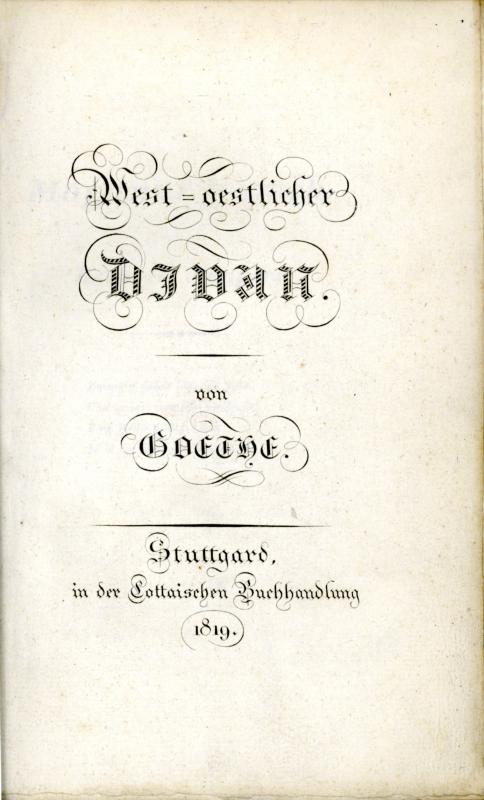
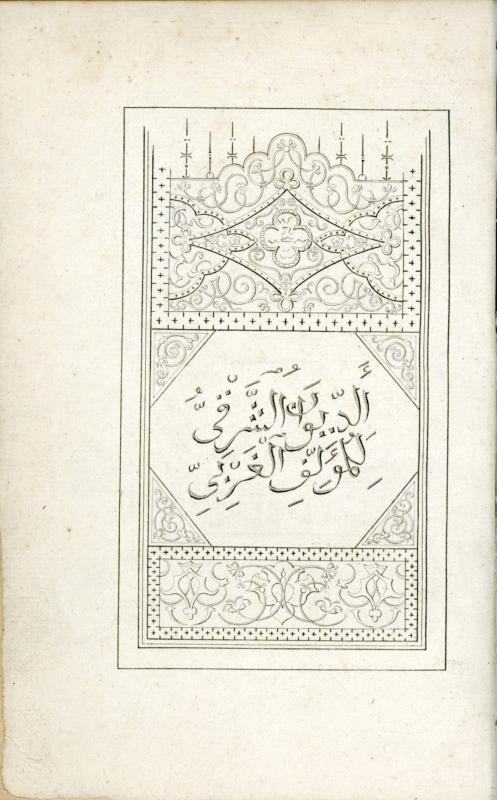
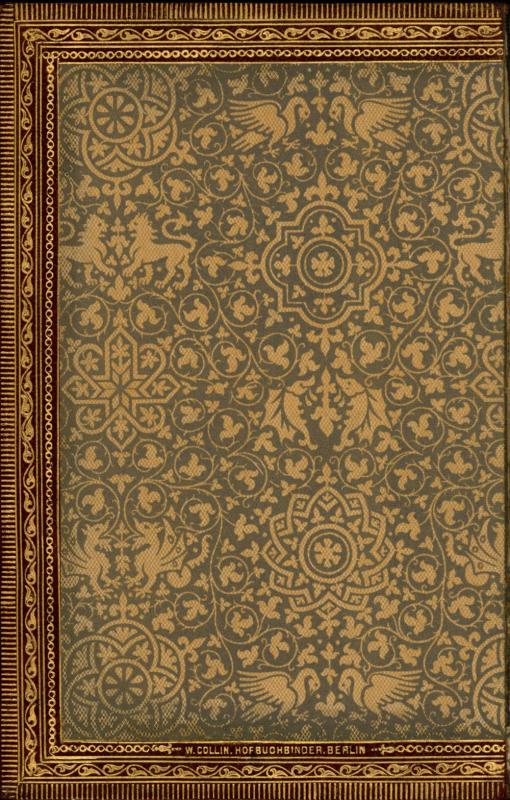
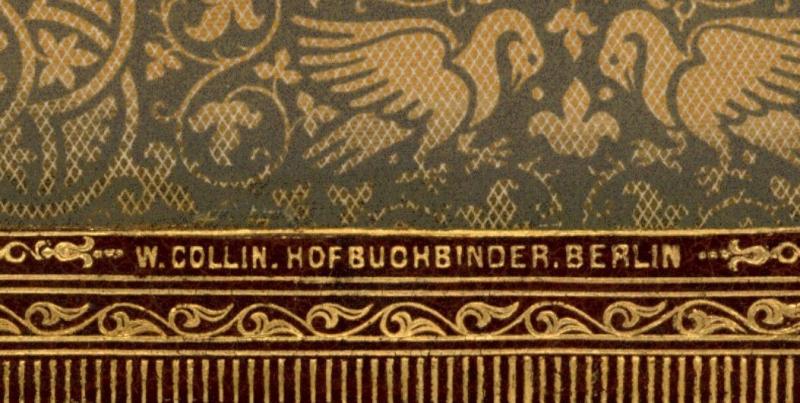
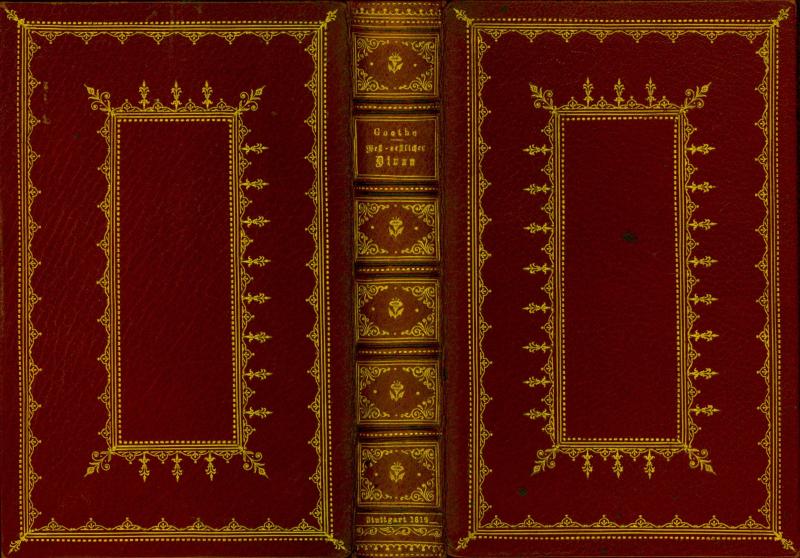
West-oestlicher Divan. Mit gestochenem Frontispiz und gestochenem Titel (von C.ERMER nach Goethes Entwürfen). Stuttgard, in der Cottaischen Buchhandlung 1819. 194x125 mm [gemessen an den Vorsätzen], (2) Bll., 556 S. Nussbrauner, geglätter Maroquinband (um 1880) mit reicher Rücken- und Deckelvergoldung, vergoldete Steh- und breite Innenkantenvergoldung, ebda mit dem Stempel „W.COLLIN Hofbuchbinder Berlin“. Vorderdeckel sehr leicht fleckig, Kanten und Gelenke partiell leicht berieben. Nicht makellos, aber insgesamt ist der Meistereinband gut erhalten. //// Nut-brown, smoothed morocco leather (circa 1880) with rich gilding on the spine and covers, gilded headband, and broad gilding along the inner edges, bearing the stamp “W.COLLIN Hofbuchbinder Berlin.” The front cover is very slightly stained; the edges and joints are partially and lightly rubbed. Not flawless, but overall, this masterful binding is very well preserved. //// Reliure en maroquin lissé, couleur noisette (vers 1880), avec de riches dorures sur le dos et les plats, dorures sur les nerfs et larges dorures sur les bords intérieurs, portant au même endroit le cachet « W.COLLIN Hofbuchbinder Berlin ». Couverture avant très légèrement tachée, tranches et articulations partiellement un peu usées. Pas impeccable, mais dans l'ensemble, cette reliure de maître est très bien conservée.
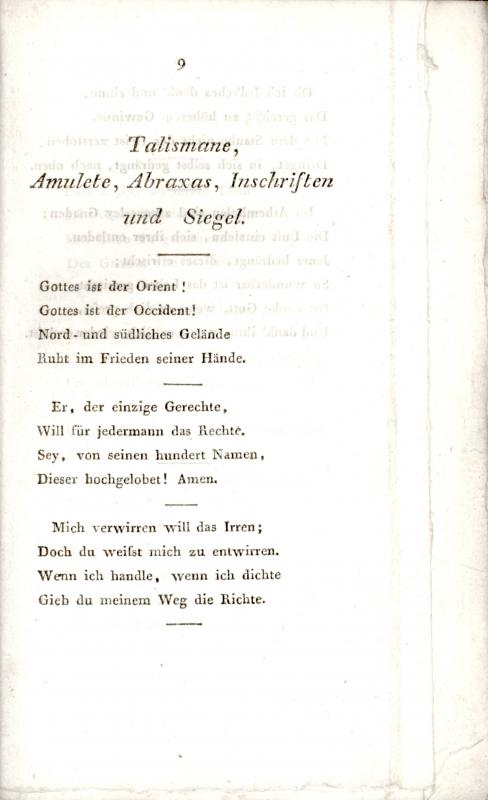
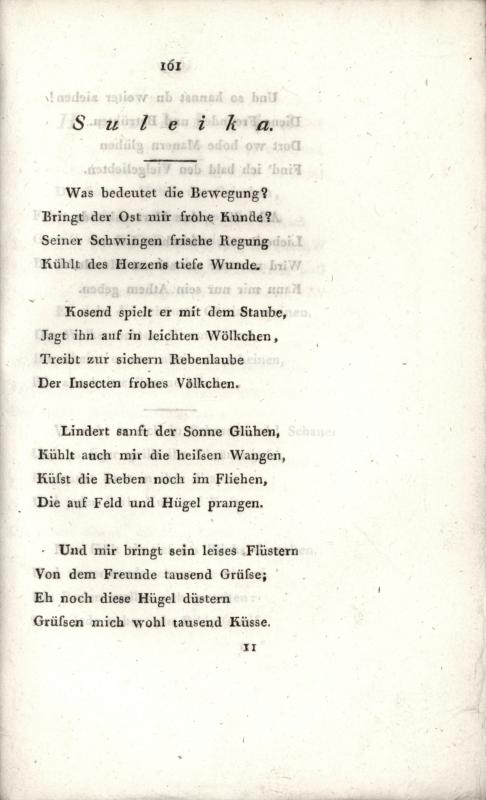
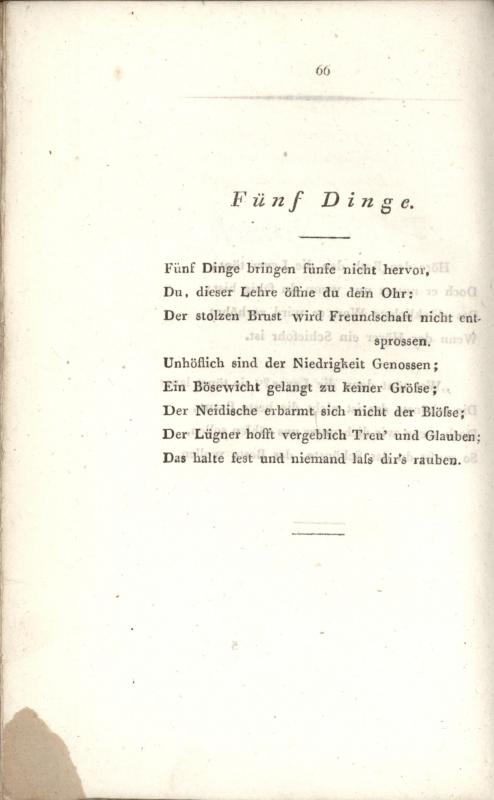
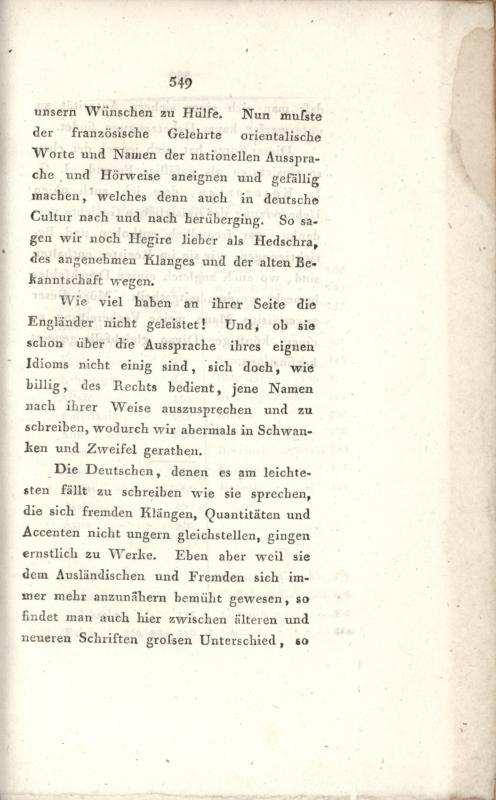
Erste Ausgabe (Goedeke IV,3,492,110; Hagen 416; Kippenberg I,401; Borst 1312; Fischer, Cotta 1189). – Kopfgoldschnitt, außen und unten unbeschnitten, die Ränder sehr unterschiedlich breit; vereinzelt sind von dem Buchbinder offensichtlich als störend empfundene Ungleichheiten im Außenrand mit bräunlichem Papier fachgerecht hinterlegt (s.Abb.). Nahezu fleckfrei. Im orientalisierenden Geschmack gemusterte Vorsätze. Papierbezug über dem vorderen Innengelenk etwas rissig. Auf echtem Velin, aber auch eines der Exemplare, die (lt. Fischer, s.o.) Cotta für Goethes eigenen Gebrauch hatte abziehen lassen? (Ich konnte bei verschiedenen Exemplaren unterschiedliche Velinpapiere feststellen. Oft wird die Variante „Velindruckpapier“, die den größten Teil der Auflage ausmachte [vgl. Fischer], so angepriesen). Titel und Kupfer auf festem Schreibpapier. Offensichtlich ein sehr früh fertiggestelltes Exemplar, denn die Seiten 7-10 sind nur in der ursprünglichen, noch unkorrigierten Fassung mit der Überschrift „Talismane, Amulete, Abraxas, Inschriften und Siegel“ eingebunden. Die korrigierte Fassung mit der zu „Talismane“ geänderten Überschrift wurde sehr bald als Teil des letzten Bogens mitgeliefert. Wie immer sind die Ss.399/400 doppelt gezählt und die Ss.495/496 in der Zählung übersprungen. „Nächst dem Faust das bedeutendste und zugleich persönlichste Werk Goethes.“ (Ernst Beutler). Goethe hatte den „Divan“ des persischen Dichters HAFEZ in der Übersetzung von J.HAMMER-PURGSTALL bald nach deren Erscheinen 1814 kennengelernt. „Zu der geistigen Anregung durch die Hafis-Lektüre kam das Gefühl körperlicher und geistiger Verjüngung, einer wiederholten Pubertät, die er später als ein Charkteristikum genialer Naturen definierte. Seit der Erstarrung nach F.SCHILLERS Tod im Jahre 1805, da er sein dichterisches Werk als abgeschlossen ansah, empfand er zum erstenmal ein Wiederaufleben seiner schöpferischen Kräfte.“ (Killy). Im August 1815 begegnete er MARIANNE JUNG, der späteren Frau seines alten Freundes J.VON WILLEMER, in Frankfurt; mit ihr und WILLEMER verbrachte er die nächsten Wochen in Heidelberg. „Aus der Leidenschaft zwischen GOETHE und MARIANNE VON WILLEMER (...) erwuchs ein großer Teil der Divan-Gedichte. In östlicher Verhüllung, in den Masken von Hatem, dem sich Verschenkenden und dem Gegenliebe geschenkt wird, und Suleika, der schönsten und zugleich geistreichsten Liebenden der islamischen Dichtung, wurde ein Liebesdialog in Gedichten geführt, die sich streng auf Motive aus dem Divan des HAFIS bezogen und an dem MARIANNE VON WILLEMER sich mit eigenen Gedichten beteiligte. So stammen einige der schönsten Gedichte aus dem Buch Suleika, wie die Lieder an den Ostwind und an den Westwind, von ihr. GOETHE nahm sie mit nur geringfügigen Änderungen in seinen Zyklus auf, und die Autorschaft der Dichterin wurde erst 1869 durch eine Veröffentlichung von H.GRIMM bekannt. Nach dem endgültigen Abschied von MARIANNE entstanden noch einige der düstersten Gedichte des Divan wie Hochbild und Nachklang, dann wandte sich GOETHE vor allem der umfangreichen Spruch- und Lehrdichtung des Zyklus zu.“ (Ebda). „So kurz das Glück gegenseitig gestandener Liebe und dichterisch vollzogener Vereinigung währen sollte, der Ertrag jener Frankfurter und Heidelberger Herbsttage war überreich. Um ihn einbringen zu können, ordnete Goethe Anfang Oktober, als der Entschluß abzureisen und Mariannen auf der Rückfahrt nicht wiederzusehen schon gefaßt war, das ganze Material neu, indem er es auf dreizehn Bücher verteilte, zu welchem Zwecke er Umschläge anlegte, die zunächst in Blei, bald aber auch in Tinte beschriftet wurden und neben Nummern deutsche und – wo dem Dichter bei Hammer-Hafis Beispiele zur Verfügung standen – auch persische Buchtitel erhielten.“ (H.A.Maier, Goethe West-östlicher Divan. Kritische Ausgabe der Gedichte mit textgeschichtlichem Kommentar, Bd.2, S.15). //// First edition (Goedeke IV,3,492,110; Hagen 416; Kippenberg I,401; Borst 1312; Fischer, Cotta 1189). – Gold-edged at the top, untrimmed on the outer and bottom edges; the margins vary greatly in width; in a few places, irregularities in the outer margin—which the bookbinder evidently found distracting—have been professionally backed with brownish paper (see ill.). Virtually spotless. Endpapers patterned in an Orientalizing style. The paper cover is slightly cracked over the front inner joint. Printed on genuine vellum, but is this also one of the copies that (according to Fischer, see above) Cotta had printed on vellum for Goethe’s own use? (I have observed different types of vellum paper across various copies. The “vellum-printed paper” variant, which made up the majority of the print run [cf. Fischer], is often touted as such). Title page and copperplate engraving on sturdy writing paper. Evidently a very early copy, as pages 7–10 are bound only in the original, uncorrected version with the heading “Talismane, Amulete, Abraxas, Inschriften und Siegel.” The corrected version, with the heading changed to “Talismane,” was supplied very soon afterward as part of the final sheet. As always, pages 399/400 are double-counted, and pages 495/496 are omitted from the page count. “Goethe’s most significant and, at the same time, most personal work after *Faust*.” (Ernst Beutler). Goethe had become acquainted with the “Divan” of the Persian poet HAFEZ in the translation by J. HAMMER-PURGSTALL shortly after its publication in 1814. “In addition to the intellectual stimulation provided by reading Hafiz, he experienced a sense of physical and mental rejuvenation—a sort of second adolescence—which he later defined as a characteristic of genius. Since the period of stagnation following F. SCHILLER’s death in 1805—when he regarded his poetic work as complete—he felt, for the first time, a resurgence of his creative powers.” (Killy). In August 1815, he met MARIANNE JUNG—who would later become the wife of his old friend J. VON WILLEMER—in Frankfurt; he spent the following weeks in Heidelberg with her and WILLEMER. “A large portion of the Divan poems arose from the passion between GOETHE and MARIANNE VON WILLEMER (...). Veiled in Eastern garb, in the masks of Hatem—the self-sacrificing lover who is reciprocated—and Suleika, the most beautiful and at the same time most witty lover in Islamic poetry, a dialogue of love was conducted in poems that strictly drew on motifs from the Divan of HAFIZ, and to which MARIANNE VON WILLEMER contributed her own poems. Thus, some of the most beautiful poems from the book *Suleika*, such as the songs to the East Wind and the West Wind, were written by her. GOETHE included them in his cycle with only minor changes, and the poet’s authorship was not revealed until 1869 through a publication by H. GRIMM. After his final parting from MARIANNE, some of the Divan’s darkest poems, such as *Hochbild* and *Nachklang*, were written; then GOETHE turned his attention primarily to the extensive didactic and moral poetry of the cycle.” (Ibid.). “However brief the happiness of mutual love and poetically realized union was to last, the fruit of those autumn days in Frankfurt and Heidelberg was abundant. In order to compile it, Goethe reorganized all the material in early October—when the decision to leave and not to see Marianne again on the return journey had already been made—by dividing it into thirteen books, for which purpose he created covers that were initially drawn in lead, but soon also in ink, and were given not only numbers but also German and—where the poet had examples from Hammer-Hafi at his disposal—Persian book titles.” (H.A.Maier, Goethe West-östlicher Divan. Kritische Ausgabe der Gedichte mit textgeschichtlichem Kommentar, Bd.2, S.15). //// Première édition (Goedeke IV,3,492,110 ; Hagen 416 ; Kippenberg I,401 ; Borst 1312 ; Fischer, Cotta 1189). – Tranche dorée en haut, non rognée sur les côtés extérieurs et en bas, les marges présentant des largeurs très variables ; ici et là, certaines irrégularités de la marge extérieure, manifestement jugées gênantes par le relieur, ont été soigneusement comblées avec du papier brunâtre (voir ill.). Pratiquement sans taches. Pages de garde à motifs d’inspiration orientale. La couverture en papier est légèrement fissurée au niveau de la jointure intérieure avant. Sur véritable vélin, mais s’agit-il également d’un des exemplaires que (selon Fischer, voir ci-dessus) Cotta avait fait tirer pour l’usage personnel de Goethe ? (J’ai pu constater des différences de papier vélin entre divers exemplaires. La variante « papier vélin imprimé », qui constituait la majeure partie du tirage [cf. Fischer], est souvent présentée comme telle). Titre et gravure sur papier à lettres épais. Il s’agit manifestement d’un exemplaire achevé très tôt, car les pages 7 à 10 ne sont reliées que dans la version originale, non encore corrigée, portant le titre « Talismans, amulettes, Abraxas, inscriptions et sceaux ». La version corrigée, dont le titre a été modifié en « Talismane », a été fournie très rapidement dans le cadre de la dernière feuille. Comme toujours, les pages 399/400 sont comptées deux fois et les pages 495/496 sont omises dans la numérotation. « L’œuvre la plus importante et en même temps la plus personnelle de Goethe après *Faust* » (Ernst Beutler). Goethe avait découvert le *Divan* du poète persan HAFEZ dans la traduction de J. HAMMER-PURGSTALL peu après sa parution en 1814. « À l’inspiration intellectuelle tirée de la lecture de Hafiz s’ajoutait le sentiment d’un rajeunissement physique et spirituel, d’une puberté renouvelée, qu’il définira plus tard comme une caractéristique des natures de génie. Depuis la période de stagnation qui avait suivi la mort de F. SCHILLER en 1805, alors qu’il considérait son œuvre poétique comme achevée, il ressentit pour la première fois un regain de ses forces créatrices. » (Killy). En août 1815, il rencontra à Francfort MARIANNE JUNG, qui devint plus tard l’épouse de son vieil ami J. VON WILLEMER ; c’est avec elle et WILLEMER qu’il passa les semaines suivantes à Heidelberg. « C’est de la passion entre GOETHE et MARIANNE VON WILLEMER (...) qu’est née une grande partie des poèmes du Divan. Sous des atours orientaux, sous les masques d’Hatem, celui qui s’offre et à qui l’amour est rendu, et de Suleika, la plus belle et en même temps la plus spirituelle des amantes de la poésie islamique, un dialogue amoureux s’est déroulé en vers, s’inspirant strictement de motifs tirés du Divan de HAFIZ, et auquel MARIANNE VON WILLEMER a participé par ses propres poèmes. C’est ainsi que certains des plus beaux poèmes du recueil *Suleika*, tels que les chants au vent d’Est et au vent d’Ouest, sont de sa plume. GOETHE les intégra dans son cycle avec seulement quelques modifications mineures, et la paternité de la poétesse ne fut révélée qu’en 1869 par une publication de H. GRIMM. Après la séparation définitive d’avec MARIANNE, GOETHE composa encore certains des poèmes les plus sombres du Divan, tels que *Hochbild* et *Nachklang*, puis il se consacra principalement à la vaste poésie moralisatrice et didactique du cycle. » (Ibid.).« Aussi brève qu’ait pu être la durée du bonheur d’un amour réciproque et d’une union poétiquement accomplie, le fruit de ces journées d’automne à Francfort et à Heidelberg fut abondant. Afin de pouvoir en tirer parti, Goethe réorganisa l’ensemble du matériel début octobre, alors que la décision de partir et de ne plus revoir Marianne lors du voyage de retour était déjà prise, en le répartissant en treize livres, pour lesquels il créa des couvertures, d’abord en plomb, mais bientôt aussi à l’encre, et qui, outre des numéros, reçurent des titres en allemand et – lorsque le poète disposait d’exemples tirés de Hammer-Hafi – également en persan.» (H.A.Maier, Goethe West-östlicher Divan. Kritische Ausgabe der Gedichte mit textgeschichtlichem Kommentar, Bd.2, S.15).
3000,- EUR
inkl. 7% USt./incl. 7% VAT
Kontakt zum