Rare Books Berlin - Internationale Messe für Bücher und Graphik

...

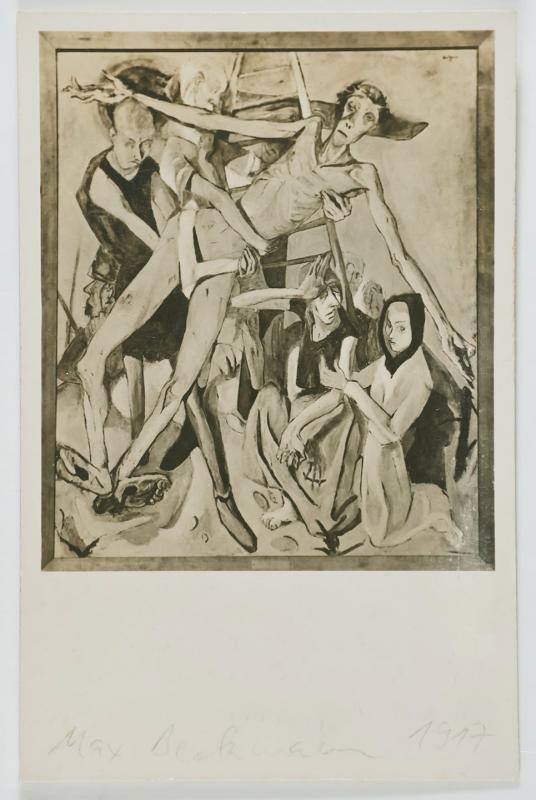
Beckmann, Max. Kreuzabnahme [PRINTED PHOTO-POSTCARD FROM THE ENTARTETE KUNST EXHIBITION, SIGNED BY MAX BECKMANN]

München. NP. 1937. Postcard (5 1/2 x 3 5/8"). Original sepia toned photo-postcard (original photograph) featuring a reproduction of Max Beckmann's painting "Kreuzabnahme", protected in mylar sleeve and taped to cream color mat. Text on verso of the postcard is visible. Printed "Ausstellung Entartete Kunst" on verso with handwritten description of camera movements for a film shoot. Exhibition organized by Adolf Ziegler and the Nazi Party opening on July 19,1937 in Munich. The original painting was rendered in oil on canvas, in 1917. Signed in pencil by Max Beckmann at the bottom of the "Max Beckmann, 1917". Verso of postcard with penciled text: "Kamera geht weiter vom Knaben weg (andere Seite) Pflanzen Ornam. Tiere fantastische Formen feuerwerkartig übersteigert, wie Anfang nur gesteigerter. Kamera geht ab zurück zum Knaben (Knabe wirkt größer. Ein ...(B or Rab?) kommt ins Bild Knabe pflückt ein Blatt, gibt es ihm. Kamera geht vom Knaben weg. Absolute Filmszene noch gesteigerter als die beiden ersten. Kamera schwenkt zurück zum Knaben. Knabe erwachsen Jüngling. Er wendet sich ab von den ... (Dl?) Tieren Formen (abweichende Bewegungen). Die Blumen verdorren und verschwinden die Tiere und Ornamente verschwinden. Eine weite unendlich weite Ferne entsteht. Er geht weg. ... (Scene?erte?) wird öde und leer ... (d(t)rocken) verlassen. TZ" #48271


01.08.2026 - 00:44

2750,- EUR

Eric Chaim Kline Bookseller

...

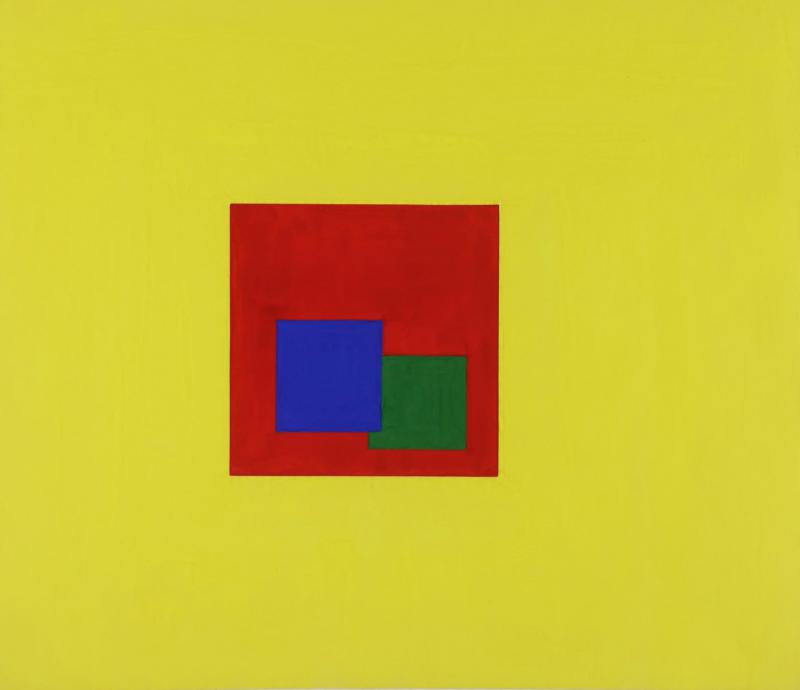
Fischinger, Oskar. 23 Original Tempera on Paper for the Abstract Animation Film "Quadrate / Squares"

Berlin. 1934. Original artwork (12 1/8 x 11 5/8"). Twenty-three paintings representing a substantial part of Oskar Fischinger's short film "Quadrate (Squares)," a four minute silent 35mm abstract animation film in color. The 271 separate "frames" for this film were painted in tempera on paper by Oskar Fischinger in July 1934, as cited by William Moritz, in "Optical Poetry The Life and Work of Oskar Fischinger," 2004. Moritz further suggests that some of these paintings may have been done a little earlier. "The drawings are numbered 1-2505 to 1-2776, indicating perhaps that they were once planned as part of a larger film... Fischinger had these 271 drawings photographed and loop-printed so that they appeared several times in the same and different colour combinations, positive and negative (which was easily possible by manipulating the filters used to print out the three-color separation master)... the serene flow of squares shaped in different colours is one of Fischinger's most striking, interesting and important compositions, prefiguring 'Radio Dynamics.' The animation paintings, like those of Kreise, are each artworks in themselves, prefiguring the balancing squares of Josef Albers." (William Moritz, as above, pages 221/2) Our 23 tempera paintings are not framed and are all stamped "Nachlass Oskar Fischinger" in the top margin. Thirteen paintings are in fine condition, incl. ## 2510, 2517, 2518, 2525, 2543, 2546, 2570, 2573, 2606, 2608, 2610, 2694, 2698. The following paintins with minor to medium blemishes as described: #2547 (1/2 x 1" light water stain at bottom edge right corner), 2567 (minor 1 x 1/8" water exposure at right lower corner), 2584 (minor, less than 1/8" wide border due to water exposure along most of bottom edge, and small water stains in orange), 2597 (1/2 x 3" water exposure), 2612 (small water stain 3/4" in diameter in blue-green square), 2679 (light 1/2" minor surface crack at upper left corner), 2688 (small area with minor ruffling, and 1/2 inch closed tear at right edge), 2691 (minor fraying along left edge), 2716 (minor blemish at bottom right, red edge), and 2724 (small water stain in blue square). Inspired when viewing Lichtspiel Opus (Play of Light), a 13 minute film of nonobjective color effects by Walter Ruttmann in 1921, Oskar Fischinger embarked on a most illustrious career as a filmmaker. Using skills from his background as an engineer he invented the so-called "Wax-Slicing Machine" to create abstract imagery for film. Fischinger also produced several films for advertising purposes using abstract animation techniques, particularly after the Nazis had taken power. Best known is his cigarette commercial "Muratti greift ein (Muratti Intervenes)." Oskar continued to produce numerous abstract animation films, now often referred to as "Optical Poetry" or "Visual Music," many times synchronizing the abstract imagery of his films with classical music. His 1934 film "Quadrate, one of Oskar's most daring experiments... was designed specifically for the GasparColor process, which used a three-color separation negative." (William Moritz. Optical Poetry, pp. 54,55). Fischinger's manipulation of filters, combined with loop printing allowed for the imagery to appear in variant sequences. Life under the Nazis regime became more and more difficult for the Fischingers. Oskar was arrested twice but, with the help of friends, was released within days. Anonymously his film "Komposition in Blau" (Composition in Blue) had been admitted to the 1935 Venice Film Festival. Despite its popularity it did not win due to the fact that Reichsfilmkammer President Fritz Scheuermann was a member of the jury. Later in 1935, an MGM agent had brought two of Oskar's films, "Composition in Blue" and "Muratti greift ein," to the attention of Ernst Lubitsch. As a result Lubitsch sent the agent back to Berlin to hire Oskar to work for him. Arrangements were made for Oskar to leave for Hollywood immediately, and Elfriede and their sons followed two month later. While working for several studios in Hollywood, Fischinger kept producing "Optical Poetry" and gradually turned to nonobjective painting. Fischinger is considered by some as a man ahead of his time. Among other capacities he is credited to be "an inventor of the music video, and prophet of Op Art as well as contemporary computer-generated motion graphics." (Nathan Vonk) His film "Composition in Blue" was awarded the King's Price at the Brussels International Exposition in 1935. In 1938 MGM released Fischinger's "Optical Poem." It was shown all across the world. His 1947 "Motion Painting No. 1" won the International Film Competition in Brussels in 1949. Fischinger's extensive work as a filmmaker is documented superbly in publications by William Morris, see above, and Cindy Keefer and Jaap Guldemond in "Oskar Fischinger 1900-1967. Experiments in Cinematic Abstractions."

Sachgebiete: Film, Kunstgeschichte, Moderne Kunst, Ornamentik, Aquarelle

01.08.2026 - 00:34

100000,- EUR

Eric Chaim Kline Bookseller
...

Harbou, Thea von. Metropolis (メトロポリス ; 殿方は金髮がお好き)

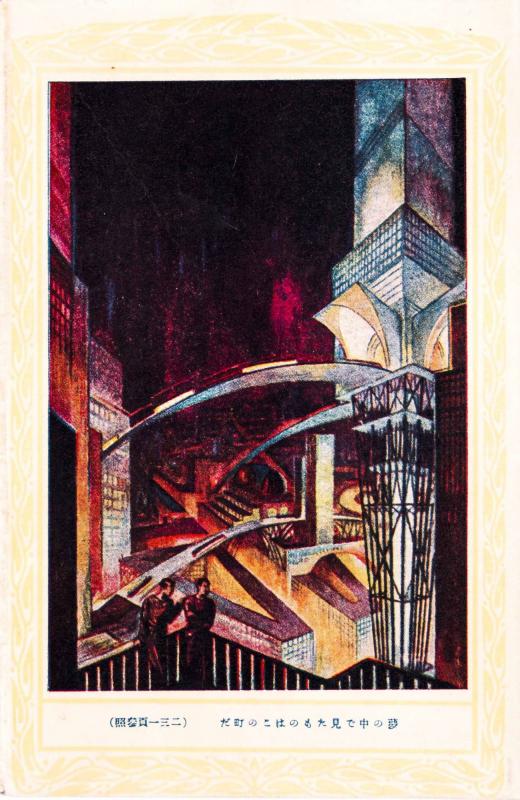
Tokyo. Kaizo-sha. 1928. First Illustrated Japanese language edition. Large Sextodecimo. 560 (1)pp. Original color illustrated dustjacket over red cloth with gilt lettering and tooling on spine. Title page with decorative orange ruling and publisher's device. Two plates following title page, one of them a film still in color, the other the beginning of the musical score for the film by Gottfried Huppertz with three b/w head shots. Illustrated with ten striking full-page b/w reproductions of film stills of the legendary Fritz Lang film considered the first science fiction film that premiered in 1927. The cover of the dustjacket is illustrated with the film still used on the cover of the first paperback edition. Thea von Harbou had given the manuscript of her novel to Fritz Lang in 1924. The two of them collaborated on the film script and from 1925 to 1927 Fritz Lang directed what was to become the most expensive German film productions of the time and a milestone of Expressionistic silent science-fiction movies at the same time. After the premiere the film was re-cut and shortened and only in 2010, after the rediscovery of archival material, Metropolis was reconstructed to its original version. Harbou's novel was published in installments starting in August of 1926 and as a paperback in the same year. The Japanese translation by Toyokichi Hata was published as volume 15 of the series "World Literature" in 1928. Bound in with Metropolis is the first Japanese translation of another German author, Anita Loos, with her 1925 novel "Gentlemen Prefer Blondes." Text in Japanese. DJ with light wear, very small chips along edges and head an tail of sunned spine, and rubbed. Binding with very light wear along edges and spine. Endpapers browned and some sporadic foxing of block and on edges. DJ, binding and interior in overall very good condition. #46604


01.08.2026 - 00:22

4500,- EUR

Eric Chaim Kline Bookseller
...

Broughton, Hugh; Saadiah Gaon. Daniel His Chaldie Visions and His Ebrew, Both Translated after the Original [WITH THE FIRST HEBREW TEXT PRINTED IN LONDON, A POEM BY SAADIAH GAON]

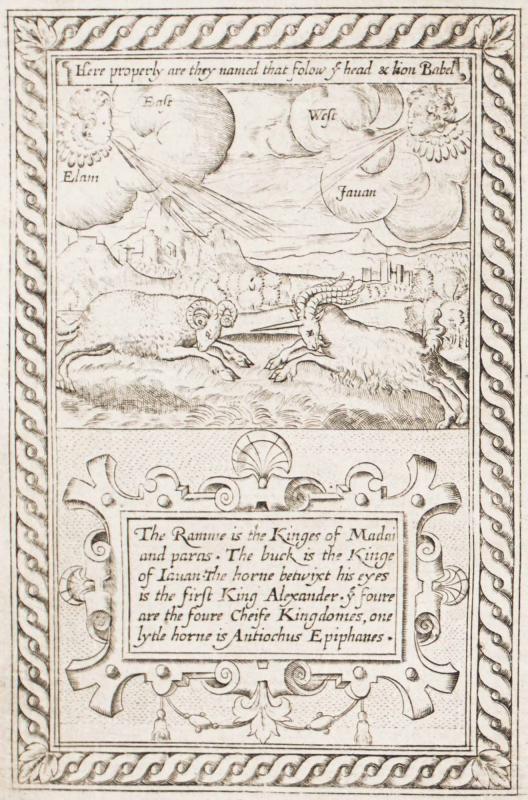
London. Printed by Richard Field [and Gabriel Simson], for William Young. 1596. First edition. Small quarto. [asterisk]4, A-K4, (2nd) H4, L-P4, 68 leaves. [136]pp., 3 (of 4) engraved plates. Woodcut anchor device at title; printed marginalia; woodcut lettrines. English text in black letter, italic, and roman type, some Hebrew and Greek passages, including a Hebrew poem (K3-4) printed in double columns with alternating red and black stanzas. A few early manuscript annotations. Recent wrappers (housed in professionally fitted clear mylar covers). Occasional mild (mostly marginal) dampstains, bottom corner A3 lacks 1-inch section (with no loss of text). A very good, amply margined copy, lacking one of the four engraved plates. First Edition of this translation and commentary on the biblical book of Daniel by the English puritan divine and Hebraist, Hugh Broughton (1549-1612), including the Hebrew text of Saadiah Gaon's Shir shel ha-Otiyyot. Tutored in Hebrew by the renowned French Hughenot scholar, Antoine Rodolphe Chevalier (1507-1572), “Broughton graduated at Magdalene College, Cambridge in 1570, became a Fellow of St. John’s, and then moved to Christ’s College. A disagreement with John Whitgift, archbishop of Canterbury, over the interpretation of scripture, persuaded Broughton to go to Germany in 1589, and apart from brief periodic visits to England he appears to have stayed on the continent until the last year of his life. While Broughton was abroad he engaged in religious discussions with Jews in Hebrew and made the acquaintance of several eminent Christian scholars including Joseph Justus Scaliger. He conducted a debate in the Frankfurt synagogue with a Rabbi Elias. He also records a dispute with Rabbi David Farrar. The close association which he developed with Jews and Christian Hebraists was a significant factor in his linguistic attainments, especially in a grasp of rabbinics unusual for an Elizabethan scholar... For the last twenty years of his life Broughton sought in vain to gain the support of the authorities for a new English translation of the Bible... Broughton’s writings demonstrate that he was an accomplished Hebrew scholar, who may justifiably be regarded as the most proficient English Hebraist of his day. Not only was he able to read the Old Testament in the original, he was familiar at first hand with a wide range of post-biblical Jewish authors... In addition to Targum and Talmud, he insisted that other Jewish writings must be regarded as indispensable to anyone engaged in translating the Bible. In a footnote to his Treatise of Melchisedek (1591) he listed no fewer than twenty-two Jewish sources which the serious student of the Hebrew scritptures might consult to his advantage” (ODNB). While Broughton’s contentious nature and controversial style alienated many of his contemporaries -- Scaliger described him as “furiosus et maledicus” (Van Rooden) -- his scholarship could not be doubted. In his 1824 Bibliotheca Biblica, William Orme notes that the celebrated Hebraist, “with a considerable portion of quackery, and a large portion of ill-nature, had certainly a respectable acquaintance with biblical literature... and it is alleged, was much displeased because he was not employed as one of the translators of our present English version of the Bible.” As a typographical monument the present work is highly notable, containing “the first protracted Hebrew text printed in London” (Roth). Hebrew printing had only just made its debut at the Cambridge press three years earlier in Andrew Downes’ 1593 edition of Lysias. As “[a] keen defender of the Hebrew verity” (Orme), Broughton here makes a remarkable selection of text as evidence for “The certaintie of the Ebrew,” deploying an acrostic poem by Saadiah Gaon (882-942), the greatest scholar and author of the geonic period, and an important leader of Babylonian Jewry. The poem, Shir shel ha-Otiyyot (Poem of the Letters) is printed in alternating couplets of red and black, and gives by means of words and biblical allusions the number of times that each particular letter of the alphabet occurs in the Hebrew scriptures. The engraver of the Hebrew fonts is quite possibly Jodocus Hondius the Elder, whom Broughton first met in 1583 after Hondius had fled to London from his native Ghent in the wake of Spanish persecution of protestants in the Low Countries. The engraved plates in the present work are attributed to Hondius, and appeared earlier in Broughton’s first book, A Concent of Scripture (ca. 1587-1591). As it happens, the first printed Hebrew texts to appear in Amsterdam occur in several books by Broughton, printed in 1605 and 1606, whose fonts were certainly engraved by Hondius (Fuks/Fuks-Mansfeld). While the type used in the present work, with its distinctively angled lamed, does not match those of the Amsterdam publications, it bears some similarity to Fuks Br. Squ. 2. Annotations: At the conclusion of the imprint, following “... where the other workes of the same author are to be sold” appears a contemporary manuscript notation “at ye Rose” #48834

Sachgebiete: Bibeln, Judaica, Judentum, Literatur bis ca. 1900, Renaissance

01.08.2026 - 00:13

6500,- EUR

Eric Chaim Kline Bookseller
...

(Holy Roman Empire). An die Römisch-Kayserliche auch in Germanien und zu Jerusalem Königliche Majestät allerunterthänigst pflichtschuldigste Interventional-Anzeige j. p. h. Pro Clementissime confirmando Sententiam Appellationis denegatoriam 14. Nov. 1771

Frankfurt/Main. Burgerlicher Ausschuss und Burgerl. Neuner. [1772]. First edition. Small Folio. 168pp. Rebound in decorative paper-covered boards with manuscript title on tan spine, protected by modern mylar. Red edges. Marginalia. Decorative headpiece and historiated initial. "...latam, nec non concedendo facultatem concipiendae vovae, originariae Judaeorum Francosurtensium conditioni, praefentique eorum statui, accommodatae ordinationis & c. Anwälde beeder Kayserlichen verordnet und bestättigter Collegien des Burgerlichen Ausschusses und Burger. Neuner in Frankfurt Intervenientenby der Sache Gemeiner Judenschaft zu Frankfurt contra den Magistrat daselbst die Cramläden und Gewölber außer der Judengasse betreffend. Mit beylagen..." (continuation of title page) Holy Roman Emperor Leopold II, King of Hungary, Croatia and Bohemia's 1771 ordinance regarding Jewish storefronts and houses in Frankfurt, with reviews by officials of the city and attachments. The address to the emperor includes passages showing uninhibited disdain for the Jews: "... that the Jews in Frankfurt, since their first admission and up until now, have been detrimental and onerous for the Christian Frankfurt merchants..." The extensive report respectfully requests confirmation of the ordinance, providing several attachments making their case. The attachments include A, B, C1, C2, C3, and C4, plus D, and the text of previous ordinances, providing a historical outline and details regarding the treatment of Jews historically, with secondary attachments, concluding with an ordinance from 1616. Contains a list of houses and occupants for both sides of the Judengasse at rear, closing with the emperor's confirmation. Signed in print by Hans Ludwig von Ulm for the emperor, and Johann Rudolph Bucher for the city. Text in German, Gothic script. Some light wear along edges of binding with spine showing several small to medium chips at head, middle, including label, and tail of spine. A couple of small chips at front joint of spine. Printed label "Ex bibliotheca Johannis Augusti Speltz, J.U.D, etc., with manuscript number 113 on inside front cover. Block in very good condition. #53544

Sachgebiete: Friedrich II., der Große, Germanistik, Judaica, Jura, Politik

01.08.2026 - 00:10

6500,- EUR

Eric Chaim Kline Bookseller