Rare Books Berlin - Internationale Messe für Bücher und Graphik

...

AGRIPPA, Henrich Cornilius. Militiae Equitis Aurati...[I]n Artem Brevem Raymundi Lullii, Commentaria

Solingen, Joannes Soter, 1538. 8vo. pp [284] a-r8 s6. Roman letter, occasional Italic. Woodcut initials, t.p. with printer's device of cherub within wreath, 8 woodcut diagrams of Lullian circles. Contemp. ex libris Antonius Dachselhof of Berne to Lly. Very minor damp stain and spot to t.p, woodcut circle on b5 just shaved at outer margin. A very good, clean and well-margined copy in contemporary limp vellum with 14 original blank unnumbered ll in front and 31 at end, contemp ink title to upper cover and spine, original kid ties. Second edition of Agrippa's (1486 - 1535) commentary on Raymond Lull's (1232-1316) Ars Magna or Ultimate General Art', a system of logic blending influences from Arabic mysticism, Egyptian hermeticism, and Lull's missions to Jews and Muslims. In his preface Agrippa praises Lull's art 'as easy to learn for students young and old': in fact it is based on a confusing series of paper 'machines' Lull had developed to do his reasoning for him, comprising of circles with symbols representing key topics. When rotated together in any combination they yield only theologically true' statements, such as 'Angels are Wise', and 'God is Eternal'. These so-called 'Lullian Circles' were intended as tools for debating faith with Muslims: ironically they were based from an Arabic astrological tool used to cast horoscopes known as the zairja. Agrippa breaks down each circle and its function: there are nine main subjects including God, Angels, and Man, each assigned a letter B-K. The same letters are assigned to characteristics: Goodness, Greatness, Duration, Power, Wisdom, Will, Virtue, Truth, and Glory. The relationship between these sets of terms is determined by three triangles that highlight their differences, similarities, and magnitudes of importance to one another. There is a detailed discussion of the meaning of each circle's constituent terms, including how it is possible to reduce all of philosophy to so few qualities from so many. The work concludes with the rules for using the Lullian Circle, and lists of all possible letter combinations that consider the meanings of some combinations, essentially meditating on the nature of goodness. The work ends with a final breakdown of Lull's terms into tables showing how each relate to the other. An ambitious and strange book irrespective of Agrippa's success in actually explaining Lull's system: Jonathan Swift thought it ridiculous enough to feature in Gulliver's Travels, but Borges credits him as the inventor of the 'thinking machine': what information scientists call the earliest type of computer. Rare. The only other copy traceable at auction is the Broxbourne copy, Sotheby's 1978.BM STC Gr. p. 11. Index Aureliensis I 101.866. Palau I 3333. Caillet II 6864 "Edition originale". L1411

Sachgebiete: Esoterik, Kunstgeschichte, Instrumente (Technik)

05.08.2026 - 12:39

5000,- EUR

Sokol Books Ltd

...

AGRIPPA, Cornelius. De incertitudine et vanitate scientiarum.

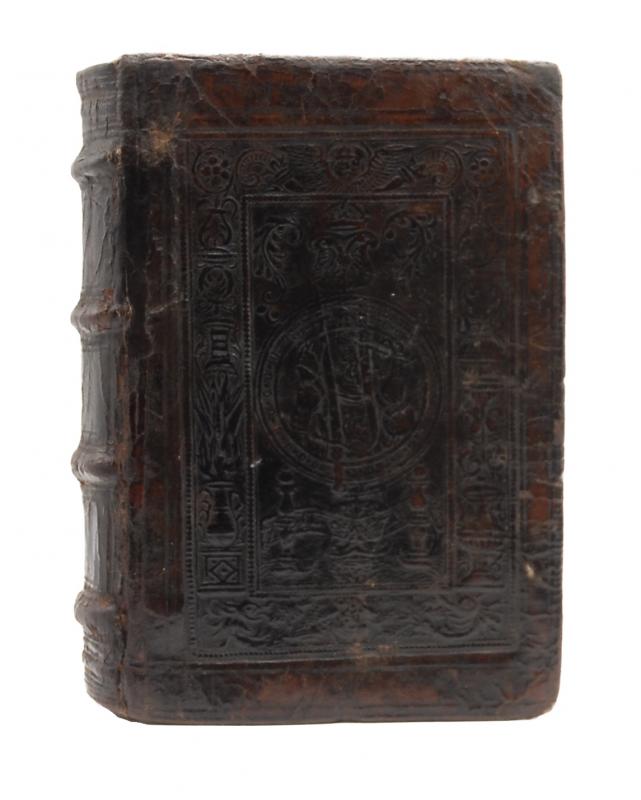
[Cologne, Eucharius Cervicornus, 1536]. 8vo. 208 unnumbered ll., A8, a-Bb8. Roman letter, little Gothic. Author s woodcut portrait to t-p, a few decorated white-on-black initials. T-p a little age yellowed, small tear from fore-edge, slight yellowing, light water stain in final gatherings, vellum slip from rubricated C15 Dutch ms. used as spine lining just visible, penultimate gathering slightly loosening at foot, small mark to lower outer blank corner of last two ll. A good, unsophisticated copy in contemporary Netherlandish calf, panel-stamped, double ruled, border of tendrils, urns, cherub at head and two interlacing wyverns at foot, centre panel with imperial arms, circular portrait of Charles V signed KO and columns of Hercules with imperial motto Plus Ultra, raised bands, few cracks to covers, edges a bit rubbed. Bookplate of Maurice Burrus and contemporary ms. inscription (signed F. Hessek?) on underlying sheet (visible with UV) on front pastedown, bibliographical notes c1800 to feps, contemporary ms. monogram (FH) to t-p, occasional contemporary annotations. An attractive, unsophisticated copy, in an unusual, contemporary Netherlandish binding, of this extremely influential philosophical work, praised by the likes of Montaigne and Descartes. Due to the controversial reputation of its author, several early editions have few recorded copies and a complex bibliographical history, i.e., from the first of 1530 (possibly a ghost ) to 1539, with most bearing neither imprint nor (frequently) a date. According to D. Clément's Bibliothèque Curieuse (1750), this edition is very similar to that printed in Cologne. The pages are unnumbered. It has no suppressed passages. There is one difference: the title is decorated with the bust of Cornelius Agrippa, absent in all preceding six editions (I, n.86). This is one of his earliest and most reliable portraits. Agrippa (1486-1535) was a major German polymath, physician, soldier (who travelled extensively in Europe) and official historian to Charles V; he was especially renowned for his occulta and ideas on the cabala (Bodin called him the greatest magician of his age), which led to clashes with the Inquisition, despite his recantation. Agrippa's ambivalence towards occultism, religion and epistemology caused a mixed reception of De incertitudine, a harsh critique of all sciences and arts, and Renaissance epistemology in general - which Agrippa subsequently defended in print. Each of the 102 chapters summarises wittily, only to berate, a discipline or art, from the elements of the trivium and quadrivium to optics, acting, painting, architecture, politics, natural philosophy, commerce, agriculture, surgery, anatomy, prostitution, veterinary medicine, law and cooking. There are fascinating sections on judicial astrology (an art bringing no certainty, which can be turned into anything, according to opinion), physiognomy (which infers nonsense from horoscopes based on physical appearance), magic (including necromancy), heraldry (by which heralds dressed in military uniform astrologise, philosophise and theologise with foolish knowledge), the inquisition (with a violent attack against the Dominicans trials of heretics from his native Cologne), and alchemy (which can be defined as an art, or sham, or persecution of nature). The conclusion is an encomium of the ass, i.e. ignorance, which is preferable to this useless knowledge. Despite the serious attacks of great minds like Bodin and Thevet, De incertitudine is a deeply ironic work, an aspect of Agrippa s work much praised, for instance, by Philip Sidney. Like the works in similar vein of Erasmus, Rabelais and many others, [it] is a literary paradox and at the same time a work of polemic (Bowen, 259), spanning the abuses of the Church and false science. The contemporary annotator of this copy, probably the F. Hassek of the concealed inscription and monogram, highlighted passages against astrology, black magic, references to Agrippa s work on occult philosophy, theories of the soul, pimps, the arts of women and cookery. He was knowledgeable as he identified a mistake, where Agrippa used Kirannides to mean the name of the author, not the title of his book. The unusual, contemporary Netherlandish binding, panel-stamped and signed by the obscure K.O., is not listed in Fogelmark s Flemish and Related Panel-Stamped Bindings or major bookbinding bibliographies. The stylised imperial escutcheon with the double-headed eagle and the columns with Charles V's motto Plus Ultra are reminiscent of BL c46b21. Only three copies recorded in the US. VD16 ZV 271; Cantamessa n.73 (mentioned); Caillet I, 87 (later eds); Durling (earlier eds); Duveen p.6 (earlier eds). Not in Brunet or Ferguson. B.C. Bowen, Cornelius Agrippa s De Vanitate: Polemic or Paradox? , Bib. d Humanisme et Ren. 34 (1972), 249-56. L3053

Sachgebiete: Wissenschaftsgeschichte, Occulta, Philosophie

05.08.2026 - 12:28

5000,- EUR

Sokol Books Ltd

...

AGRICOLA, Georgius (BAUER, Georg). De re metallica libri XII - De animantibus subterraneis liber

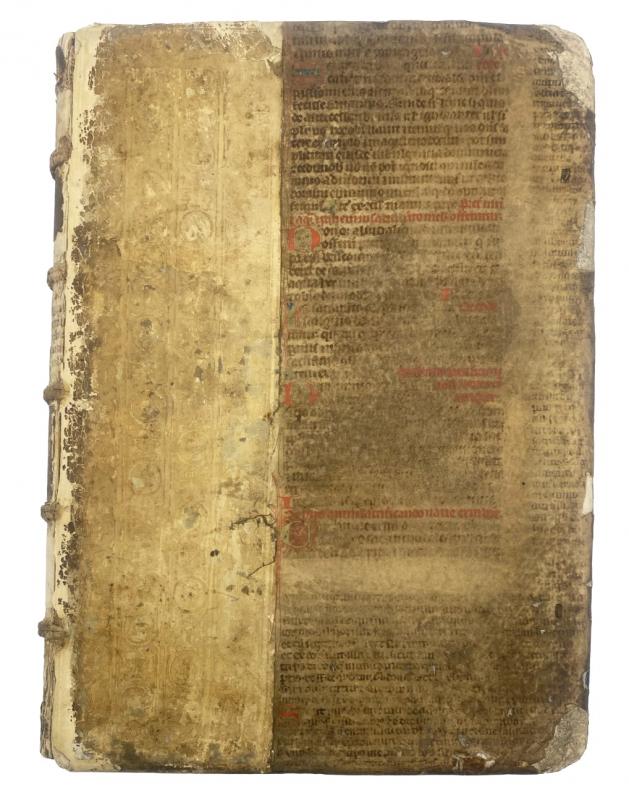
Basel, Hieronymus Froben and Nicolaus Bischoff, 1561. Folio, pp. [xii] 502 [lxxiv]. Roman, Greek and Gothic letter. Woodcut printer's device on title and verso of last, two woodcut plates, one folding, a total of 273 large woodcut illustrations and diagrams in good clean impression, some full-page, white on black initials. Light age yellowing, a few marginal spots and splashes, clean tear without any loss in one leaf, early ms press mark to t-p and later, but not modern, to pastedown. A good, clean wide-margined copy. Formerly in contemporary 1/4 pigskin over paste-boards, the pigskin removed exposing stitching and binder's waste, cover from a ms. on vellum in red and brown ink, decorated initials, early 1400's. In folding box. SECOND EDITION of the "first systematic treatise on mining and metallurgy and one of the first technological books of modern times" (PMM), the earliest and pre-eminent early work on metallurgy and mining. It is remarkably richly illustrated with technical woodcuts of the highest quality, largely by Hans Rudolf Manuel Deutsch (after Blasius Weffring). All of them are based on Agricola's own drawings of processes and phenomena he personally observed. The work "embraces everything connected with the mining industry and metallurgical processes, including administration, prospecting, the duties of officials and companies and the manufacture of glass, sulphur and alum. The magnificent series of two hundred and seventy three large woodcut illustrations add to its value. Some of the most important sections are those on mechanical engineering and the use of water power, hauling pumps, ventilation, blowing of furnaces, transport of ores etc., showing a very elaborate technique" (PMM). It is "one of the great monuments of technology by reason of the comprehensiveness of its text and the detail and intelligibility of its numerous illustrations" (Singer, vol II, p. 27), and became "the early standard treatise" on the subject (Horblit, 2b). It is also one of the important contributions to physical geology, in particular the influence of wind and water erosion on landscape and its clear account of the order of strata exposed by mines. The work concludes with a 20 page glossary of technical terms and names in Latin and German which contains a new scientific classification of minerals based on their physical properties; the mode of occurrence and mutual relation of some 80 minerals and ores are discussed, no less than 21 of them for the first time. Written over two decades, the work illustrates Bauer's familiarity both with the technical and financial aspects of mining as well as his concern for the health of the miners. Bauer had studied medicine in Leipzig before moving to the important mining centre of Joachimstal (in latter-day Czechoslovakia) as the town physician. There, Bauer observed both by day and by night the unceasing activities of the mines, "and his interests were aroused by the metallurgical, mineralogical and chemical problems of the trade. He published several books relating to these, the above is outstanding in the field of all science and technology; it was published posthumously. Many large woodcuts present vivid pictures of men at work, machines pumping, ventilating, smelting, assaying, transportation, and hoisting equipment and methods of his time" (Dibner, Heralds of Science, 88). The work was translated into English in 1912 by Herbert Hoover, afterwards president of the United States. BM STC Ger. p.8; Adams A-350; PMM 79 (1st edn); Brunet I, 113; Horblit, One Hundred Books Famous in Science, 2 (1st); Duveen pp. 4-5; Ferguson I, p.9; Kress I, 71 (1st); Ford, Images of Science, pp. 124-5; Norman 20. L1730

Sachgebiete: Bergbau, Instrumente (Technik), Schweiz, Technik

05.08.2026 - 12:08

14500,- EUR

Sokol Books Ltd