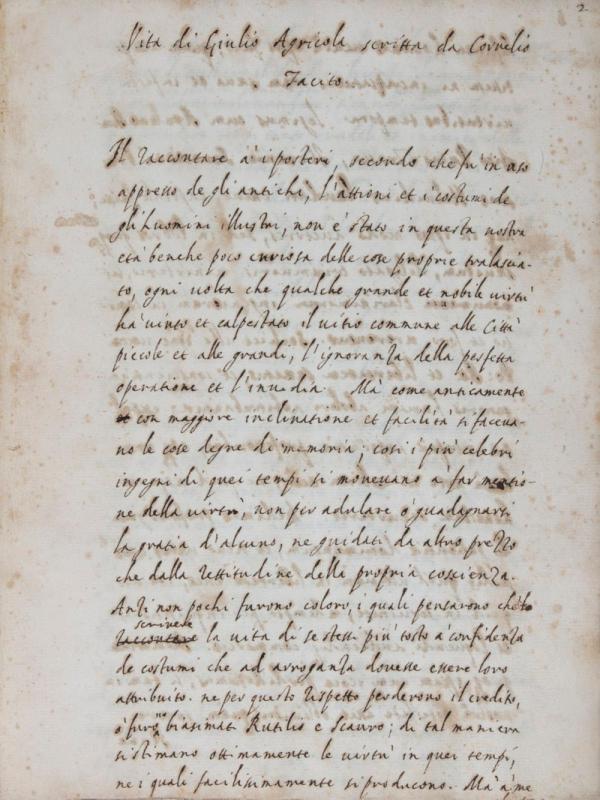
Tacitus, Gaius Cornelius. Vita di Giulio Agricola scritta da Cornelio Tacito (Life of Julius Agricola written by Cornelius Tacitus) [MANUSCRIPT FROM THE THOMAS PHILLIPPS COLLECTION]
[Italy] 1650. Manuscript. Small folio (21.5 by 26.5 cm). 124, [1]pp. Contemporary sprinkled rustica boards, with manucript title at spine: "Vita di Agricola di Tacito." First leaf loose; touches of marginal foxing, else clean, easily legible text on crisp paper. Text in Latin and Italian (with corrections in same hand) on facing pages, 20-24 lines per page. Nearly fine copy.
Manuscript (ca. 17th-18th cent.) text of Tacitus' Agricola in Latin and Italian, Phillipps MS 19272. The Italian translation does not correspond to either of the following early modern versions:
1. Giovanni Maria Manelli's La Vita di Giulio Agricola Scritta Sincerissamente (London: J. Wolfe, 1585), which appears to be a rare work. The present translation varies considerably from this earlier version.
2. In: Opera (Venice: Giunti, 1628; 1644), "trasportati dalla lingua castigliana nella toscana da D. Girolamo Canini d'Anghiari" [translated from the Castilian language into Tuscan by D. Girolamo Canini d'Anghiari] noted at title, but the caption title to the Agricola in the 1644 edition notes: "Tradotta in vulgar senese dal Signor Adriano Politi, & illustrata da D. Girolamo Canini" [translated into the Sienese vernacular by Signor Adriano Politi, and illustrated by D. Girolamo Canini].
Written around 98 C.E., "Agricola" is Tacitus' first historical work. It recounts the life of his father-in-law Gnaeus Julius Agricola, an eminent Roman general. It also covers, briefly, the geography and ethnography of ancient Britain. As in the Germania, Tacitus favorably contrasts the liberty of the native Britons to the corruption and tyranny of the Empire. The work has a strong anti-despotic tone and contains eloquent and vicious polemics against the rapacity and greed of Rome. Tacitus sets the despotism of Domitian against the merits of Agricola: an incorruptible officer and a great commander, who fitted the model of the mos maiorum ("the custom of the forefathers", the presumed superior morality of an earlier time). The writer implicitly says that, as the Empire should be accepted as a necessary evil, one has to keep one's dignity without mixing up one's own responsibility with the responsibility of an arbitrary despot like Domitian. One can be an honest and scrupulous officer, doing his job with serenity and in collaboration with the regime, keeping his job and keeping the interest of the state, waiting for a better age, when a writer would be able to write in freedom.
Provenance and annotations: Small printed label at spine tail with library number "12972" (Phillipps MS 12972 noted in pencil at bottom margin of the first leaf); old label with number "164." affixed to front board. Printed label affixed at rear pastedown, "Carleton P. Small," with the following information added in ink: 11/15/29; [case] 7; [section] 4; [remark] Portland, Maine; [no.] 993; 17th Cent. MS.
Sir Thomas Phillips (1792-1872) assembled one of the largest private collections ever, comprised of manuscripts, books, paintings, drawings, prints, photographs, and other materials. The manuscript portion alone numbered between forty- and sixty thousand items largely collected from the dispersal of religous libraries in France and Italy in the late eighteenth- and early nineteenth centuries. Reference: Catalogus librorum manuscriptorum in bibliotheca D. Thomae Phillipps, no. 12972 (p.229): "Taciti Vita Agricolae, Latin and Italian, pp. 124." #18737
31.07.2026 - 23:42
5000,- EUR
Eric Chaim Kline Bookseller
.jpg)
.jpg)