James Cook
Voyage dans l'hémisphère austral, et autour du monde, fait sur les vaisseaux de roi, l'Aventure & la Résolution, en 1772, 1773, 1774 & 1775 ... Dans lequel on a inséré la relation du Capitaine Furneaux, & celle de MM. Forster. Traduit de l'anglois par J.B.A. Suard.
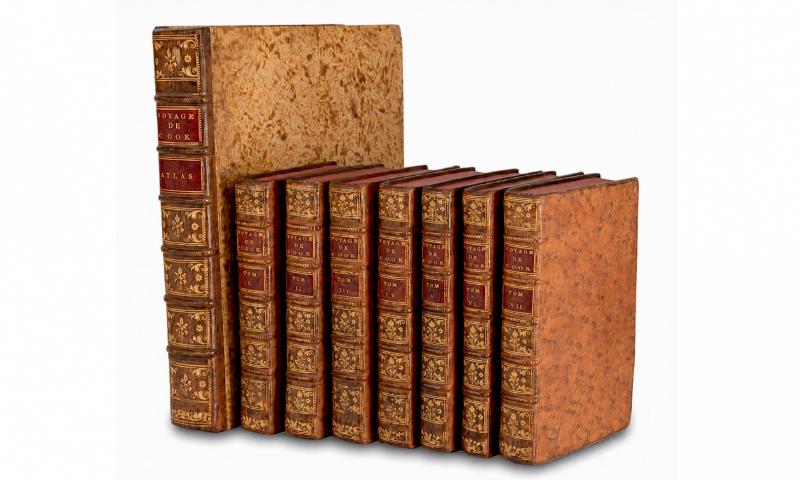
Paris, Hôtel de Thou, 1778. 7 Bände Text in 8° sowie ein Atlasband in 4°. Mit 66, größtenteils gefalteten prachtvollen Kupfertafeln (Ansichten von Küsten und Häfen, ethnographische Darstellungen der Insulaner Polynesiens, Melanesiens und Feuerlands, botanische und zoologische Tafeln, Abbildungen von Geräten, Waffen und Wasserfahrzeugen). Zeitgenössischer Ledereinband, Rücken jeweils mit zwei goldgeprägten Rückenschildern und reicher floraler Rückenvergoldung; der Atlasband in stilistisch der Zeit angepasstem Halbleder mit ebensolcher Rückenvergoldung und zwei Rückenschildern. Minimal berieben und an den Kanten leicht beschabt, insgesamt jedoch ein bemerkenswert wohlerhaltenes, dekoratives Exemplar. Beddie 1223; Cox I, 60; Henze I, 543 ff.; Sabin 16249; O'Reilly, Tahiti, 419. - Erste französische Ausgabe der offiziellen, von Cook selbst verfassten Darstellung seiner zweiten Weltumsegelung (1772–1775) an Bord der Resolution, begleitet von der Adventure unter Kapitän Tobias Furneaux. Die Reise war unmittelbar von der Royal Society und der britischen Admiralität mit dem Ziel initiiert worden, die seit der Antike diskutierte Hypothese eines großen, bewohnbaren südlichen Kontinents – der sogenannten Terra australis incognita – endgültig zu klären. Cook durchsegelte hierfür als erster Seefahrer den Südlichen Ozean in mehreren Vorstößen bis über den 71. Breitengrad hinaus, überquerte dreimal den Südpolarkreis und konnte durch dieses systematische Vorgehen die Nichtexistenz eines bewohnbaren Südkontinents in gemäßigten Breiten schlüssig widerlegen. Damit setzte er einen der folgenreichsten Wendepunkte der geographischen Entdeckungsgeschichte des 18. Jahrhunderts.
Die Expedition gilt zugleich als die erste eigentliche wissenschaftliche Forschungsfahrt in polare Gewässer. An Bord befanden sich mit Johann Reinhold Forster und seinem Sohn Georg Forster zwei der bedeutendsten Naturforscher ihrer Zeit, die im Auftrag der Royal Society umfassende botanische, zoologische und ethnographische Beobachtungen sammelten. Georg Forsters eigenständiger Bericht A Voyage Round the World (1777) gilt heute als Meilenstein der wissenschaftlichen Reiseliteratur und beeinflusste maßgeblich Alexander von Humboldts spätere Forschungsreisen. Die in Suards Übersetzung eingearbeiteten Passagen der Forsterschen Aufzeichnungen verleihen der vorliegenden französischen Ausgabe einen eigenständigen wissenschaftlichen Wert gegenüber dem reinen Cookschen Originaltext. Kapitän Furneaux' separat integrierter Bericht dokumentiert die Erlebnisse der durch einen Sturm von der Resolution getrennten Adventure, darunter die Erkundung Van-Diemens-Landes (Tasmanien) und den tragischen Zwischenfall mit Teilen der Besatzung in der Bucht von Grass Cove auf Neuseeland. Zu den geographischen Ergebnissen der Expedition zählt ferner die Entdeckung der Südlichen Sandwichinseln sowie die Vermessung zahlreicher pazifischer Inselgruppen. Die 66 Kupfertafeln, nach den an Bord entstandenen Zeichnungen William Hodges' gestochen, zählen zu den frühesten und ethnographisch bedeutendsten bildlichen Dokumenten des Südpazifiks und Feuerlands und besitzen über ihren dokumentarischen Wert hinaus auch kunsthistorischen Rang als Zeugnisse der aufklärerischen Bildwissenschaft. Beigebunden (Bd. 7): [RICKMAN, John]. Troisième voyage de Cook, ou journal d'une expédition faite dans la mer Pacifique du sud & du nord, en 1776, 1777, 1778, 1779 & 1780. Paris, Berlin, 1782. Zweite Ausgabe der französischen Übersetzung von J.-N. Démeunier, mit einem gefalteten Frontispiz und einer gefalteten Karte. Rickmans – zunächst anonym erschienener – Bericht über Cooks dritte und letzte Reise, während der der Entdecker 1779 auf Hawaii den Tod fand, ergänzt die Sammlung um den chronologischen Abschluss der Cookschen Pazifikexpeditionen. Es fehlt der Reihentitel in Bd. 2; ansonsten ein insgesamt sehr schön erhaltenes, vollständiges Exemplar dieses für die Geschichte der Geographie, Ethnographie und Naturwissenschaften gleichermaßen bedeutenden Reisewerks der europäischen Aufklärung. - 7 text volumes in octavo, plus an atlas volume in quarto. With 66, mostly folding, copper-engraved plates (views of coasts and harbours, ethnographic depictions of the islanders of Polynesia, Melanesia, and Tierra del Fuego, botanical and zoological plates, and images of implements, weapons, and watercraft). Contemporary leather bindings, each spine with two gilt-lettered labels and richly gilt-tooled decoration; the atlas volume in half-leather executed in the style of the period, with matching gilt spine decoration and two spine labels. Minor rubbing and slight chafing to the extremities, but overall a remarkably well-preserved and handsome set. First French edition of the official account—written by Cook himself—of his second circumnavigation of the globe (1772–1775) aboard the Resolution, accompanied by the Adventure under Captain Tobias Furneaux. The expedition had been commissioned directly by the Royal Society and the British Admiralty with the aim of finally resolving the question, debated since antiquity, of a great habitable southern continent—the so-called Terra Australis Incognita. Cook was the first navigator to systematically penetrate the Southern Ocean in repeated forays beyond the 71st parallel, crossing the Antarctic Circle three times, and through this methodical approach was able to conclusively disprove the existence of any habitable southern continent in temperate latitudes. This achievement marks one of the most consequential turning points in the history of geographical discovery in the eighteenth century. The expedition is likewise regarded as the first genuine scientific research voyage into polar waters. On board were Johann Reinhold Forster and his son Georg Forster, two of the most eminent naturalists of their age, who—commissioned by the Royal Society—gathered extensive botanical, zoological, and ethnographic observations. Georg Forster's independent account, A Voyage Round the World (1777), is today considered a landmark of scientific travel literature and significantly influenced Alexander von Humboldt's later expeditions. The passages from the Forsters' records incorporated into Suard's translation lend this French edition a distinct scientific value beyond Cook's original text alone. Captain Furneaux's separately integrated narrative documents the experiences of the Adventure, which had been separated from the Resolution by a storm, including the exploration of Van Diemen's Land (Tasmania) and the tragic incident involving members of the crew at Grass Cove in New Zealand. Among the expedition's geographical achievements was the discovery of the South Sandwich Islands, along with the surveying of numerous Pacific island groups. The 66 copper plates, engraved after drawings made on board by William Hodges, rank among the earliest and most ethnographically significant pictorial documents of the South Pacific and Tierra del Fuego, and beyond their documentary value hold considerable art-historical importance as testimonies to Enlightenment-era visual science. Bound in (Vol. 7): [RICKMAN, John]. Troisième voyage de Cook, ou journal d'une expédition faite dans la mer Pacifique du sud & du nord, en 1776, 1777, 1778, 1779 & 1780. Paris, Berlin, 1782. Second edition of the French translation by J.-N. Démeunier, with one folding frontispiece and one folding map. Rickman's account—initially published anonymously—of Cook's third and final voyage, during which the explorer met his death in Hawaii in 1779, rounds out the collection with the chronological conclusion of Cook's Pacific expeditions. The half-title is lacking in Vol. 2; otherwise a wholly attractive, complete set of this travel work of the European Enlightenment, of equal importance to the history of geography, ethnography, and the natural sciences.
Sachgebiete: Illustrierte Bücher, Ozeanologie, Reisen/Reiseliteratur
30.07.2026 - 17:44
3500,- EUR
Jeschke Jádi Auctions Berlin GmbH