Rare Books Berlin - Internationale Messe für Bücher und Graphik

...

BERNI, Francesco (1610-1673)]. Il torneo a piedi, e l’invenzione, ed allegoria, colla quale il Signor Borso Bonacossi comparì a mantenerlo: e l’Alcina maga favola pescatoria [...] Ferrara, Gioseffo Gironi & Francesco Gherardi, 1631.

4to (198x140 mm). [16], 107, [1] pp. and [6] etched folding plates attributed to Alfonso Chenda (1607-1640). Collation: a-b4 A-M4 N6. 18th-century half vellum, inked title on spine, panels covered by light blue floral paper, red sprinkled edges (slightly worn and rubbed). Private stamp to the title-page verso. Worm track to the lower outer corner of the first ten leaves, which then becomes just a small hole, never affecting the text, other work track to the outer margin of the final leaves with no loss of text, two small holes on l. C2 one of which slightly affects the text, some foxing and staining, more strongly towards the end, all in all a good, genuine copy. Extremely rare first and only edition of the account by Francesco Berni (1610-1673, disguised under the academic name of “Aggirato”) of the first festival held in Ferrara after the War of the Mantua Succession (1628-1631), to celebrate the wedding of Giovanni Francesco Sacchetti (1595-1656) and Beatrice Estense Tassoni (1611-1633), in the presence of the Duke of Mantua, Charles de Nevers -to whom the volume is dedicated- and Cardinal Giulio Sacchetti. The book describes a tournament organised by Borso Bonacossi at Carnival time and accompanied by recited texts (one of which is signed by Ottavio Magnanini), as well as poems, stage designs, and machinery (pp. 6-86). It also contains the Alcina maga, a “favola pescatoria” by Sebastiano Martini (pp. 87-96), a wedding ode by Francesco Berni recited that same evening (Il Tebro, overo la Pittura loquace del pittor muto, pp. 99-107), two sonnets, by Alfonso Fiornovelli and Ippolito Visdomini, and a Latin poem by I. Visdomini. The plates depict the allegorical and historical re-enactments that were performed, including two scenes from the Alcina maga. Sartori, 23349; Italian Union Catalogue, IT\ICCU\MODE\034506; Michel & Michel, I, pp. 152-153; Watanabe, 418; Cicognara, 1438.


03.09.2026 - 11:24

12000,- EUR

Govi Rare Books LLC

...

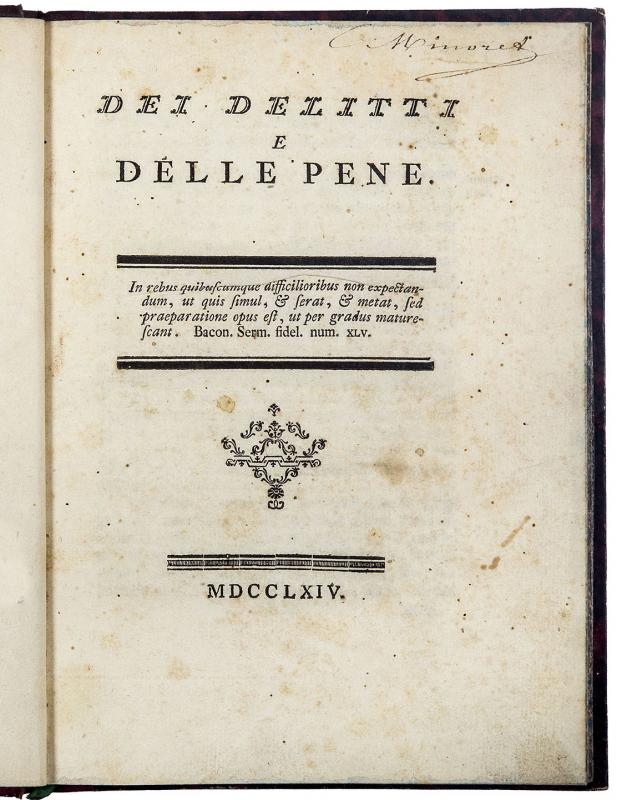
[BECCARIA, Cesare (1738-1794)]. Dei delitti e delle pene. N.pl., n.pr., n.d. [Livorno, Marco Coltellini], [July] 1764.

4to (203x145 mm). 104, [2] pp. Collation: A-N4 χ1. 19th-century French half morocco, spine with four raised bands and gilt title, marbled endleaves and marbled edges. Between the front flyleaves is a loose paper strip written in an elegant 19th-century hand which contains a few verses against torture taken from Voltaire’s Ode à la verité. On the title page is the ownership entry “C. Minoret”. Title page a bit soiled, uniformly slightly browned, some scattered foxing, all in all a good, wide-margined copy. First edition (in one of the rare copies with the errata leaf containing twenty-one corrections, printed as a separate sheet) of one of the most important works of the Italian Enlightenment. A manifesto on legal reform, and one of the best interpretations of the ideas circulating around France in the second half of the eighteenth century.
The young Milanese nobleman Cesare Beccaria Bonesana composed this work between March 1763 and January 1764, while he was an active member of the intellectual circle known as the Accademia dei pugni, founded in Milan in 1762 by the brothers Alessandro and Pietro Verri, and Beccaria himself, among others. The central theme of the work is the reform of criminal justice, in a context in which punishment was still both brutal and arbitrary. Beccaria advocates an egalitarian justice system and traces a new metric for punishment and laws rooted in the concept of public happiness. “One of the most influential books in the whole history of criminology [...] Beccaria maintained that the gravity of the crime should be measured by its injury to society and that the penalties should be related to this. The prevention of the crime he held to be of greater importance than its punishment [...] his ideas have now become so commonplace that it is difficult to appreciate their revolutionary impact at the time” (PMM). The work enjoyed wide and immediate success, and its influence was enormous. Voltaire, d’Alembert, Helvétius, Holbach, Hume, and Hegel all counted among its enthusiastic readers; Beccaria’s ideas also inspired justice reforms introduced by Grand Duke Leopold of Tuscany, Emperor Joseph II, and Catherine II of Russia, and its influence on constitutionalism broadly, especially the Declarations des droits de l’homme of 1789, is likewise evident. The Dei delitti e delle pene was published in Livorno (Tuscany) – then one of the most advanced cities in Italy – on 12 April 1764, anonymous and without indication of place, for fear of repercussions owing to its strong egalitarianism. The printer Coltellini had already published, in 1763, the Meditazioni sulla felicità by Pietro Verri, Beccaria’s closest friend. The ‘innovative’ feature of the reform proposed by Beccaria was, however, perceived by the Roman censorship, and in 1766 Dei delitti e delle pene was included in the Index of Forbidden Books. A good sign, as Beccaria admonishes: if a government needs censorship, it comes from the weakness of its constitution. The work was translated into English in 1767, and On Crimes and Punishments “significantly shaped the views of American revolutionaries and lawmakers. The first four U.S. Presidents – George Washington, John Adams, Thomas Jefferson and James Madison – were inspired by Beccaria’s treatise and, in some cases, read it in the original Italian. On Crimes and Punishments helped to catalyze the American Revolution, and Beccaria’s anti-death penalty views materially shaped American thought on capital punishment, torture and cruelty” (J. D. Bessler, The Italian Enlightenment and the American Revolution, p. 1). Gamba, no. 2147; Parenti, p. 67; Melzi, I, p. 281; Printing and the Mind of Man, no. 209; L. Firpo Le edizioni italiane dei delitti e delle pene, Milano, 1984, no. 1; Einaudi, no. 3362; B. E. Harcourt, Beccaria’s ‘On Crimes and Punishments’: A Mirror on the History of the Foundations of Modern Criminal Law, Chicago, 2013; M. Palumbo & E. Sidoli (eds.), The Books that Made Europe, Bruxelles, 2106, pp. 248-249.


03.09.2026 - 11:21

18000,- EUR

Govi Rare Books LLC

...

GALLI BIBIENA, Antonio (1697-1774). Disegni del nuovo teatro de quattro cavalieri eretto in Pavia l’anno MDCCLXXIII opera del Cav. Antonio Galli Bibiena. N.pl. [Pavia], n.pr., n.d. [c. 1773].

Folio (412x287 mm). Engraved architectural title page by Giovanni Ramis after Paolo Mescoli, dedicaton leaf to the Archduke Ferdinand of Austria, [1] leaf of text, and [3] double-page plates engraved by Giovanni Ramis after Paolo Mescoli and Antonio Martorini, showing the plan, the façade and a section of the theater. Contemporary colored wrappers (spine repaired, worn and faded). A very good copy printed on thick paper. Extremely rare first edition, probably printed after 24 May 1773, date indicated in the text for the inauguration of the theater. Begun in 1771 by the famous architect Antonio Galli Bibiena, son of Ferdinando, and completed two years later, the Teatro dei Quattro Cavalieri, now known as Teatro Fraschini, is one of the most important monuments in the city of Pavia and the last of a series of theatres built by Bibiena in Italy, including the Comunale in Bologna, the Teatro Rossini in Lugo di Romagna and the Teatro Scientifico in Mantua. The façade of the building on Strada Nuova shows the affirmation of the neoclassical style, while the interior, with its symmetrical division of the rectangular plan, destined to the stage on one side and the audience on the other, was designed so that the protagonist would be exactly in the centre of the hall. The theatre was inaugurated in 1773 with J. Mjsliweczek’s Il Demetrio in the presence of Archduke Ferdinand of Austria, to whom the opera is dedicated. The four knights who financed its construction, Count Francesco Gambarana Beccaria, Marquis Pio Bellisomi, Marquis Luigi Bellingeri Provera and Count Giuseppe de Giorgi Vistarino, wanted to oppose the monopoly of theatrical performances held by G. Omodei, owner of the only theatre in Pavia until then. “The Teatro dei Quattro Cavalieri, now known as the Fraschini, is destined to play a fundamental role in the corpus that will be critically defined around the name of Antonio, at least as important as that of the Comunale in Bologna (1756-1763) and the Scientifico in Mantua (1767-1769). In fact, it is reasonable to assume, and a reading of the monument confirms this, that in the Pavia project the previous experiences in Bologna and Mantua led to a rethinking and to new, albeit partial, acquisitions in the formulation of the theatrical organism. The main source for the commission, the original icnography of the building and the timing of its realisation is the folio publication entitled Disegni del nuovo teatro de quattro cavalieri eretto in Pavia l'anno MDCCLXXIII opera del Cav. Antonio Galli Bibiena, published by the coowners patrician cavalieri at an unspecified date, but probably on the occasion of the theatre’s inauguration, and dedicated to Archduke Ferdinand of Austria. In the introduction to the three plates - plan, section and prospectus of the theatre - that make up the volume, it is stated that ‘ebbe principio il nuovo Teatro nella Regia Città di Pavia l'anno 1771, coll’essersi sul fine del mese di luglio formata una società di quattro Cavalieri Patricj, e Decurioni della città stessa cioè: il Conte Francesco Gambarana Beccaria, il Marchese Pio Bellisomi..., il Marchese Luigi Bellingeri Provera..., ed il Conte Giuseppe de Giorgi di Vistarino’ (‘The new theatre in the royal city of Pavia began in 1771 with the formation, at the end of July, of a company of four patrician knights and decurions of the city itself, namely: Count Francesco Gambarana Beccaria, Marquis Pio Bellisomi..., Marquis Luigi Bellingeri Provera... and Count Giuseppe de Giorgi di Vistarino’). It is clear that this was a private company that brought together some of the leading representatives of the local ruling class for an initiative in the public interest, in line with the enlightened directives of the central power. The nature of the company and its private funding were very much in line with 18th-century practice, which was full of similar examples; we need only think of the Comunale in Bologna, the Filarmonico in Verona, the Aliberti in Rome. In this particular case, the construction of a theatre was intended to avoid a precarious situation. Confined to the salons of patrician houses in the 17th century, the theatrical life of the city found an opening at the beginning of the 18th century with the construction of a theatre open to the public. It was a poorly equipped hall owned by the Homodei family, who ran it according to dubious criteria inspired by a misunderstood caste pride. The intention of the four knights was therefore to provide the city with a stable structure more suited to its needs […] The choice of the architect was probably determined by two factors: Bibiena’s fame as a theatre engineer, apparently untainted by the controversy that had surrounded the Bolognese commission, and his qualification as Architect of the Imperial Court of Vienna, a particularly prestigious title in a city of strict Austrian observance. In October 1777, the demolition of the existing houses in the chosen area began and the foundations of the building were laid. The inauguration took place on 24 May 1773 with the opera ‘Il Demetrio’, text by Pietro Metastasio, music by Giuseppe Mjsliweczek, scene changes by Antonio Bibiena himself. According to the first local historians, the architect personally supervised the work […] Following the principles laid down by the architect during the controversy over the construction of the Comunale in Bologna, the Teatro di Pavia was also built entirely in brick and stone, materials that contemporary theorists had a very negative view of, considering them to be unacoustic par excellence. In the Teatro dei Quattro Cavalieri, Antonio Bibiena used other means to ensure the success of the acoustics. The ceiling, the structure of which was later rebuilt, and the pit under the stalls probably played a prominent role in this undertaking. Antonio Galli Bibiena’s role in 18th-century theatre architecture was gradually defined. The bell-shaped plan, typical of the entire Bibiena tradition, became here the object of geometric formulation and was concretized in stable wall structures” (cf. L. Giordano, Il teatro dei quattro cavalieri e la presenza di Antonio Galli Bibiena a Pavia, in: “Bollettino d’arte”, 60, series 5., fasc. 1-2, Jan.-Jun. 1975, pp. 88-93). Antonio Luigi, one of the sons of the famous architect Ferdinando Galli Bibiena, was born in Parma in 1697. After his early studies in Bologna, he began his career as an architect, set designer and painter with his father. His most active period was in Vienna, where he was employed annually as a set designer for court shows. Around 1740 he accepted the invitation and protection of Imre Esterházy, Bishop of Veszprém and later Archbishop of Esztergom, who employed him in Bratislava in both civil and religious works. After the death of Cardinal Esterházy (1745), he returned to Vienna, where he was appointed “First Imperial Architect” in 1748. He permanently returned to Italy in 1751. The experience he had gained in over 30 years at the Viennese court and his exceptional skills as a theatre architect won him a prominent position in Italy, where he first worked on the reconstruction of the Teatro dei Rinnovati in Siena (1751-53), then on the reconstruction of the small theatres in Colle di Val d’Elsa and Pistoia (1754-55), and finally on the scenography and decoration of the Teatro della Pergola in Florence (1755). He returned to Bologna in 1756 to complete the new public theatre, inaugurated on 14 May 1763. He then designed stage sets for theatres in Milan (1751-53), Parma (1753, 1761, 1763), Reggio Emilia (1759) and Bologna. He was also responsible for the design of the Teatro di Lugo, the Teatro Scientifico in Mantua (1767-69) and the Teatro dei Quattro Cavalieri in Pavia (1771-77). His late activity was divided between Emilia and Lombardy. Antonio Luigi died in Milan on 28 January 1774 (cf. A. Coccioli Matroviti, Galli Bibiena, in: “Dizionario Biografico degli Italiani”, vol. 51, Rome, 1998, s.v.). Italian Union Catalogue, IT\ICCU\PUVE\004090; Cicognara, 752.


03.09.2026 - 10:41

3900,- EUR

Govi Rare Books LLC

...

[SAINT-DENIS, Antoine de (fl. mid 16th cent.)]. Les Comptes du Monde adventureux par A.D.S.D. Paris, Estienne Groulleau [for Jean Longis and Vincent Sertenas booksellers], [8 July] 1555.

8vo (169x104 mm). [11], 245, [1] leaves. Collation: ã8 ē4 A-Hh8. Lacking the blank leaves ē4, Hh7 and Hh8. Groulleau’s device on title page. Woodcut initials. Colophon on l. Hh5r, Privilège du Roi on ll. Hh5v-6v. Roman and italic types. 19th-century gilt hazelnut calf, spine in compartments with lettering piece, gilt edges, marbled endleaves, blue silk bookmark (part of the spine and hinges skillfully repaired). On the front flyleaf bookplate with the monogram “AMB”, on the title page barely readable ownership entry “Le marquis De P[…]” and library stamp “Ex bibliotheca J. Richard M.D.” (repeated on l. A1r). Contemporary manuscript notes on ll. Q2r and Q6r in a French hand. Worm tracks repaired on the lower blank margin of most of the volume only occasionally minimally affecting the text, title page slightly soiled, some occasional light browning, all in all a good copy. Extremely rare first edition of this collection of fifty-four moralizing stories, often rather coarse and spicy, nevertheless dedicated “Aux sages et vertueuses Dames de France”. The work is traditionally attributed to Antoine de Saint-Denis, a priest from the diocese of Mans, who seems to have been in close relationship with Marguerite de Navarre. “Par ses tendances come par sa forme littéraire, ce recueil appartient bien au petit cercle des contes de la reine de Navarre, et la personalité d’Antoine de Saint-Denis [curé de Champfleury] s’y encadre sans difficulté […] Il faut reconnaître que, en effet, si Marguerite d’Angoulême étendit largement sa protection sur le monde entier des lettres et des arts, elle se fit tout près d’elle un cenacle choisi de poëtes et de conteurs, et que sa personalité fut, pour ceux-ci, una cause vivante démulation autant qu’un centre d’attraction […] Par ces points de contact fréquents entre le livre de la reine de Navarre et le recueil de Comptes du monde adventureux se trouve corroborée l’opinion que j’ai déjà émise au sujet de la priorité des ces Comptes, priorité d’allieurs publiquement affirmée par les amis de l’auteur au moment de l’impression du recueil in 1555, et qui ne souleva de la part des contemporaines aucune réclamation” (F. Frank, Notice, in: “Les comptes du monde adventureux”, Paris, 1878, pp. XIV, XXIV and CXXVII; see also V.-L. Saulnier, Martin Pontus et Marguerite de Navarre, la Réforme lyonaise et les sources de l’Héptameron, in: “Bibliothèque d’Humanisme et Renaissance”, XXI, 1959, pp. 577-594). At the beginning of each story the author gives his short general moral lesson and at the end he addresses specifically to women to tell them what lesson they have to draw from the story. As in Boccaccio’s Decameron, the stories are told within a narrative frame, which is in itself a short story. The author is traveling from Provence to Savoy through the Dauphiné. Along the way he meets a gentleman who is accompanying his recovering wife to a thermal center. He joins them and their group, and during the journey - on horseback, during and after meals - they tell each others short stories to entertain themselves. Investigations about the sources of the stories were made by G.-A. Pérouse in his Nouvelles françaises du 16me siècle (Genève, 1977, pp. 139-155). Thus the main source of the stories is Masuccio Salernitano (c. 1410-1475), as at least thirty stories are drawn from him. Some single stories are adaptations from the Pecorone of Giovanni Fiorentino (fl. mid 14th cent.), from Heinrich Bebel (1472-1518), from Matteo Bandello (1485-1561) (cf. V.-L. Saulnier, Sur une nouvelle de Bandello et l’un des Comptes du Monde adventureux, in: “Bibliothèque d’Humanisme et Renaissance”, XXIII, 1961, pp. 347-350), from Le petit Jehan de Saintré by Antoine de La Sale (c. 1388-1461) (cf. G.-A. Pérouse, Les Comptes du Monde adventureux et le roman de Jehan de Saintré, in: “Bibliothèque d’Humanisme et Renaissance”, XXX, 1968, pp. 457-469), and from the Cent Nouvelles nouvelles (c. 1450s). The remaining stories, however, are original and “constituent un ensemble de récits inspirés par des anecdotes françaises et contamporaines, dont la note est très distincte de celle que rend le reste du recueil; ce sont des nouvelles, au sens propre du terme” (Pérouse, op. cit., p. 144). “[…] A.D.S.D. est écrivain et, de plus d’une manière, y fait preuve d’originalité. Tout d’abord, ses ‘histoires’ sont loin d’être tout “traduites”; et, lorsque traduction il y a, celle-ci est rarement simple traduction. Mais notre auteur se distingue encore par son recours à un récit liminaire (alors que les collections commerciales en sont depourvues, on l’a constaté), ou par le fait que ses emprunts s’addressent à la ‘deuxième génération’ des modèles italiens, enfin et surtout par sa constante volonté d’enseigner […] Tout cela étant, les Comptes du Monde adventureux ont bien une place entre Taillemont et Tahureau. Mais ils sont aussi liés de près à l’Heptameron […] Malgré la date tardive de leur publication, au bord des années de crise, les Comptes du Monde adventureux se rattachent assurément, pour une part, à la grande époque du genre. Les quinze récits realists qui s’y détachent ont leur place à côté des Nouvelles Récreations et surtout de l’Heptaméron: narrations ‘ancrées’ dans la réalité sociale quotidienne de ce côté-ci des Alpes, et exprimant ces réalités françaises dans des intrigues souvent fort reussies, ce sont proprement des ‘nouvelles’ au sens que nous avons voulu dégager au début de cette étude – éléments épars d’un authentique ‘Decameron françois’ ”(Pèrouse, op. cit., pp. 140 and 154). “La répartition des délits et du personnel criminel entre histoires comiques et histoires tragiques dans l’Heptaméron et Les Comptes du monde adventureux délivre un premier enseignement: les crimes les plus graves sont associés aux histoires tragiques tandis que les crimes bénins sont majoritaires dans les histoires comiques – ce qui n’exclut néanmoins pas la présence de délits majeurs. Dans ces deux recueils, les histoires tragiques accordent une place prépondérante aux crimes les plus graves tels que le meurtre, le viol ou encore l’adultère – ce dernier délit étant lui-même considéré comme le plus criminogène de tous, dans la mesure où il entraîne dans son sillage une multiplication des crimes les plus graves, de l’homicide au crime de lèse-majesté […] [D]ans la trente-quatrième histoire des Comptes du monde adventureux, l’adultère monnayé d’une dame avec un étudiant mène le mari trompé à assassiner son épouse et dans la cinquantième histoire, l’adultère d’une dame avec un écuyer la conduit à commettre un homicide, celui d’un enfant innocent. De manière générale, les pulsions sexuelles et les malheurs liés à l’amour et au désir sont au cœur des histoires tragiques où désir et violence sont étroitement associés […] (dans Les Comptes du monde adventureux, sur onze histoires criminelles trois tragiques, un mariage clandestin, cinq relations sexuelles illicites et quatre adultères peuvent être comptabilisés): l’amour est mortifère et malheureux dans la peinture tragique […] Cependant, contrairement à ce qui se passe dans l’Heptaméron, les histoires comiques réservent dans Les Comptes du monde adventureux une place importante aux délits mineurs, vols, duperies et autres bons tours, dont les victimes provoquent le rire, et non la compassion. Ce personnel criminel professionnel est représentatif de la perspective facétieuse et satirique, tandis qu’il est le plus souvent absent des histoires tragiques ou y apparaît au second plan. La satire des milieux marchands et artisans, dans la tradition des fabliaux, est présente dans la onzième histoire où un couturier voleur se fait meunier et apprend à être un peu larron pour éviter d’être réduit à la mendicité ; les moines malhonnêtes sont mis en scène dans la dixneuvième histoire et dans la vingt-deuxième, alors que les membres du clergé apparaissent au contraire comme des proies faciles pour les voleurs du fait même de leur cupidité et de leur soif d’argent dans les trente-troisième et quarante-sixième histoires. Ces figures criminelles sont héritières de la tradition satirique et se caractérisent par la ruse, la finesse, la duplicité dont elles font preuve pour mystifier leurs victimes. La vingt-quatrième histoire est très représentative, puisque le menu larcin accompli par les protagonistes est assimilé à une plaisanterie, une raillerie permettant de rire aux dépens d’un personnage respecté, un docteur ès lois de la ville de Boulogne: l’identité de la victime, un notable, représentant de la justice ou membre du clergé, contribue beaucoup à faire ressortir le sel des bons tours accomplis par des personnages mi-voleurs mi-plaisantins” (E. Ziercher, Représentations du sujet criminel, entre facétie et pathétique, in: “Juges et criminels dans la narration brève du XVIe siècle, J.-C. Arnould, ed., 2010, pp. 2-3 and 8; see also W.K. Pietrzak, Le Tragique dans les nouvelles exemplaires en France au XVIe siècle, Lódź, 2006, ad indicem; and L. Dion, Histoires de mariage. Le mariage dans la fiction narrative française (1515-1559), Paris, 2017, ad indicem). The present edition was shared between four Parisian publishers: Estienne Groulleau, Jean Longis, Robert Le Mangnier and Vincent Sertenas, and is extant with three variant title pages bearing the name of one or the other publishers. The work was very successful and was reprinted seven times until the end of the century. The 1582 edition contains an addition of five “discours modernes et facetieux”, that do not appear in the latest known 16th-century edition printed in 1595. The first modern edition is the one edited and commented by F. Frank cited above, that was reprinted at Geneva in 1969 (cf. Pérouse, op. cit., p. 502). BMSTC French Books, 127; Cioranesco, 6795; Melzi, I, 236; Barbier, I, 658.


03.09.2026 - 10:39

4800,- EUR

Govi Rare Books LLC

...

AMMANNATI, Bartolomeo (1511-1592). Lettera di messer Bartolomeo Ammannati architetto, e scultor fiorentino. A gli honoratissimi Accademici del disegno. Florence, Bartolomeo Sermartelli, 1582.

4to (208x154 mm). [8] leaves. Collation: A-B4. Italic type. Woodcut printer’s device on title page, woodcut initial. Modern carta rustica. Small stain around a repaired tiny hole going through each leaf. Bookplate of Giannalisa Feltrinelli (see sale Christie’s London, 2 June 1998, lot 1091). Rare first edition (it was reprinted in Florence in 1687) of Ammanati’s famous letter to the Accademia del Disegno, the artist’s guild at Florence, in which he denounced the display of nude sculpture, including his own colossal figure of Hercules in Padua and the Neptune fountain in the Piazza della Signoria in Florence. One of the leading Mannerist sculptors and architects in Florence, Ammannati worked for Cosimo de’ Medici on his programme of public works, remodelling Palazzo Pitti and the Boboli gardens, and building the Ponte Santa Trinita and the Neptune fountain in the Piazza della Signoria. Under the influence of the Counter-Reformation, however, at the end of his life Ammannati reconsidered his artistic expression and his art became more religious in tone. The present letter expressed his remorse at depicting nude bodies in his previous art, despite the importance of the shape of the body in his earlier work. As an example of virtuous sculpture from his last period, Ammannati cites in the letter the tomb of Giovanni Boncompagni, commissioned by Gregory XIII in 1572 for the cemetery of Pisa, which depicts Christ between Peace and Justice. Although Ammannati doesn’t mention it directly in the letter, this radical change may have been due to his advancing age and his new collaboration as patron and architect for the Jesuits, for whom he designed and financed the renovation of the church and college of San Giovannino. It was probably around 1572, thanks to the influence of his wife Laura Battiferri, that Ammannati began to be more involved in the activities of the Society of Jesus in Florence (cf. V. Kirkham, Creative Partners: The Marriage of Laura Battiferra and Bartolomeo Ammannati, in “Renaissance Quarterly”, LV, 2, 2002, pp. 498-558). “When the first Jesuits arrived in Florence in 1551, they hoped to set up a community for twelve members of their order with the support of the Duchess Eleonora di Toledo. During the first few years, the Florentine Jesuits experienced many setbacks, and finding a permanent residence was one of their main concerns. For several years, they were forced to occupy a number of unsuitable, rented houses. They probably expressed their troubles to Eleonora, because in 1554 her husband, Duke Cosimo I de’Medici, donated the medieval church and the rectory of San Giovannino to them. The location was almost perfect: a central position, easily reached by students from all over town. However, the medieval building was too small and in a state of disrepair […] In Florence, due to the absence of a devoted and wealthy patron, no improvement of the accommodation of the Jesuit community was forthcoming. Almost fifteen years after establishing their foundation in Florence, the Jesuits still faced an insecure future. In 1566 a committee of supportive and prominent citizens was founded to find a solution, and it is likely that Ammannati soon became involved with their work […] Indeed, Ammannati’s assistance proved to be of great value. His close involvement with the construction of the new complex was exceptional; Ammannati not only proposed to make the designs, he and his wife also offered to take care of a substantial part of the expenses. The couple had agreed to pay for the construction of the college as early as 1577, although Ammannati hoped to persuade Giacomo Salviati, the cousin of Francesco de’ Medici, to be the main patron of the church. It seems that Salviati pulled back, making Ammannati responsible for bearing the cost of both the church and school. The best proof of Ammannati’s and Battiferri’s generosity was the decision of the childless couple in 1581 to make the Jesuit community in Florence their heir. His sympathy with the Jesuits was in keeping with his religious awakening at the end of his life. In 1582, when Ammannati was seventy-one, he wrote a well-known letter to all the artists in Florence expressing remorse for the character of his artistic oeuvre and warning his colleagues to refrain from making unchaste images. He repented for creating the sensual ignudi for the Neptune fountain on Piazza della Signoria in Florence, saying that it was improper to erect these kinds of images in a public place, where the statues could evoke impure thoughts. This change in thinking might have sprung from the prospect of his death, for Ammannati was old and probably in bad health, but it seems that his contact with the Jesuits was in part responsible […] Following the decision to enlarge the existing site, Bartolomeo Ammannati planned a new building. In 1579 the construction of the new nave of the church began, and already in 1581 the church was consecrated after the first three bays were built. However, after this successful start, the acquisition of new land largely failed, compelling Ammannati to adjust his design. In 1590 he produced a carefully made plan, which is now preserved in the Archivio di Stato in Rome (ASR) […] The complex of San Giovannino is adapted to its specific situation. Ammannati had to create a design that complied with the new ideological and functional demands of the Jesuits while taking into account the grave spatial and financial limitations. The final design of 1590 demonstrated his flexibility and acute observation, which were architectural skills championed in Antonio Possevino’s encyclopedia, the Bibliotheca selecta (1593). Possevino consulted Valeriano and Ammannati for his chapter on architecture, which is wellknown for its dismissal of blind adherence to Vitruvius’s De architectura […] The Florentine Jesuits were particularly proud of overcoming the problems they encountered in building their church. In 1581, when San Giovannino was consecrated, the annual report remarked with enthusiasm that the people considered it almost a miracle that, in spite of many setbacks, the church was built so swiftly that it seemed to have appeared suddenly. The admiration of San Giovannino is apparent in its influence on seventeenth- and eighteenth-century churches in Florence and Tuscany. Several churches were inspired by Ammannati’s system of alternating chapels and confessionals in niches […] But although Ammannati did not have the stature of a Farnese or a Borromeo, and although his support for the Jesuits did not spring from political aspirations, he had one thing in common with those grander patrons. He, too, wanted to demonstrate his stature, and the prospect of burial in the church is likely to have pleased him. Ammannati and Laura Battiferri were granted this unusual privilege in recognition of their zeal for the Jesuit cause, because without their ongoing efforts the new complex would never have been accomplished. The couple were even permitted to decorate the chapel of Saint Bartholomew with an altarpiece. The altarpiece that Ammannati commissioned from Alessandro Allori is still visible in the second chapel on the left, and it is said that the couple are depicted on the lower right. Clearly, Ammannati could not have wished for a better expression of his prestige, to be buried in front of the chapel of Saint Bartholomew in a church he designed and financed. He was highly satisfied with his achievement, as he wrote to the Accademia del Disegno in 1582, boasting that, through his contribution, the very beautiful San Giovannino (la bellissima Chiesa di S. Giovannino) was being erected. Even though their sepulcher must have originally been no more than a humble stone with an inscription, it drew prestige from the lack of other private tombs. In that sense Ammannati’s intentions were not so far removed from those of Farnese at Il Gesù. San Giovannino would be his mortuary monument” (M. Hurx, Bartolomeo Ammannati and the College of San Giovannino in Florence: Adapting Architecture to Jesuit Needs, in: “Journal of the Society of Architectural Historians”, vol. 68, no. 3, September 2009, pp. 339-341 and 351-354). “Lo stesso Bartolomeo Ammannati, accademico della prima ora, amico di Vasari e Borghini, considerò la scomparsa degli amici il momento opportuno di scrivere, nel 1582, una ‘lettera agli Accademici del Disegno’. In quello scritto, dato alle stampe, rivendicava a sé un metodo didattico, diretta espressione di una discussione accademica, capace di far comprendere ai giovani artisti il vero metodo di fare l’arte. L’obiettivo dell’Ammannati era però un altro. Sempre più vicino alle pratiche della pietà della Compagnia di Gesù, da poco instaurata anche a Firenze, l’architetto esprimeva il suo pubblico confiteor pregando tutti i membri dell’Accademia affinché non raffigurassero nudità ‘coprendo quelle parti che si deono ricoprire e che vedere non si possono se non con vergogna, e che ragione et arte ricoprir c’insegna, è grandissimo e gravissimo errore’. Il messaggio, rivolto proprio a quegli allievi del disegno, era tra le più insidiose mistificazioni scritte nel periodo. L’Ammannati, infatti, nel testo loda spesso il magistero michelangiolesco, al quale è perfino dedicato l’epitaffio finale, ma al contempo, con un’abile espediente retorico, sublima le pulsioni estetiche ed artistiche del Buonarroti in un’aurea di eterea castità e vergogna: ‘i buoni cristiani sempre facevano le buone e belle figure’. Ecco che, ribaltando le prospettive, persino una presunta frase attribuita al divino artista diveniva, nelle mani di sapienti pedagoghi, strumento di potere e di pressione sull’animo delle giovani generazioni. Del resto lo stesso Ammannati, il 28 aprile del 1583, fece dono all’Accademia di un torso michelangiolesco non finito, un modello ricevuto dallo stesso Granduca e identificato oggi con l’eponimo di Dio Fluviale, previsto da Michelangelo come ornamento di una tomba dei duchi di casa Medici ai lati dei sarcofagi di San Lorenzo. L’episodio, apparentemente in contraddizione, rappresentando il modello una divinità nuda - ma non evidentemente sessuata - si può inquadrare perfettamente nella concezione accademica dell’Ammannati per cui occorreva studiare, copiare, ispirarsi (anche secondo le indicazioni del De pictura di Leon Battista Alberti), ma con discernimento. Nella piccola collezione dell’Accademia si aggiungeva così, alla copia in gesso del Cristo della Minerva di Michelangelo di cui, oltre che per la didattica, si disponeva largamente per l’uso liturgico interno all’accolita, il ‘modello di terra cruda grande in sur una basa di lengio’ che rimarrà preziosa reliquia, per almeno due secoli, di un padre a cui mai fu permesso di fare da padrone” (E. Sartoni, Arte e potere. Il mito di Michelangelo padre e “fondatore” dell’Accademia del Disegno, in: “L’immortalità di un mito. L’eredità di Michelangelo nelle arti e negli insegnamenti accademici a Firenze dal Cinquecento alla contemporaneità”, S. Bellesi & F. Petrucci, eds, Florence, 2014, pp. 47-48). Bartolomeo Ammannati was a prominent sculptor and architect of the Italian Mannerist period. He began as a pupil of Baccio Bandinelli before working under Jacopo Sansovino and Giovanni Angelo Montorsoli. In the 1530s and 1540s, Ammannati collaborated on Sansovino’s project for the Biblioteca Marciana in Venice and Montorsoli’s tomb for the poet Jacopo Sannazaro in Naples. Between 1544 and 1548, he worked as a sculptor and architect in Padua for the humanist and antiquarian Marco Mantua Benavides. Ammannati’s tomb for Benavides in the Church of the Eremitani illustrates his take on Michelangelo’s unfinished wall tombs in the Medici Chapel. In 1550, Ammannati married Laura Battiferra, an accomplished poet and a prominent figure in the devotional culture of Counter-Reformation Italy. He traveled to Rome where he undertook important commissions related to the papal family, including tombs for the Del Monte in S. Pietro in Montorio and portions of Julius III’s Villa Giulia, on which he collaborated with Giorgio Vasari and Jacopo Vignola. In 1555, Ammannati returned to Florence to serve under Duke Cosimo I de’ Medici. His works during this period exemplify Mannerism at its height, from the bronzes of the Neptune Fountain to the courtyard of the Palazzo Pitti. As architect and engineer, he was also responsible for the Ponte Santa Trinità and the Column of Justice. In his later years, Ammannati took on architectural projects outside of Florence and he grew increasingly dedicated to the Jesuit order. He and Laura left their possessions to the Jesuits and helped with the reconstruction of the church of S. Giovannino in Florence, funding a chapel where they were buried (cf. Ch. Avery, Ammanati [Ammannati], Bartolomeo [Bartolommeo], in: “Grove Art Online” J. Rodenbeck, ed., New York, 2003). Edit 16, CNCE1542; Gamba, 1192; Schlosser-Magnino, pp. 373-375; USTC, 809077.


03.09.2026 - 10:38

5800,- EUR

Govi Rare Books LLC