Rare Books Berlin - Internationale Messe für Bücher und Graphik

...

Heinz Gappmayr

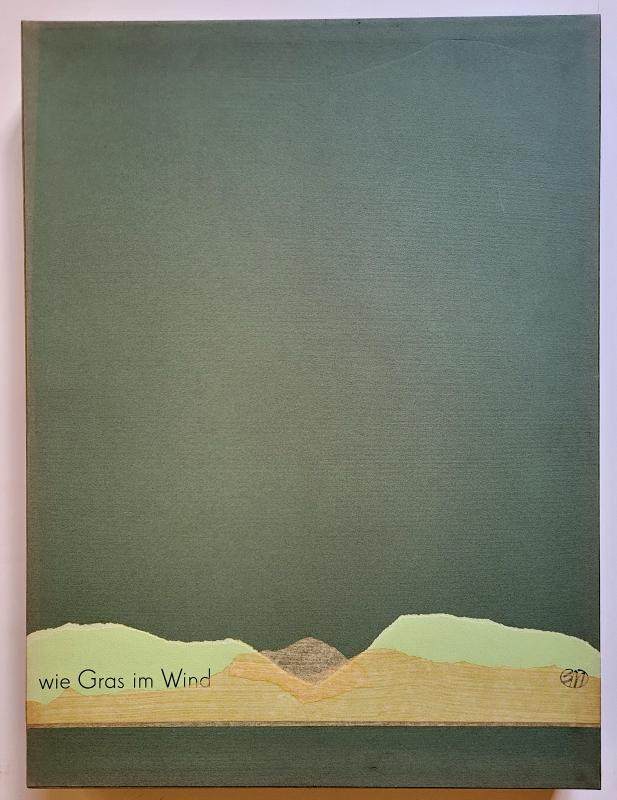
Visuelle Gedichte/Palermo fünf Miniaturen. Serie von 5 Folienprägedrucken von Blinky Palermo. Hundertdruck XII. Guido Hildebrandt Verlag, Duisburg 1972. 28 Bll. Fol. Je Folienprägedruck auf festem Aquarellpapier. Je signiert. - In Schuber (etw. gebräunt und mit partiellen Bereibungen.) – Jahn, Palermo 28. - Exemplar außerhalb der Auflage von 100. - Selten. Herausragendes Mappenwerk von Heinz Gappmayr und Blinky Palermo, dessen Oeuvre von einer konsequenten Auseinandersetzung mit Raum, Farbe und Form geprägt ist. Heinz Gappmayrs Visuelle Gedichte / Palermo fünf Miniaturen lässt sich als Schnittstelle von Sprache, Schrift und Bild lesen. Literaturhistorisch steht das Werk in der Tradition der konkreten und visuellen Poesie, in der Sprache nicht mehr vor allem Bedeutungsträger im linearen Sinn ist, sondern als Material, Form und Anordnung auf der Seite erscheint. Der Titel selbst verweist auf diese Doppelbewegung: Gappmayrs poetischer Begriff der "visuellen Gedichte" trifft auf Palermos streng reduzierte, kleine Bildzeichen, sodass Sprache und Bild in einen offenen Dialog treten. Kunsthistorisch gehört die Arbeit zu Blinky Palermos seltener früher Druckgrafik und zu seiner konsequenten Erforschung von Reduktion, Fläche und Form. Die fünf Miniaturen sind keine expressiven Einzelbilder, sondern präzise, seriell angelegte, kleine Prägedrucke, die Nähe zur Minimal Art und zur konzeptuellen Kunst erkennen lassen. Entscheidend ist hier weniger das Motiv als die körperliche Präsenz des Materials: Prägung, Papier, Rhythmus und Reihenfolge erzeugen eine stille, aber genaue Bildsprache. Im historischen Kontext der frühen 1970er Jahre zeigt sich darin eine Kunstauffassung, die sich von narrativer Darstellung entfernt und stattdessen mit Ordnung, Wiederholung und Zeichenhaftigkeit arbeitet. Palermos Arbeiten dieser Zeit werden oft als "konkrete" oder "essentielle" Malerei verstanden: Bild wird nicht abgebildete Welt, sondern eine klar gesetzte visuelle Relation. In Verbindung mit Gappmayrs visueller Poesie entsteht so ein Werk, das zwischen Literatur, Grafik und Objektkunst vermittelt. - Der Band innen ausgesprochen frisch und tadellos schön mit brillantem Druck, die Farbe satt und intensiv. An outstanding portfolio by Heinz Gappmayr and Blinky Palermo, whose work is characterized by a consistent exploration of space, color, and form. Heinz Gappmayr's *Visual Poems* / Palermo's *Five Miniatures* can be read as an intersection of language, writing, and image. From a literary-historical perspective, the work stands in the tradition of concrete and visual poetry, in which language is no longer primarily a carrier of meaning in a linear sense, but appears as material, form, and arrangement on the page. The title itself refers to this dual movement: Gappmayr's poetic concept of "visual poems" meets Palermo's strictly reduced, small pictorial symbols, so that language and image enter into an open dialogue. From an art-historical perspective, the work belongs to Blinky Palermo's rare early printmaking and to his consistent exploration of reduction, surface, and form. The five miniatures are not expressive individual images, but precise, serially arranged small embossed prints that reveal an affinity with Minimal Art and conceptual art. What is decisive here is not so much the motif as the physical presence of the material: embossing, paper, rhythm, and sequence create a quiet yet precise visual language. Set against the historical backdrop of the early 1970s, this reflects an artistic approach that moves away from narrative representation and instead engages with order, repetition, and symbolism. Palermo's works from this period are often understood as "concrete" or "essential" painting: the image becomes not a depicted world, but a clearly defined visual relationship. In conjunction with Gappmayr's visual poetry, this results in a work that bridges the gap between literature, graphic art, and object art. - The volume is exceptionally fresh and impeccably beautiful inside, with brilliant printing and rich, intense colors.

Sachgebiete: Graphik, Kunst nach 1945 , Pressendrucke, Typographie, Vorzugsausgaben

30.07.2026 - 18:05

10500,- EUR

Jeschke Jádi Auctions Berlin GmbH

...

WEIR, JOANNE [WEYER, JOHANN]

EXPANDED EDITION - INCLUDES THE INDEX OF DEMONS De Praestigiis Daemonum, Et Incantationibus ac ueneficiis,  Fourth edition, [2], 3-697, [55]pp., woodcut printers device to title, early ownership mark to title, early ink marginalia and underlining, later endpapers, later vellum over boards, hinges repaired, 8vo (183 x 120mm), Basel: Oporinus, 1568. “Those who err should be brought gently home, not incarcerated with punitive ferocity.”  Johann Weyer, a respected Lutheran physician at the court of William III, was one of the first to protest against the persecution of witches. He is considered "the founder of medical psychiatry" (Garrison-Morton), and a human rights defender avant la lettre. He published on rare diseases and sexual abuse. Weyer influenced contemporaries such as Michel de Montaigne and later thinkers such as Victor Hugo, Karl Marx and Sigmund Freud. After studying at the University of Paris, Weyer apprenticed under Agrippa of Nettesheim from 1530 to 1534. The poetic, mysterious and liberal-minded Agrippa was also an outspoken critic of witch persecution.  Weyer sought to derogate the law concerning witchcraft prosecution, using two forms of thinking. He argued that those accused of practising witchcraft were mentally ill - suffering from “melancholia” - and the confessions they made were actually delusions of the mind. By arguing that the moral weakness in women made them easy prey to Satan’s temptations, Weyer started one of the most vigorous and enduring controversies surrounding demonology and the witch in the early modern period. Weyer powerfully argues the case for leniency to the repentant and eloquently rejects the assimilation of witchcraft to heresy. He insisted that women were neither helped nor healed by torture or burning, but that they rather needed the healing power of prayer, religious instruction, medical intervention, and meditative isolation. He bolstered this attack on realist demonology with medical authorities as well as his own clinical experience as a practising physician. Whilst he is right to insist on the relevance of medical diagnosis in many cases of witchcraft, medicine was then too primitive to suggest convincing explanations. Weyer’s most important contribution in the field of medical diagnosis may be the understanding that undernourishment was the cause of much witchcraft melancholia.  Medical and juridical objections often went hand in hand. Weyer challenged demonologists on a legal terrain, attacking the prosecution's reliance on a confession, the point where demonology’s theoretical and practical endeavours converged. Weyer attempts to demolish various witch confessions, notably he publicly attacked the trials of the Wurttemberg preachers, attesting they were illegal, since the death penalties could be imposed only in cases of maleficent magic, not for mere fantasies. Weyer was careful to specify that he did not doubt the reality of witchcraft, but only its relevance to the majority of prosecutions.  Weyer has become a symbol of courage and lucidity in the face of intolerance and ignorance, but he was not quite as radical as it would seem. Despite Weyer’s appeal for a greater tolerance towards alleged witches, he also wants greater severity towards male magicians, who Weyer perceived as actual practitioners of natural or demonic magic. It has been suggested that in its very conception, this work is an ideological attack on Catholic idolatry and superstition, rather than a radical stand against the cruel persecution of witches.  The reaction to De Praestigiis Daemonum was formidable. Weyer had chosen to publish his book precisely at the moment when the witch-craze, after a long lull, was beginning again. That, indeed, was what had provoked him to write. But this Erasmian Platonist was no longer heard by a generation that had repudiated Erasmus. A fellow physician might hail him as a prophet of enlightenment, but his other readers thought differently. Weyer was told by his friends that his book must be destroyed or rewritten; by his enemies that he was a lunatic.  Yet Johann Weyer shaped opposition to witch hunting for generations. Demonologists who wrote after him took care to demolish his arguments, and Bodin’s famous Demonomanie de sorciers includes a lengthy rebuttal of De praestigiis. Yet as they engaged with Weyer’s ideas, their own thought was shaped by his. [ADB XLII, p. 266; Garrison-Morton 4916; Robbins (1972), Encyclopedia of Witchcraft; Thorndike, L. (1941). A History of Magic and Experimental Science, pp. 515-516.; Witchcraze, Terror and Fantasy in Baroque Europe, Roper, 2004; Witches, Devils, and Doctors in the Renaissance: Johann Weyer, Mora, 1991; The Oxford Handbook of Witchcraft in Early Modern Europe and Colonial America, 2013; Ideas and Cultural Margins in Early Modern Germany, 2009; The Damned art : essays in the literature of witchcraft, 1977] 

Sachgebiete: Jura, Occulta, Theologie

30.07.2026 - 17:52

8700,- EUR

Marshall Rare Books

...

VOLCKMANN, GEORG ANTON.

BOTANICAL MANUSCRIPT WITH 245 WATERCOLOURS OF WILD AND GARDEN FLOWERS OF SILESIA Sciagraphia et Icones Plantarum Indigenarum, maxime vero Exoticas jum turissimo labore collectarum à vivis depicta additis synonymis et locus natalibus singulari industria et penicillo … A Very Fine Herbarium and Botanical Folio with 245 Full Page Watercolours with Manuscript Descriptive Text Leaf to Each Drawing. Finely executed and carefully coloured drawings with manuscript captions and descriptive manuscript text leaf to each watercolour. Extensive manuscript with 245 Watercolours of Garden Flowers; Wild Flowers and Plants of Silesia. Legnica/ Silesia circa 1690/1700 , Folio (320 x 220 mm). with Manuscript title, 254 Latin descriptions all but 10 on separate leaves, mostly interleaved, 245 watercolours on 245 leaves, Later calf with gilt printed morocco label on cover: “Hr Ct Dubois. Buttes”, Title page a little stained and mounted at time of binding, overall in excellent condition. The 245 full-page watercolours executed in gouache and opaque colours are titled in ink with latin names Extensive, yet unrecorded botanical manuscript on the Silesian wild and garden flora by the well - known Silesian physician and naturalist Georg Anton Volckmann (1664 - 1721), who is still known today as the author of the geological work ‘Silesia Subterranea’, printed in 1720, which includes elaborate sketches of fossils including Carboniferous plants from the Lower Silesia region.  Georg Anton Volckmann was the son of the botanist Israel Volkmann (1636 - 1706), whose fundamental collection ‘Phytologia magna’ he continued. The series on the Silesian wild and garden flora, comprising a total of 10 volumes was written between 1666 and 1716, but never printed; the manuscripts are now in the Saxon State and University Library (SLUB) Dresden: Mscr.Dresd.B116-125.  The renowned Liegnitz physician Dr. Israel Volckmann and subsequently his son Dr. Georg Anton Volckmann wrote the manuscript in their own hands and illustrated the work with plant depictions, sometimes accompanied by insects, after nature in watercolours and opaque colours. The names commonly used in older botanical literature and the medicinal uses of the plants are recorded on the reverse of the nearly 3.600 leaves. The work was intended for publication but would have been too expensive because of the many copper plates required.  This manuscript might be a condensed or shorter version of these 10 vols. also intended to be published which however never happened. Georg Anton Volckmann was born in Liegnitz/ Legnica in 1663, studied medicine (where is unknown; only his stay in Padua is known) and settled as a doctor in Legnica/Silesia around 1687. His father was the doctor Israel Volckmann, born on 6 December 1636 in Nikolstadtnear Legnica, where his father was a priest from 1630-1633, attended the town school in Legnica, then the Elisabeth gymnasium in Wroclaw, studied medicine and philosophy in Leipzig from 1655 to 1659 and, after a stay in Italy, settled as a doctor in Legnica in 1660 or 1661, his mother was Ursula Marianne née Schultheß. His father introduced Georg Anton to botany at an early stage and, from 1687 onwards, entrusted him with the continuation of his ‘Phytologia magna’ (vol. I, 1666/68; II, 1668/70; III, 1670; IV, 1671/77; V, 1678/85), a large manuscript work with his own plant drawings, which his son enlarged by a further five volumes (VI, 1678/85). 5 volumes (VI, 1686/89; VII, 1689/91; VIII, 1692/97; IX, 1698/1703; X, 1704/18). Georg Anton’s drawings are more artistic, his locations more varied than those of his father, who died in Legnica on 5 February 1706. This magnificent work came with G. A. Volckmann’s collection to Dresden, first to the Zwingers collection of vegetation, later to the State Library. G. A. Volckmann explored Silesia on numerous journeys; he recorded his mineralogical, geological and prehistoric observations in ‘Silesia subterranea’ (Leipzig 1720). He also produced a handwritten ‘Historia Conchyliorum’ and an ‘Ornithologia’ (before 1712, now lost) as well as a collection of Silesian town coats of arms drawn by him. He analysed the water of the Hedwigsbrunnen fountain discovered in the Grüntal valley near Legnica; in 1716, together with Maximilian Preuß, Gottfried David Mayer and Gottfried Ernst Wilhelm, he described the health springs in Skarsine. He undertook excavations at Töpferberg in 1697/98 and 1707, at Simsdorf near Legnica in 1712 and at Großendorf near Steinau in 1716.  Volckmann died on 21 March 1721  Reference: H. Neumann, ‚Liegnitzer Naturforscher’ in Mitt. d. Gesch. u. Altertums Ver. Liegnitz, Heft 8, 1920/21, Liegnitz 1922, p. 246-262); Heinrich Robert Göppert, Über ältereschlesische Pflanzenkunde als Beitrag zur vaterländischen Kulturgeschichte, Schles. Provinzialbl., 96, pp. 1–27. Provenance: Maybe looted property in the Napoleonic Wars, as an ownership note of a French officer ‘à l’ Etat major du 5 corps d’ armée à Breslau, le 12 may 1808 is on the title. Later added ownership note “à Ami Dubois”, dated July 1836; since then privately owned in Switzerland.

Sachgebiete: Papier/Buntpapier, Botanik, Handschriften, Naturwissenschaften

30.07.2026 - 17:50

58500,- EUR

Marshall Rare Books