Rare Books Berlin - Internationale Messe für Bücher und Graphik

...

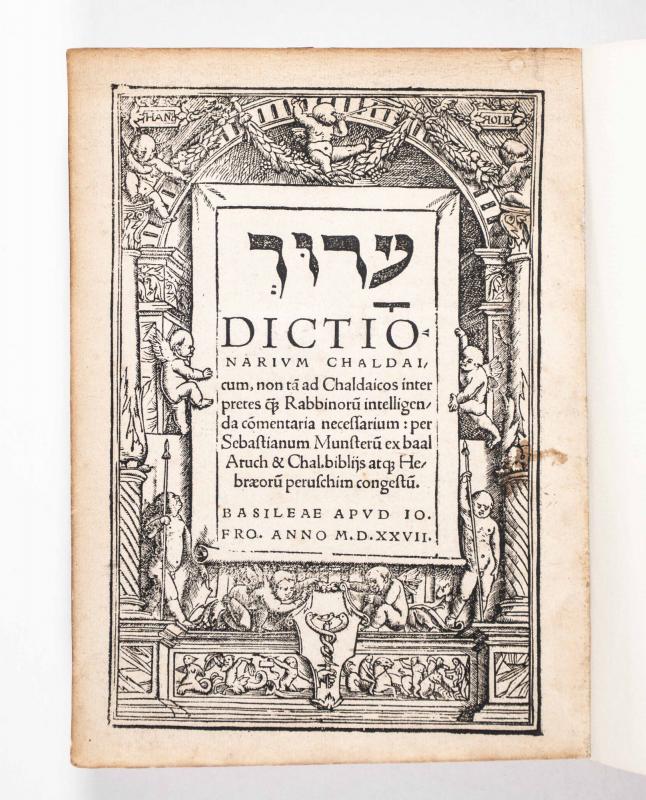
Munster, Sebastian. Arukh: Dictionarium Chaldaicum

Basel. Johann Froben. 1527. First edition. Small quarto: a-z, A-2H4, 2I6 (=222 leaves). [8], 434, [2]pp. Recent wrappers. Mild embrowning at margins, light dampstain at final leaves, else a fresh, clean copy. First edition of Sebastian Münster's Aramaic-Latin dictionary to the Targumim and Rabbinic literature. The first Aramaic dictionary edited by a Christian scholar, it is based primarily on the Arukh of Nathan ben Jehiel of Rome (1035-c.1110). "Through quotes and commentaries it explains the myriad of difficult terms and concepts in the Talmud and the Midrash collections. It is a work for advanced Talmudists and was widely used. The sizeable Aruch was also one of the first Hebrew works to be printed (Rome, c. 1470) and Christian Hebraists made use of it in their study of rabbinical literature" (Heb. Veritas Cat., 37). The celebrated polymath, cosmographer, astronomer, and Semitic language scholar Sebastian Münster (1489-1552) was born in Niederingelheim, Hesse, the son of a hospital master. Apart from some private instruction in Latin and later studies at Freiberg, along with attendance at lectures given by the Franciscans, he had no university education. After entering the Minorite order in 1506 was sent to study in Rufach under Konrad Pellikan. Münster assisted Pellikan in teaching at Pforzheim and occupied the chair of Hebrew at the University of Heidelberg from 1524 to 1529. After converting to Protestantism in 1529, he moved to Basel where he would occupy the chair of Hebrew for twenty-three years. "Sebastian Muenster was one of the first Hebraists who, by his numerous publications, firmly embedded Hebrew in protestant theology. Although he did not travel as widely as Reuchlin, Widmanstetter and, later, Masius, his unremitting industry in his home town Basle produced an astounding series of publications which provide a good view of the breadth over which the subject manifested itself" (Heide). "From about 1525, Muenster was a student of Elijah Levita, translating and editing his grammatical works. Muenster also translated a number of other Hebrew works into Latin... His jewish oeuvre, more than three-score publications, covered all aspects of Judaica, excepting Kabbalistic studies..." (Heller). Apart from his grammar books, Münster was the author of no fewer than five dictionaries in which Biblical Hebrew is usually combined with Aramaic and post-biblical Hebrew. Münster dedicates the Dictionary to the Bishop of Rochester in Kent, for his appreciation of the theological sciences. The foreword emphasizes the value of the grammatical and lexicographical writings of Elijah Levita and the Arukh from which he takes the title. Not having access to the earlier editions of Nathan ben Yehiel's rabbinic lexicon printed at Rome and Pisarro, Münster mistakenly believed the Arukh to be the work of a German Jew. J. Perles was later able to identify the German manuscript from which Münster worked (Prijs). In addition to this Latin adaptation of ben Yehiel's rabbinic lexicon, Münster's and accompanying Aramaic Grammar in the same year. The woodcut title border of cherubim cut by Hans Holbein is here reused after its appearance in De optimo reipublicae (Thomas More's Utopia; 1518) and Martin van Dorp's commentary on St. Paul's Epistles (1516). Provenance: Entry at colophon, “Calend. Januarij 1570 dono accepi hunc librum cum paraphrasi Campensis in Psalmos, ab adolescente amico L.C.G. in nominis ipsius memorium”; old owner’s entry in different hand and ink, “David Dasmeres/Dasnières [?]" #48853

Sachgebiete: Bibeln, Judaica, Judentum, Religion, Renaissance

01.08.2026 - 00:48

3250,- EUR

Eric Chaim Kline Bookseller

...

Khazin, S. B. (Engraver); Maxim Petrovich Dmitriev (Photographer). M. Gor'kii. Rasskazy "Mal'va" T. III-II [Folio Cyrillic Micrographic script portrait of Maxim Gorky]

Kiev. NP. 1903. First edition. Folio. Size approx. 28 x 20 inches (50 x 70 cm). Rare micrographic portrait of Maxim Gorky composed from the letters of his short story Malva. The portrait was engraved by S. B. Khazin based on a photograph of the famous Russian author taken in Nizhny Novgorod by the Russian photographer Maxim Petrovich Dmitriev and printed by S. V. Kul'zhenko. Portrait passed by the censor in Kiev, 23 February 1903. The technique of portraiture using words and letters first appears in Russia in 1900 with Khazin's portrait of Count Leo Tolstoy which used 4700 characters to form the work. His second portrait in this style was the present work, that of Gorky, which used the approximately 82,000 cha33059 lume of Gorky's story, as identified in the title. Little is known of Khazin except that he was mostly likely born near the town of Yarysheva Mogilev-Podolsk in the Ukraine, and that he had his portraits printed in Kiev. His technique consisted of using a well-known photograph, leaving the face untouched but washing away everything else except for an outline of the original. He then drew the portrait using the handwritten text, with the individual letters usually less than a millimeter in height, all of which needed to be engraved in mirror image so that it could be read once the print was struck. Not found in OCLC or any major European libraries. There is a copy at Centraljnaya Gorodskaya Biblioteka im. A.M. Gorjkogo, Krasnoyarsk, Russia. Sporadic and minor closed tears along edges (not affecting portrait). Moderate age-toning along edges (not affecting image). Print in overall very good condition.

Sachgebiete: Deutschland, Moderne Kunst, Nationalsozialismus, Photographie, Plastik

01.08.2026 - 00:46

4500,- EUR

Eric Chaim Kline Bookseller

...

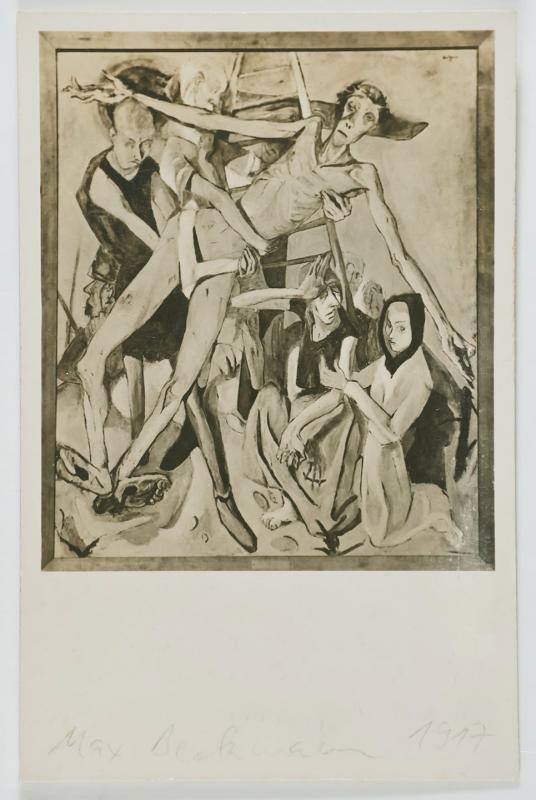
Beckmann, Max. Kreuzabnahme [PRINTED PHOTO-POSTCARD FROM THE ENTARTETE KUNST EXHIBITION, SIGNED BY MAX BECKMANN]

München. NP. 1937. Postcard (5 1/2 x 3 5/8"). Original sepia toned photo-postcard (original photograph) featuring a reproduction of Max Beckmann's painting "Kreuzabnahme", protected in mylar sleeve and taped to cream color mat. Text on verso of the postcard is visible. Printed "Ausstellung Entartete Kunst" on verso with handwritten description of camera movements for a film shoot. Exhibition organized by Adolf Ziegler and the Nazi Party opening on July 19,1937 in Munich. The original painting was rendered in oil on canvas, in 1917. Signed in pencil by Max Beckmann at the bottom of the "Max Beckmann, 1917". Verso of postcard with penciled text: "Kamera geht weiter vom Knaben weg (andere Seite) Pflanzen Ornam. Tiere fantastische Formen feuerwerkartig übersteigert, wie Anfang nur gesteigerter. Kamera geht ab zurück zum Knaben (Knabe wirkt größer. Ein ...(B or Rab?) kommt ins Bild Knabe pflückt ein Blatt, gibt es ihm. Kamera geht vom Knaben weg. Absolute Filmszene noch gesteigerter als die beiden ersten. Kamera schwenkt zurück zum Knaben. Knabe erwachsen Jüngling. Er wendet sich ab von den ... (Dl?) Tieren Formen (abweichende Bewegungen). Die Blumen verdorren und verschwinden die Tiere und Ornamente verschwinden. Eine weite unendlich weite Ferne entsteht. Er geht weg. ... (Scene?erte?) wird öde und leer ... (d(t)rocken) verlassen. TZ" #48271

Sachgebiete: Germanistik, Graphik, Kunstgeschichte, Moderne Kunst, Nationalsozialismus

01.08.2026 - 00:44

2750,- EUR

Eric Chaim Kline Bookseller

...

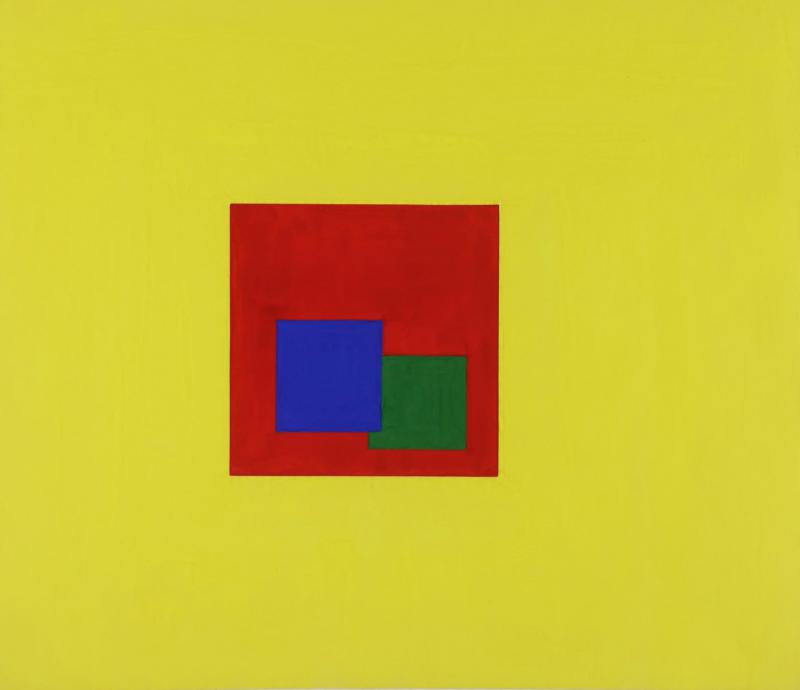
Fischinger, Oskar. 23 Original Tempera on Paper for the Abstract Animation Film "Quadrate / Squares"

Berlin. 1934. Original artwork (12 1/8 x 11 5/8"). Twenty-three paintings representing a substantial part of Oskar Fischinger's short film "Quadrate (Squares)," a four minute silent 35mm abstract animation film in color. The 271 separate "frames" for this film were painted in tempera on paper by Oskar Fischinger in July 1934, as cited by William Moritz, in "Optical Poetry The Life and Work of Oskar Fischinger," 2004. Moritz further suggests that some of these paintings may have been done a little earlier. "The drawings are numbered 1-2505 to 1-2776, indicating perhaps that they were once planned as part of a larger film... Fischinger had these 271 drawings photographed and loop-printed so that they appeared several times in the same and different colour combinations, positive and negative (which was easily possible by manipulating the filters used to print out the three-color separation master)... the serene flow of squares shaped in different colours is one of Fischinger's most striking, interesting and important compositions, prefiguring 'Radio Dynamics.' The animation paintings, like those of Kreise, are each artworks in themselves, prefiguring the balancing squares of Josef Albers." (William Moritz, as above, pages 221/2) Our 23 tempera paintings are not framed and are all stamped "Nachlass Oskar Fischinger" in the top margin. Thirteen paintings are in fine condition, incl. ## 2510, 2517, 2518, 2525, 2543, 2546, 2570, 2573, 2606, 2608, 2610, 2694, 2698. The following paintins with minor to medium blemishes as described: #2547 (1/2 x 1" light water stain at bottom edge right corner), 2567 (minor 1 x 1/8" water exposure at right lower corner), 2584 (minor, less than 1/8" wide border due to water exposure along most of bottom edge, and small water stains in orange), 2597 (1/2 x 3" water exposure), 2612 (small water stain 3/4" in diameter in blue-green square), 2679 (light 1/2" minor surface crack at upper left corner), 2688 (small area with minor ruffling, and 1/2 inch closed tear at right edge), 2691 (minor fraying along left edge), 2716 (minor blemish at bottom right, red edge), and 2724 (small water stain in blue square). Inspired when viewing Lichtspiel Opus (Play of Light), a 13 minute film of nonobjective color effects by Walter Ruttmann in 1921, Oskar Fischinger embarked on a most illustrious career as a filmmaker. Using skills from his background as an engineer he invented the so-called "Wax-Slicing Machine" to create abstract imagery for film. Fischinger also produced several films for advertising purposes using abstract animation techniques, particularly after the Nazis had taken power. Best known is his cigarette commercial "Muratti greift ein (Muratti Intervenes)." Oskar continued to produce numerous abstract animation films, now often referred to as "Optical Poetry" or "Visual Music," many times synchronizing the abstract imagery of his films with classical music. His 1934 film "Quadrate, one of Oskar's most daring experiments... was designed specifically for the GasparColor process, which used a three-color separation negative." (William Moritz. Optical Poetry, pp. 54,55). Fischinger's manipulation of filters, combined with loop printing allowed for the imagery to appear in variant sequences. Life under the Nazis regime became more and more difficult for the Fischingers. Oskar was arrested twice but, with the help of friends, was released within days. Anonymously his film "Komposition in Blau" (Composition in Blue) had been admitted to the 1935 Venice Film Festival. Despite its popularity it did not win due to the fact that Reichsfilmkammer President Fritz Scheuermann was a member of the jury. Later in 1935, an MGM agent had brought two of Oskar's films, "Composition in Blue" and "Muratti greift ein," to the attention of Ernst Lubitsch. As a result Lubitsch sent the agent back to Berlin to hire Oskar to work for him. Arrangements were made for Oskar to leave for Hollywood immediately, and Elfriede and their sons followed two month later. While working for several studios in Hollywood, Fischinger kept producing "Optical Poetry" and gradually turned to nonobjective painting. Fischinger is considered by some as a man ahead of his time. Among other capacities he is credited to be "an inventor of the music video, and prophet of Op Art as well as contemporary computer-generated motion graphics." (Nathan Vonk) His film "Composition in Blue" was awarded the King's Price at the Brussels International Exposition in 1935. In 1938 MGM released Fischinger's "Optical Poem." It was shown all across the world. His 1947 "Motion Painting No. 1" won the International Film Competition in Brussels in 1949. Fischinger's extensive work as a filmmaker is documented superbly in publications by William Morris, see above, and Cindy Keefer and Jaap Guldemond in "Oskar Fischinger 1900-1967. Experiments in Cinematic Abstractions."

Sachgebiete: Film, Kunstgeschichte, Moderne Kunst, Ornamentik, Aquarelle

01.08.2026 - 00:34

100000,- EUR

Eric Chaim Kline Bookseller
...

Broughton, Hugh; Saadiah Gaon. Daniel His Chaldie Visions and His Ebrew, Both Translated after the Original [WITH THE FIRST HEBREW TEXT PRINTED IN LONDON, A POEM BY SAADIAH GAON]

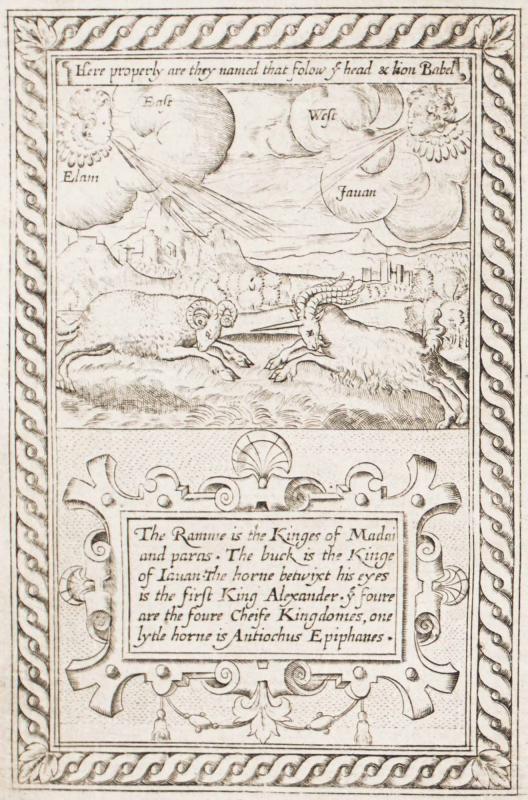
London. Printed by Richard Field [and Gabriel Simson], for William Young. 1596. First edition. Small quarto. [asterisk]4, A-K4, (2nd) H4, L-P4, 68 leaves. [136]pp., 3 (of 4) engraved plates. Woodcut anchor device at title; printed marginalia; woodcut lettrines. English text in black letter, italic, and roman type, some Hebrew and Greek passages, including a Hebrew poem (K3-4) printed in double columns with alternating red and black stanzas. A few early manuscript annotations. Recent wrappers (housed in professionally fitted clear mylar covers). Occasional mild (mostly marginal) dampstains, bottom corner A3 lacks 1-inch section (with no loss of text). A very good, amply margined copy, lacking one of the four engraved plates. First Edition of this translation and commentary on the biblical book of Daniel by the English puritan divine and Hebraist, Hugh Broughton (1549-1612), including the Hebrew text of Saadiah Gaon's Shir shel ha-Otiyyot. Tutored in Hebrew by the renowned French Hughenot scholar, Antoine Rodolphe Chevalier (1507-1572), “Broughton graduated at Magdalene College, Cambridge in 1570, became a Fellow of St. John’s, and then moved to Christ’s College. A disagreement with John Whitgift, archbishop of Canterbury, over the interpretation of scripture, persuaded Broughton to go to Germany in 1589, and apart from brief periodic visits to England he appears to have stayed on the continent until the last year of his life. While Broughton was abroad he engaged in religious discussions with Jews in Hebrew and made the acquaintance of several eminent Christian scholars including Joseph Justus Scaliger. He conducted a debate in the Frankfurt synagogue with a Rabbi Elias. He also records a dispute with Rabbi David Farrar. The close association which he developed with Jews and Christian Hebraists was a significant factor in his linguistic attainments, especially in a grasp of rabbinics unusual for an Elizabethan scholar... For the last twenty years of his life Broughton sought in vain to gain the support of the authorities for a new English translation of the Bible... Broughton’s writings demonstrate that he was an accomplished Hebrew scholar, who may justifiably be regarded as the most proficient English Hebraist of his day. Not only was he able to read the Old Testament in the original, he was familiar at first hand with a wide range of post-biblical Jewish authors... In addition to Targum and Talmud, he insisted that other Jewish writings must be regarded as indispensable to anyone engaged in translating the Bible. In a footnote to his Treatise of Melchisedek (1591) he listed no fewer than twenty-two Jewish sources which the serious student of the Hebrew scritptures might consult to his advantage” (ODNB). While Broughton’s contentious nature and controversial style alienated many of his contemporaries -- Scaliger described him as “furiosus et maledicus” (Van Rooden) -- his scholarship could not be doubted. In his 1824 Bibliotheca Biblica, William Orme notes that the celebrated Hebraist, “with a considerable portion of quackery, and a large portion of ill-nature, had certainly a respectable acquaintance with biblical literature... and it is alleged, was much displeased because he was not employed as one of the translators of our present English version of the Bible.” As a typographical monument the present work is highly notable, containing “the first protracted Hebrew text printed in London” (Roth). Hebrew printing had only just made its debut at the Cambridge press three years earlier in Andrew Downes’ 1593 edition of Lysias. As “[a] keen defender of the Hebrew verity” (Orme), Broughton here makes a remarkable selection of text as evidence for “The certaintie of the Ebrew,” deploying an acrostic poem by Saadiah Gaon (882-942), the greatest scholar and author of the geonic period, and an important leader of Babylonian Jewry. The poem, Shir shel ha-Otiyyot (Poem of the Letters) is printed in alternating couplets of red and black, and gives by means of words and biblical allusions the number of times that each particular letter of the alphabet occurs in the Hebrew scriptures. The engraver of the Hebrew fonts is quite possibly Jodocus Hondius the Elder, whom Broughton first met in 1583 after Hondius had fled to London from his native Ghent in the wake of Spanish persecution of protestants in the Low Countries. The engraved plates in the present work are attributed to Hondius, and appeared earlier in Broughton’s first book, A Concent of Scripture (ca. 1587-1591). As it happens, the first printed Hebrew texts to appear in Amsterdam occur in several books by Broughton, printed in 1605 and 1606, whose fonts were certainly engraved by Hondius (Fuks/Fuks-Mansfeld). While the type used in the present work, with its distinctively angled lamed, does not match those of the Amsterdam publications, it bears some similarity to Fuks Br. Squ. 2. Annotations: At the conclusion of the imprint, following “... where the other workes of the same author are to be sold” appears a contemporary manuscript notation “at ye Rose” #48834

Sachgebiete: Bibeln, Judaica, Judentum, Literatur bis ca. 1900, Renaissance

01.08.2026 - 00:13

6500,- EUR

Eric Chaim Kline Bookseller