Rare Books Berlin - Internationale Messe für Bücher und Graphik

...

HIERONYMUS de Villa Vitis

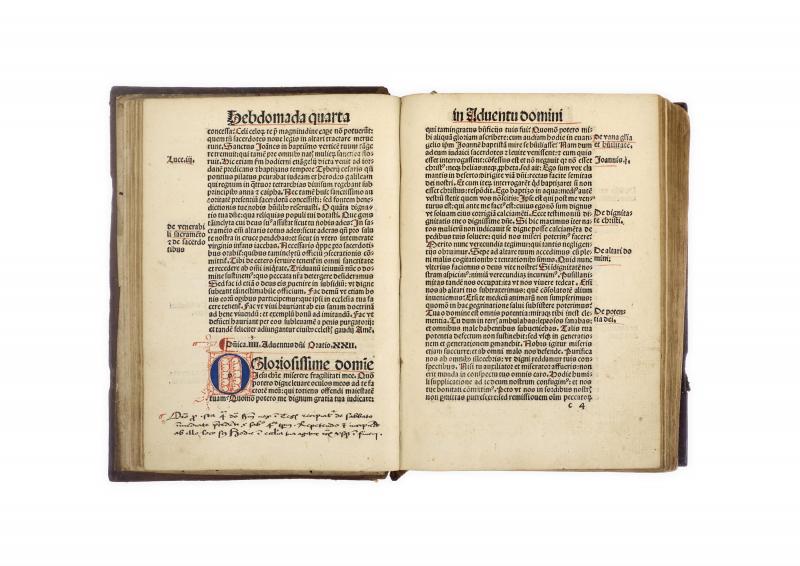
Panis quotidianus de tempore [– de sanctis scilicet pars hyemalis estivalis]. Iste liber i[de]o sic dictus est q[uia] quotidie p[er] totu[m] annu[m] [con]tinet speciale[m] oratione[m] cu[m] utilibus et eva[n]gelicis doctrinis insertis in q[ui]bus devotio et v[ir]tutu[m] dilectio faciliter hauriri poterit q[uia] p[re]cipua dilige[n]tia o[mn]ia illa p[ro] salute viventiu[m] edita. [(Colophon:) Hagenau, Heinrich Gran for Johann Rynmann von Öhringen, 1509.] Two parts in one vol., 4to, ff. I: [326], II: [304] (of 312, bound without first quire 2π8 containing the calendar); with blanks M8 and R8; capitals supplied in alternating blue and red by Paulus Wigg, some with pen flourishing and infilling, paragraph marks in blue and red, small capitals highlighted in red, underlining in red; some marginal wormholes at beginning of each part, occasional small marks, wormhole to outer margin of R8–aa5, D4.5 short at head, old marginal repair to E2, but overall a very good copy; bound at Tegernsee in near-contemporary calf over bevelled wooden boards (see below), boards roll-tooled and stamped in blind to a panel design, later paper labels to spine, fore-edge tabs, sewn on 3 pairs of cords with single kettlebands, spine lined with manuscript waste on vellum, several backfolds repaired before rubrication, quires numbered in Arabic numerals at backfolds; a little rubbed and scuffed, spine worn with losses to spine ends and some splitting to joints, wanting metal corner- and centrepieces, clasps, and catches, minor worming to endpapers; inscriptions to first title ‘1521’, and ‘HR 1524 Vital[i]s no[min]e’, ‘memento pauli wigg’ (in blue ink) with the date 1521 to aa2r and LL6r, a note signed by him ‘fr[ater] paulus wigg’ to Pp8r, a few neat contemporary annotations in black and red ink in Wigg’s hand, seventeenth-century inscription ‘Mon[aste]rij Tegernsee’ to first title, bookplate removed from front pastedown.

Sachgebiete: Einbände, Inkunabeln, Reformation, Religion, Theologie

29.07.2026 - 17:10

6500,- EUR

Bernard Quaritch Ltd.

...

PTOLEMAEUS, Claudius; translated by ANGELUS, Jacobus, and edited by Nicolaus GERMANUS

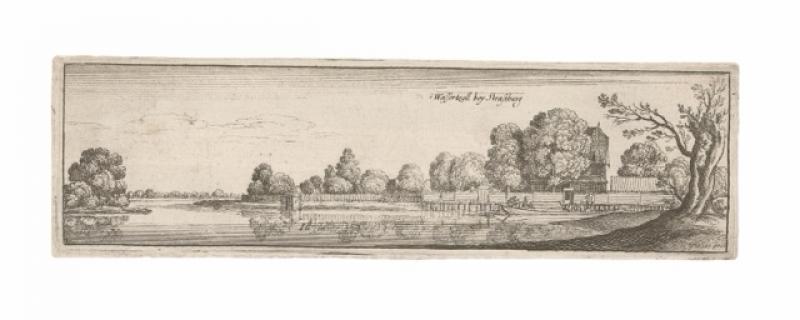
Cosmographia., 1482 Ulm, Lienhart Holle, 16 July 1482. Folio (428 by 310mm), 102 leaves, double- column, 44 lines and headline, Gothic letter, 32 double-page woodcut maps with fine original hand-colour, 4 woodcut diagrams in the text, 2 large illuminated historiated initials, one showing Donnus Nicolaus presenting his book to Pope Paul II, the other of Ptolemy, 159 other woodcut initials coloured in red, green and ochre, paragraph marks and initial-strokes supplied in ochre, tear to d6, and repaired tear to the map ‘Tertia Africa’, some dampstaining and discolouration throughout, including spotting affecting the final three maps, skilful reinforcement to weakened lower page corners on maps, single leaf free endpaper bearing ownership inscription; re- cased in contemporary doeskin over clasped oak boards, joints reinforced with vellum waste, remnants of one clasp remaining. [Bound after]: ‘Registrum’ from Johannes Reger’s 1486 edition of Ptolemy’s “Cosmographia”, decorated with 17 5- and 6-line manuscript initials in red and blue, 30 leaves bound in 6s (not 8s as is usually the case); 9 leaves in the ‘registrum’ uncut, tear to d6. Collation: [Registrum]: a-d(6), e(5); [Cosmographia]: [i], a10, b-g8, h11, 32 maps. Watermark: Late fifteenth century Italian watermark of a flower with 7 petals throughout, with the exception of the front endpaper/’initial blank’, which bears the watermark of an upper case letter ‘B’ on a crowned shield. These were used by the le Bé family of Troyes, in this case ‘Ioane le Bé’. Three members of the Troyenne papermaking le Bé family bore the Christian name ‘Jean’: Jean I started his business in 1406. Jean II owned two paper mills around the 1470s, and Jean III lived in Troye in the first half of the 16th century. The le Bé family were accredited papermaker for the Université de Paris from 1520 onwards.


29.07.2026 - 17:03

1400000,- EUR

Daniel Crouch Rare Books Ltd
...

Piet Zwart

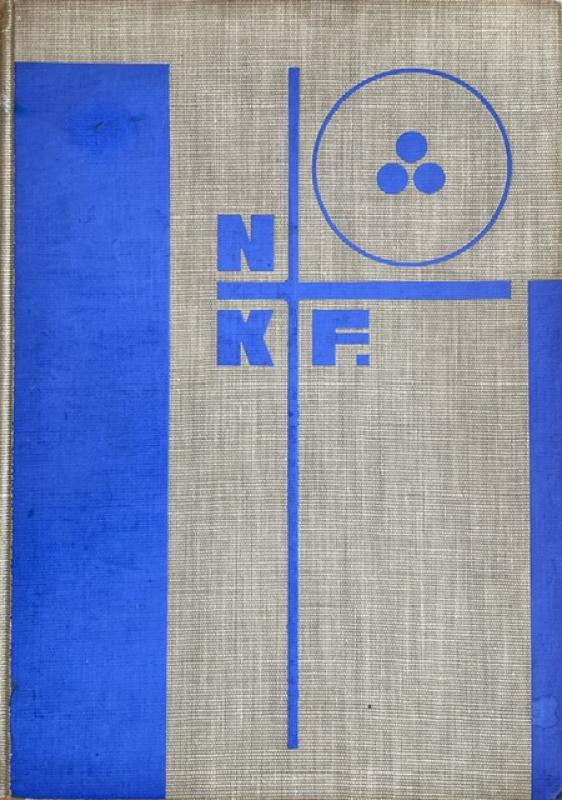
Piet Zwart, NKF. Delft, N.V. Nederlandsche Kabelfabriek, 1928, (80)p., tipped-in paper samples, printed in various colours w. typography, design, photogr. (photomontage) ills. and orig. stiff paper wrappers by PIET ZWART, large 4to. Printed by Drukkerij Trio, The Hague Deluxe Dutch edition: slight wear to the covers, a bumped corner, a stain on the back cover has been diminished, small touch-ups in the blue on the front. Else a very good copy. The rare trade-catalogue for the Netherlands Cable Works, generally considered the 'magnum opus' of Piet Zwart, WITH the loosely inserted EXTRA LEAF "?60 50? 60kM 50kV-kabel geleverd en in bedrijf (...)". Brentjens p.166ff; Broos p.46ff; Monguzzi p.39-59; Müller p.49-63 (odd pages only); Spencer p.124f; Purvis p.72ff; Purvis/ De Jong p.145; Broos/ Hefting p.86f; Andel p.209 and 264; Maan/ Van der Ree p.44; Rattemeyer p.100 ff. "In de zomer van 1926 schrijft Piet Zwart, dat hij bezig is met het ontwerpen van een catalogus 'waarin zeer opmerkelijke dingen komen, waarin ik allerlei experimenten uithaal, die, meen ik, nog niet vertoond zijn op reclamegebied'. Het is de catalogus van de Nederlandse Kabelfabriek, waarvan een nederlandse en engelse versie in 1928 en 1929 verschenen. De catalogus was inderdaad een 'zeer opmerkelijk ding'. De mogelijkheiden van een elementaire typografie, zoals Zwart die enkele jaren had kunnen uitproberen in de NKF-advertenties, werden hier aan één omvangrijk werkstuk gedemonstreerd, samen met de mogelijkheden van de door hemzelf tot op dat moment nog nauwelijks ontgonnen gebieden van fotografie, fotogram en fotomontage (...)" (Broos p.46). "(...) een van de hoogtepunten in Zwarts typografische carrière" (Brentjens p.168); "His first use of photographs was in the 1928-29 catalog for NKF in which he incorporated close-up cross-section photographs of electric cables. Products had never before been presented with such clarity. He achieved a dynamic balance between text, photograph, and white space on the page. Double-page spreads work as single compositions, and the catalogue is distinguished by dramatic contrasts, asymmetry and spaciousness" (Purvis p.72).


29.07.2026 - 16:48

22000,- EUR

Galerie Stylo

...

Hahnemann, Samuel; [Brunnow, Ernst George von]

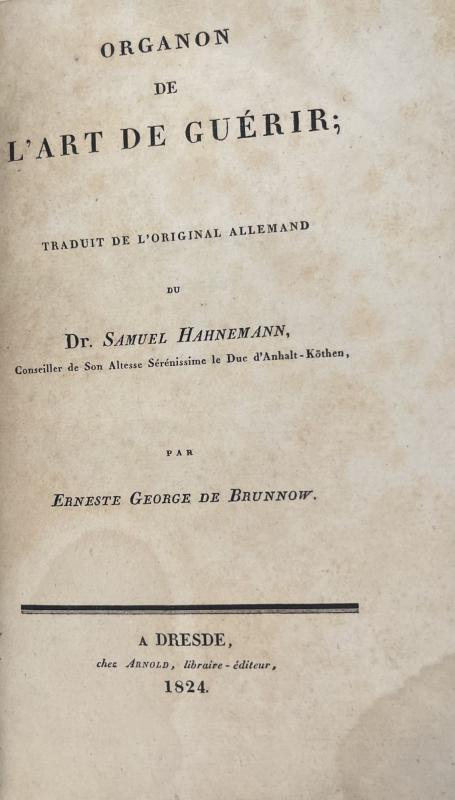
Organon de l’art de guérir; traduit de l’original allemand du Dr. Samuel Hahnemann Conseiller de Son Altesse Sérénissime le Duc d’Anhalt-Köthen, par Erneste George de Brunnow. a Dresde: chez Arnold, libraire-éditeur [a Berlin, de l’imprimerie d’Auguste Guillaume Schade, Alte Grün-Strasse No. 18.], 1824. First edition. In later red half Russia in period style, ribbed spine gilt; publisher’s blue wrappers preserved. [9] X–LXII [2] [1]–271 [1] p. Untrimmed at outer and lower edges, top edge gilt. Slight fading to upper front panel; light dampstaining to lower outer corner of first 20 leaves; title lightly foxed. A fine copy overall. First French edition of the foundational treatise of homeopathy, and the first translation of the Organon into any language—a key product of Romantic-era medical and intellectual reform. Samuel Hahnemann’s Organon, first published in German in 1810, introduced a radically different model of medicine based on the principle similia similibus curentur—“like cures like.” In contrast to the dominant “heroic” treatments of the time, it advocated a gentler, individualized approach grounded in close symptom observation and the use of highly diluted substances. The Organon codified a system that drew from Enlightenment rationalism while reflecting the Romantic search for harmony between nature, spirit, and healing. This 1824 edition is the first translation of the Organon into any language, based on the revised and expanded second German edition (1819). The translator, Baron Ernest Georg von Brunnow (1796–1845), though not a physician, was a key figure in the early promotion of homeopathy in Europe. Treated successfully by Hahnemann as a young man, Brunnow became a committed advocate. His translation was instrumental in spreading Hahnemann’s ideas to French-speaking audiences in France and beyond. He also contributed to the Latin translation of Materia Medica Pura and translated several of Hahnemann’s lesser writings into French. The edition opens with a dedication to Duke Frederick Ferdinand of Anhalt-Köthen, Hahnemann’s patron after his departure from Leipzig, followed by Brunnow’s introduction situating homeopathy within ongoing medical debates. It includes the prefaces to the first (1810) and second (1819) German editions, and concludes with a French translation of Hahnemann’s treatise on small doses, excerpted from volume six of the Materia Medica Pura. Published in the midst of a broader Romantic reconsideration of science, nature, and the human body, the Organon resonated with the period’s intellectual currents—from Goethe’s natural philosophy and Schelling’s vitalism to Alexander von Humboldt’s integrative vision of the natural world. Far from being an isolated medical anomaly, it was a product of its age: a synthesis of empirical observation and speculative thought shaped by the philosophical and cultural upheavals of early 19th-century Europe. Extremely scarce. The last recorded sale on Rare Book Hub dates to 1963. Institutional holdings are limited, with most copies located in France and Germany. Only a single copy is recorded in the United States (University of Wisconsin).

Sachgebiete: Erstausgaben, Homöopathie, Medizin

29.07.2026 - 16:48

6000,- EUR

Foldvaribooks