Rare Books Berlin - Internationale Messe für Bücher und Graphik

...

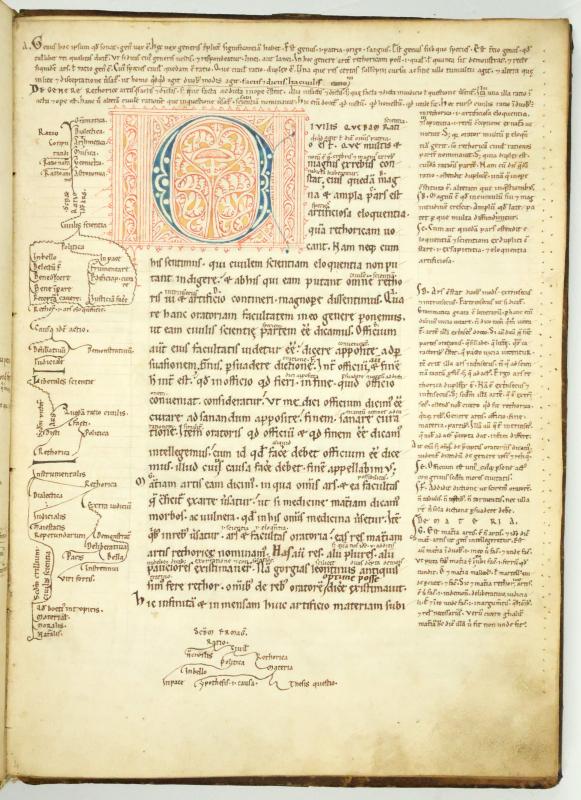
Maes, Petrus. Prooemium in Logicam Aristotelis [MANUSCRIPT: 17th-CENTURY ARISTOTELIAN SCHOOL CURRICULUM WITH ELABORATE CALLIGRAPHIC INITIALS]

Louvain. P. Maes. 1632. Twelve parts, quarto (20.5 by 15 cm). Dated manuscript on paper, 571 leaves; ca. 30 lines per page. Manuscript title in red on blank oval within engraved leaf with historiated borders. Neat cursive text in dark brown or black ink; red ink and elaborate calligraphic initials employed for the main sectional titles and further subdivisions. Contemporary calf (expertly rebacked), lettered in gilt, with stamped vignettes (dated 1632) at both boards. Green silk ties partially preserved. Occasional mild soiling. Leaves 17/18 and 259/260 partially stuck together due to offsetting of the titles; leaves 565-570 separated with some paper damage and minimal obscuring of the text. Overall, text about fine, composed in a neat hand on good quality paper, crisp and clean. Early seventeenth-century manuscript interpretation of lectures in Aristotelian logic given at the Falcon College of Louvain University, penned by Petrus Maes, originally from the Brabant village of Zichem. Relatively few such manuscripts survive from this era; the universities of Leiden and Louvain have mangaged to acquire collections numbering several dozen. Leaf 7 - Commentarius in Isagogen Porphirii - De Ar[istote]li Partib[us] Logicae. Leaf 72 - Liber praedicamentorum prooemium. Leaf 152 - Liber postpraedicamentorum Leaf 184 - Liber primus priorum prooemium Leaf 242 - Liber secundus priorum analiticorum Leaf 250 - Liber primus posteriorum analiticorum prooemium Leaf 293 - Praefatio in librum pro di dogmatum Leaf 358 - Prooemium in libros periermenias Leaf 432 - Liber secundus periermenias Leaf 446 - Liber primus topicorum Leaf 485 - Prooemium in reliquos libros topicorum Leaf 550 - Prooemium in libros elenchorum. The engraved leaf, which provides a blank oval for lettering, depicts at the top a coat of arms with crowned falcon, surrounded by two angels, and above two scholars or sages, each holding a book, at the bottom. The iconography refers to the Pedagogie De Valk. (Falcon College). Final Leaf 571 contains the chronogram: FIneM totIVs LI/bris posVIt DIVI/IgnatI VIgILIa #48965

Sachgebiete: Antike, Altphilologie, Griechenland, Philosophie

01.08.2026 - 01:05

9500,- EUR

Eric Chaim Kline Bookseller

...

(Vitruvius Pollio, Marcus). Rusconi, Giovanni Antonio. Della Architettura di Gio. Antonio Rusconi, con centosessanta figure dissegnate dal medesimo, secondo i precetti di Vitruvio, e con chiarezza, e brevità dichiarate libri dieci

Venice. The Giolito Press [Giovanni II & Giovanni Paolo Giolito de Ferrara]. 1590. First edition. Small folio (27.3 by 18.7 cm). Signatures: a-c2, A-Z2, AA-NN2 (= 78 leaves). [xii], 143, [1, blank] pp. Title set within elaborate woodcut historiated borders; full- and half-page woodcut illustrations, plans, and diagrams throughout (a list of 144 figures appears after the contents); initials and ornaments. Recent period-style vellum; spine lettered in gilt; yapp edges, exposed thongs. Margins trimmed; occasional mild stains or smudges (mostly marginal). A nearly fine, crisp copy. First edition, first issue (without errata) of "an unusual publication in the architectural literature of the sixteenth century [in which] a remarkably effective group of illustrations was married to an underelaborated text" (Millard). Antonio Rusconi (ca. 1520-1587) was introduced to the building trades and painting as a youth; he studied mathematics at the University of Padua under Giovanni Battista Memmo and Niccolò Tartaglia. He would serve as a hydraulic engineer for the Republic of Venice throughout his life. At the urging of Pietro Lauro, who had translated Leon Battista Alberti's De Architectura into Italian, Rusconi began in 1540 to prepare a translation of Vitruvius, with commentary, illustrated with more than 300 woodcuts. While his Venetian editors, Giolito and Tommaso Porcacchi, were accorded a publication privilege by the duke of Tuscany in March 1553, they decided not to publish the work, with so many editions of Vitruvius appearing at that time. After Rusconi's death in 1587, the Venetian publisher Giovanni Giolito decided to publish the woodcuts. Giolito died before the work went to press. "The commentaries to the illustrations published by Giolito's heir in 1590 were probably not by Rusconi, but the publisher may have desired not to waste the investment made in the already cut illustrations... The author refers constantly to Renaissance architectural theorists, such as Palladio, Bárbaro, Sebastiano Serlio, and Cesariano, turning the book into an extended discourse with a knowledgeable audience. Indeed, the author himself recognizes that the sketchlike quality of his publication disqualifies it as a fundamental teaching tool for architecture (p. 143: "poiche manco il fine e l'intention nostra è stata mai d'insegnarla con queste poche annotationi" [since our aim and intention has never been to teach it with these few annotations]). This author's main contribution is in the quality of the images... His illustrations display an unusual degree of independence from that of earlier commentaries on Vitruvius, revealing a marked anticlassical attitude (Millard). The military and civil engineer Marcus Vitruvius Pollio (ca. 70-80 BCE - ca. 15 CE) is the author of the only surviving ancient treatise on architecture, arranged in ten books. By his own account, Vitruvius served in the Roman army under the command of Julius Caesar. Rediscovered by the Florentine humanist Poggio Bracciolini in the library of Saint Gall Abbey, and publicized by Leon Battista Alberti (1404-1472), Vitruvius’ De Architectura would later define the canon of classical architecture. His assertion that structures should exhibit the three qualities of stability (firmitatis), utility (utilitiatis), and beauty (venustatis) became a commonplace in architectural theory. The wide-ranging program of De Architectura deals with “principles of buildings in general, building materials, designs of theatres, temples and other public buildings, town and country houses, baths, interior decoration and wall paintings, clocks and dials, astronomy, mechanical and military engineering...” (PMM). Throughout the Renaissance, Vitruvius’ work provided inspiration for such important artists and architects as Michelangelo, Leon Battista Alberti, Donato Bramante, Lorenzo Ghiberti, Giacomo Vignola, Andrea Palladio and many others. The first printed edition of De Architectura appeared at Rome (ca. 1483-90); the first illustrated edition, at Venice (1511). Provenance and annotations: Faint early entry in Italian at verso title (privilege); a few old underlinings in black ink at early leaves; old numbers appear in manuscript at some margins; old entry in Italian at bottom margin final text page. #55413

Sachgebiete: Architektur, Klassizismus, Wissenschaftsgeschichte, Italien, Renaissance

01.08.2026 - 00:57

7500,- EUR

Eric Chaim Kline Bookseller

...

Korolev, Boris [Boris Korolyov]. Russische Plastik (Russian Sculpture) [UNIQUE COLLECTION OF 26 ORIGINAL PHOTOGRAPHS OF WORKS EXHIBITED AT THE ERSTE RUSSISCHE KUNSTAUSSTELLUNG] [SIGNED]

Berlin. [1922]. Small folio. 14 leaves, unpaginated. Hand-made string-bound paper portfolio, in paper wrappers, with calligraphic black German text on the front cover. Housed in a custom tan cloth clamshell box, with a dark brown leather label lettered in gilt on the spine. Signed by the artist on the first leaf. This unique collection is comprised of 26 mounted silver gelatin photographs, showing 20 works by acclaimed Russian sculptor Boris Korolev (Boris Korolyov, 1884-1963), 19 of which he would be exhibiting at the Erste Russische Kunstaustellung (The First Russian Art Exhibition) in Berlin in 1922. The exhibition was historically important in that it was first show devoted to Russian art to be presented in Western Europe in the years since the Russian revolution. The exhibition opened on Sunday, October 15, 1922, at the Gallery van Diemen, showing more than 700 works by 167 artists. The show was organized by the International Bureau of the Soviet People's Commissariat for Education under the auspices of David Sterenberg, Naum Gabo, and Nathan Altman, and was scheduled to run for one month, but due to the positive response by press and a large number of visitors was extended until the end of the year. The architect Adolf Behne described it as the "boldest and most extensive exhibition of creative production" that has been seen in Berlin in years. While it was originally scheduled to travel to various European capitols, the French government refused to give permission for an exhibition in Paris. Subsequently the exhibition was only shown in the Stedelijk Museum in Amsterdam in the Spring of the following year. Retrospectively the event has been seen as an important moment in the history 20th century art, which highlighted the significant Russian contributions to modern art. The first photograph is a portrait of the sculptor, with his signature below. Most of the heavy stock paper leaves contain a photograph mounted on both the rector and the verso (a few leaves are single sided only). All of the photographs, which range in size from 5 1/2 x 3 1/2 to 7 x 9 1/2", are captioned below in hand-written Cyrillic text in ink. The captions contain the title of the piece, the year of it's completion, medium used, and in some cases the name of the museum where the work was held at the time. All of the 20 individual works shown here, mostly sculpture and few sketches, were produced by the artist between 1915 and 1920. Some prints are mat, and some are glossy (some with oxidation to corners). This collection of images is significant in that it documents, in-part, Korolev's short-lived but notable cubist period (ca.1918-1923). Many of these early works in Korolev's career no longer survive, including his notorious monument to revolutionary Mikhail Bakunin, which stood for only a few months in Moscow's Turgenev Square before it was officially removed. Images of both his small scale mockup design sculpture, and the full scale monument standing in Moscow are included. This controversial design has since been acclaimed as an important moment in the history of Russian sculpture. Also shown is Korolev's even more radical cubist design for a proposed statue of Karl Marx, which was ultimately rejected in favor of a more traditional design by Georghe Lavrov (1895-1991), and erected in 1919. The final three photographs included show cubist drawings and sketches, including the artist's interesting design for the facade of the Project of the Central City Public Building, in Moscow. These and many of Korolev's other works from this period were ultimately deemed to be too experimental for even Soviet sensibilities during this early period, which was concerned with defining a new Soviet artistic identity. After the negative reception and controversy surrounding many of these works, he switched to a more realistic style, which was in line with Soviet authorities. Wrappers with minor to light stains, age toning and creasing, as well as some light rubbing to extremities. Spine of the wrappers has been re-backed and restored. Interior relatively clean, save for some minor age toning to leaves, and some oxidizing to the edges of some of the photographs. String-tied binding still holding tight. In very good- condition all things considered. #53840


01.08.2026 - 00:52

39500,- EUR

Eric Chaim Kline Bookseller

...

Munster, Sebastian. Arukh: Dictionarium Chaldaicum

Basel. Johann Froben. 1527. First edition. Small quarto: a-z, A-2H4, 2I6 (=222 leaves). [8], 434, [2]pp. Recent wrappers. Mild embrowning at margins, light dampstain at final leaves, else a fresh, clean copy. First edition of Sebastian Münster's Aramaic-Latin dictionary to the Targumim and Rabbinic literature. The first Aramaic dictionary edited by a Christian scholar, it is based primarily on the Arukh of Nathan ben Jehiel of Rome (1035-c.1110). "Through quotes and commentaries it explains the myriad of difficult terms and concepts in the Talmud and the Midrash collections. It is a work for advanced Talmudists and was widely used. The sizeable Aruch was also one of the first Hebrew works to be printed (Rome, c. 1470) and Christian Hebraists made use of it in their study of rabbinical literature" (Heb. Veritas Cat., 37). The celebrated polymath, cosmographer, astronomer, and Semitic language scholar Sebastian Münster (1489-1552) was born in Niederingelheim, Hesse, the son of a hospital master. Apart from some private instruction in Latin and later studies at Freiberg, along with attendance at lectures given by the Franciscans, he had no university education. After entering the Minorite order in 1506 was sent to study in Rufach under Konrad Pellikan. Münster assisted Pellikan in teaching at Pforzheim and occupied the chair of Hebrew at the University of Heidelberg from 1524 to 1529. After converting to Protestantism in 1529, he moved to Basel where he would occupy the chair of Hebrew for twenty-three years. "Sebastian Muenster was one of the first Hebraists who, by his numerous publications, firmly embedded Hebrew in protestant theology. Although he did not travel as widely as Reuchlin, Widmanstetter and, later, Masius, his unremitting industry in his home town Basle produced an astounding series of publications which provide a good view of the breadth over which the subject manifested itself" (Heide). "From about 1525, Muenster was a student of Elijah Levita, translating and editing his grammatical works. Muenster also translated a number of other Hebrew works into Latin... His jewish oeuvre, more than three-score publications, covered all aspects of Judaica, excepting Kabbalistic studies..." (Heller). Apart from his grammar books, Münster was the author of no fewer than five dictionaries in which Biblical Hebrew is usually combined with Aramaic and post-biblical Hebrew. Münster dedicates the Dictionary to the Bishop of Rochester in Kent, for his appreciation of the theological sciences. The foreword emphasizes the value of the grammatical and lexicographical writings of Elijah Levita and the Arukh from which he takes the title. Not having access to the earlier editions of Nathan ben Yehiel's rabbinic lexicon printed at Rome and Pisarro, Münster mistakenly believed the Arukh to be the work of a German Jew. J. Perles was later able to identify the German manuscript from which Münster worked (Prijs). In addition to this Latin adaptation of ben Yehiel's rabbinic lexicon, Münster's and accompanying Aramaic Grammar in the same year. The woodcut title border of cherubim cut by Hans Holbein is here reused after its appearance in De optimo reipublicae (Thomas More's Utopia; 1518) and Martin van Dorp's commentary on St. Paul's Epistles (1516). Provenance: Entry at colophon, “Calend. Januarij 1570 dono accepi hunc librum cum paraphrasi Campensis in Psalmos, ab adolescente amico L.C.G. in nominis ipsius memorium”; old owner’s entry in different hand and ink, “David Dasmeres/Dasnières [?]" #48853

Sachgebiete: Bibeln, Judaica, Judentum, Religion, Renaissance

01.08.2026 - 00:48

3250,- EUR

Eric Chaim Kline Bookseller

...

Khazin, S. B. (Engraver); Maxim Petrovich Dmitriev (Photographer). M. Gor'kii. Rasskazy "Mal'va" T. III-II [Folio Cyrillic Micrographic script portrait of Maxim Gorky]

Kiev. NP. 1903. First edition. Folio. Size approx. 28 x 20 inches (50 x 70 cm). Rare micrographic portrait of Maxim Gorky composed from the letters of his short story Malva. The portrait was engraved by S. B. Khazin based on a photograph of the famous Russian author taken in Nizhny Novgorod by the Russian photographer Maxim Petrovich Dmitriev and printed by S. V. Kul'zhenko. Portrait passed by the censor in Kiev, 23 February 1903. The technique of portraiture using words and letters first appears in Russia in 1900 with Khazin's portrait of Count Leo Tolstoy which used 4700 characters to form the work. His second portrait in this style was the present work, that of Gorky, which used the approximately 82,000 cha33059 lume of Gorky's story, as identified in the title. Little is known of Khazin except that he was mostly likely born near the town of Yarysheva Mogilev-Podolsk in the Ukraine, and that he had his portraits printed in Kiev. His technique consisted of using a well-known photograph, leaving the face untouched but washing away everything else except for an outline of the original. He then drew the portrait using the handwritten text, with the individual letters usually less than a millimeter in height, all of which needed to be engraved in mirror image so that it could be read once the print was struck. Not found in OCLC or any major European libraries. There is a copy at Centraljnaya Gorodskaya Biblioteka im. A.M. Gorjkogo, Krasnoyarsk, Russia. Sporadic and minor closed tears along edges (not affecting portrait). Moderate age-toning along edges (not affecting image). Print in overall very good condition.

Sachgebiete: Deutschland, Moderne Kunst, Nationalsozialismus, Photographie, Plastik

01.08.2026 - 00:46

4500,- EUR

Eric Chaim Kline Bookseller

...

Beckmann, Max. Kreuzabnahme [PRINTED PHOTO-POSTCARD FROM THE ENTARTETE KUNST EXHIBITION, SIGNED BY MAX BECKMANN]

München. NP. 1937. Postcard (5 1/2 x 3 5/8"). Original sepia toned photo-postcard (original photograph) featuring a reproduction of Max Beckmann's painting "Kreuzabnahme", protected in mylar sleeve and taped to cream color mat. Text on verso of the postcard is visible. Printed "Ausstellung Entartete Kunst" on verso with handwritten description of camera movements for a film shoot. Exhibition organized by Adolf Ziegler and the Nazi Party opening on July 19,1937 in Munich. The original painting was rendered in oil on canvas, in 1917. Signed in pencil by Max Beckmann at the bottom of the "Max Beckmann, 1917". Verso of postcard with penciled text: "Kamera geht weiter vom Knaben weg (andere Seite) Pflanzen Ornam. Tiere fantastische Formen feuerwerkartig übersteigert, wie Anfang nur gesteigerter. Kamera geht ab zurück zum Knaben (Knabe wirkt größer. Ein ...(B or Rab?) kommt ins Bild Knabe pflückt ein Blatt, gibt es ihm. Kamera geht vom Knaben weg. Absolute Filmszene noch gesteigerter als die beiden ersten. Kamera schwenkt zurück zum Knaben. Knabe erwachsen Jüngling. Er wendet sich ab von den ... (Dl?) Tieren Formen (abweichende Bewegungen). Die Blumen verdorren und verschwinden die Tiere und Ornamente verschwinden. Eine weite unendlich weite Ferne entsteht. Er geht weg. ... (Scene?erte?) wird öde und leer ... (d(t)rocken) verlassen. TZ" #48271


01.08.2026 - 00:44

2750,- EUR

Eric Chaim Kline Bookseller