Rare Books Berlin - Internationale Messe für Bücher und Graphik

...

CAESAR, Gaius Julius. [The Commentaries.]

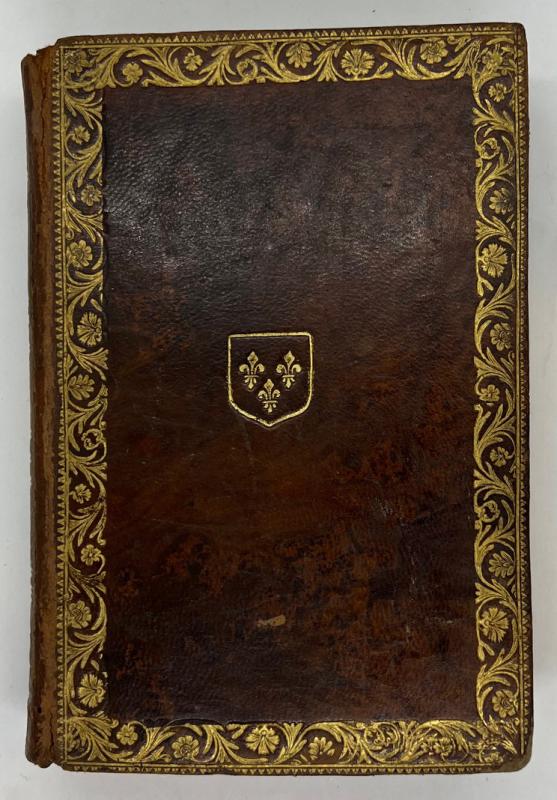
London: Jacob Tonson, 1712. Folio (465 x 288mm). 87 engraved plates, comprising: engraved double-page additional title, 61 double-page plates, many by C. Huijberts after Mantegna, including a famous image of a bison, 25 full-page plates including a folding portrait of the Duke of Marlborough by George Vertue (1684-1756); numerous engraved headpieces and vignettes in the text, initials. Faint even browning throughout but a very fine copy in contemporary red morocco, spine richly gilt in 8 compartments, dark-green morocco gilt lettering-piece in second, the others with foliate tools and volute cornerpieces, marbled endpapers, gilt turn-ins and edges. Provenance: 'L' (small circular stamp dated 1910 on rear free endpaper). First edition.‘The most sumptuous classical work which this country has produced' (Lowndes) bound in contemporary red morocco with 87 attractive engravings by various artists, including the famous image of a bison that is sometimes missing or damaged. The Tonson's Caesar received contemporary praise from Joseph Addison as ‘a Work that does honour to the English Press', having ‘passed thro' the Hands of one of the most accurate, learned and judicious Writers this Age has produced. The Beauty of the Paper, of the Character, and of the several Cuts with which this noble Work is illustrated, makes it the finest Book that I have ever seen; and is a true Instance of the English Genius' (The Spectator no. 367, May 1712). The work is annotated by Samuel Clarke (1675-1729), a major English philosopher, especially renowned for his theories on the existence of God and the immortality of the soul. He also corresponded with Leibnitz and in 1706 translated Newton's Optiks into latin. Among his philological works is also an edition of the first 12 books of the Iliad. For the present edition, he chose Caesar's accounts of his campaigns in Gaul and Britain (58-50BC) and of his participation in the Roman Civil War (49-48BC) along with the remaining works on his military campaigns in Alexandria and Asia, Africa, and the Iberian peninsula. The volume is ‘dedicated to John Churchill, 1st Duke of Marlborough, the victorious English general at the Battle of Blenheim (1704) and instrumental to the military successes of the Grand Alliance more generally, this monumental volume establishes by a secular typology that Marlborough is the new Julius Caesar of Europe. Strange as that may seem from the long view of history, Samuel Clarke's cloying dedication to the Duke as the “noblest, wisest, and strongest” of men (“Nobilissimo, Sapientissimo, & Fortissimo”) says as much from its opening paragraph, describing the ancient commander as “outdone only by YOU [Marlborough] in glory and success, and in every part of the character of a consummate general” (“TUA solius armorum gloria & felicitate & laude omni superatum”).10 Understandably, then, Marlborough's portrait (by George Vertue after Godfrey Kneller), complete with a cartouche proclaiming him “Illustrissimus, Potentissimus, et Excellentissimus,” occupies pride of place as the frontispiece of the volume.' (Michael F. Suarez, Hard Cases: Confronting Bibliographical Difficulty in Eighteenth-Century Texts. pbsa 111:1 (2017): 1–30 © 2017 Bibliographical Society of America.)

Sachgebiete: Antike, Einbände, Chroniken, Altphilologie, Völkerkunde/Ethnographie

21.07.2026 - 16:37

20000,- EUR

Meda Riquier Rare Books LTD

...

BARBERINI, Maffeo. [POPE URBAN VIII].. Poemata. Poesie toscane.

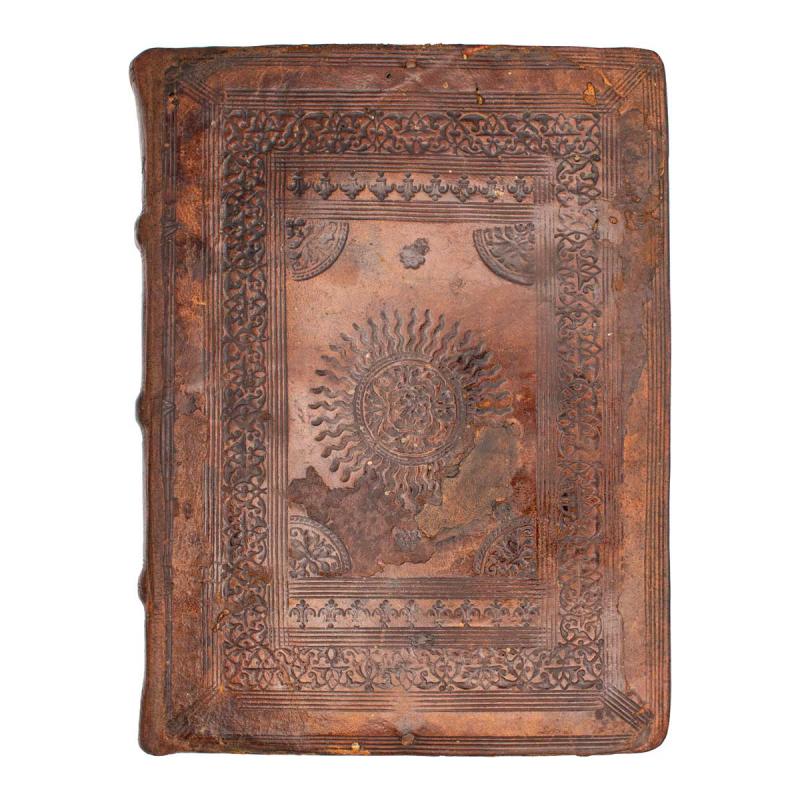
Rome: ex typographia reverendae camerae Apostolicae, 1637. Quarto (211×145mm), two works bound together. I: [10] leaves, 231; [1 errata] pages. II: [7] leaves; 106 pages, [1] errata leaf. Title-pages with engraved arms of Pope Urban VIII. Engraved headpieces and tailpieces throughout. Contemporary Roman black morocco binding by the Andreoli bindery: two concentric borders separated by double fillets, the outer border with roll of stylised flowers and leafy branches and the broader, internal border with alternating triangular tools and with arabesque tools in the corners; alternating triangular tools on spine; central panel with four fan corner-pieces and the arms of Leone Strozzi (1637–1703), Bishop of Pistoia and Prato and, from 1700, Archbishop of Florence. In a modern box. Early annotations on endpapers, few spots. A very good copy from the library of Francesco Riccardi del Vernaccia (1794–1863), chamberlain of the Grand Duke of Tuscany Ferdinand III (ex-libris). Two rare collections of poetry by Pope Urban VIII, born Maffeo Barberini (1568–1644). The first collected edition of Barberini's poems was printed in Paris in 1621. Despite him being elected pope in 1623, "it took till 1631 before the first Roman edition appeared, with the Vatican Press. […] In the same year, a smaller, and therefore supposedly cheaper but yet identical version was published by the press attached to the Apostolic Chamber; this, of course, was the press that usually catered to the people of Rome and of the Papal States and therefore could be instrumental in distributing the book to those teachers who expressed an interest in using it in their classes." (Rietbergen, p. 113) "In a papal brief titled Poesis probis et piis ornata documentis primaevo decori restituenda, that would precede the text of all subsequent Roman editions, he […] maintained […] that poetry should be restored to its pristine quality, turning its back on pagan themes and images and instead inciting to Christian virtues. Still, sometimes it might be necessary to use classical elements to direct the reader to biblical texts and their messages, or to moral examples. […] Not only was the official Roman edition constantly re-issued, it also was constantly enlarged, as the Pope's poetic vein continued to flow. Indeed, almost each new edition contained additional, mostly Latin poems […]. From 1635 onwards, the Roman editions of Urban's Latin poems mostly were followed by editions of his Italian verses as well […]. The purpose of the poems now published was manifestly didactic, since most are provided with explanatory captions. All Urban's favourite themes recur: the moral education of the members of his family—various Latin poems for the Pope's brothers and nephews […]—the cult of poverty, expressed in a sonnet [II, 69] on St. Francis, and the prayer- like meditations." (ibid., pp. 114, 115) "As the years went by, the number of printed editions of the papal poems increased. Obviously, the two main presses of Rome, that of the Vatican and of the Apostolic Chamber, re-issued their editions, quite probably on express papal orders but also because a genuine demand for them must have sprung up all over the Roman Catholic world." (ibid., p. 118) "Maffeo Barberini was born on April 5, 1568 as the youngest of the six sons of Antonio Barberini and Camilla Barbadori, who were citizens of Florence. Young Maffeo was first sent to school with the Florentine Jesuits and then, in 1584, moved to Rome to live under the tutelage of his uncle Francesco. In Rome, too, he was schooled in the humanistic curriculum of the Jesuits, in their famous Collegio Romano. Despite his obvious cultural interests, the career mapped out for a young man of his social background demanded that he go on to university to study for a law degree. This he did, at Pisa, where he spent several years. Though he wanted to marry, nothing came of the match arranged for him by his mother. Therefore he returned to Rome in 1588, to seek a career in the Church. With the initial aid of his uncle he soon succeeded, gaining one position after the other and thus moving upwards in the hierarchy of the Curia. The life he had started in 1588 found its culmination in 1623, with his election to the papacy.” (ibid., pp. 97–98) Urban VIII was the longest-reigning pope of the XVII century, ruling until his death in July 1644. His papacy was marked by the Galileo affair, with the Florentine scientist being condemned by the Roman Inquisition in 1632, as well as his patronage of major Baroque artists such as Gian Lorenzo Bernini, Francesco Borromini and Pietro da Cortona. It is interesting to note that "poetry may well have been Maffeo Barberini's first and most important inclination." (ibid., p. 96) "Maffeo Barberini […] was a poet before he could even think to aspire after the papacy. As pope, he continued to be a poet. Rather than, only, expressing a personal aesthetic in his poetry, he used it as the powerful means it was precisely to propagate his deepest convictions and feelings." (ibid., p. 136). "Maffeo's poetic compositions […] can and should be read as a running commentary on many of the issues he had to confront, on many of the actions he did take; they even seem to suggest a unity of thought that may help to give meaning to a number of his deeds and, moreover, point to a surprising consistency and continuity in his policy." (ibid., p. 97)

Sachgebiete: Barock, Einbände, Kirchengeschichte, Italien, Religionsgeschichte

21.07.2026 - 16:28

7000,- EUR

Meda Riquier Rare Books LTD

...

Geheimfach mit Pistole - Histoire Universelle, Sacrée et profane, depuis le commencement du monde jusqu'a nos jours' von Augustin Calmet, erschienen 1735-1771 in 17 Bänden vollständig, dabei Histoire Universelle' von 1753,

Zustand: Gut bis sehr gut. Geheimfach mit Pistole - Histoire Universelle, Sacrée et profane, depuis le commencement du monde jusqu'a nos jours' von Augustin Calmet, erschienen 1735-1771 in 17 Bänden vollständig, dabei Histoire Universelle' von 1753, mit Geheimfach und Steinschloßpistole aus der Zeit. Zusammen in 18 Bänden, wobei der Titel mit dem Geheimfach kaum merklich im Rücken unterschiedlich gebunden ist. Das Geheimfach wurde durch Einschnitt angelegt zwischen den Seiten 57 und 312 des Werks ‚Histoire Universelle, depuis le commencement du monde jus qu'a present', Tome Quatorzieme (Band 14), Amsterdam und Leipzig, Arkstée et Merkus 1753. --- Beiliegend die ganze Reihe (17 Bände) des ähnlichen Werks mit sehr ähnlicher Aufmachung (jeweils mit Rückentitel ‚Histoire Universelle, Tome . . .'): ‚Histoire Universelle, Sacrée et profane, depuis le commencement du monde jusqu'a nos jours' von Augustin Calmet, erschienen 1735-1771, zuerst in Strasbourg bei Jean Renauld Doulsseck, ab Band 12 dann in Nancy bei Claude-Sigisbert Lamort. --- Alle 18 Bände mit Ganzleder-Einband, dreiseitigem Rotschnitt, geprägtem Rücken und gleichem Rückentitel (bis auf die Angabe der Bandnummer). Strasbourg, Nancy, Amsterdam und Leipzig 1735-1771 Das Tarnbuch im Format 26 x 21 x 5 cm; das Geheimfach misst 18 x 11 x 1,5 cm. Die Pistole im Format 16,5 x 8 cm (Länge des Metalllaufs 10 cm). Die Bände der beiliegenden Reihe (mit über 10.000 Seiten) im Format von ca. 25,5 x 20 x 5,5 cm. Im Bücherregal nebeneinandergestellt ergibt sich eine Länge von etwas über einem Meter. Das Tarnbuch mit Kupferstich-Landkarte ‚Carte de la retraite des dix mille'. --- Zustand: gut.


21.07.2026 - 16:26

2400,- EUR

Antiquariat Thomas Mertens

...

Pracht-Fotoalbum Berlin-Brandenburg - um 1870-1903, 110 Fotos, Ansichten aus Brandenburg (u.a. Buckow, Zellin, Berlin, Eberswalde, Frankfurt/O., Cottbus), Straßenszenen, fast alle bezeichnet

Prachtvolles Ganzleder-Fotoalbum, angelegt am 19. Oktober 1903 zum 70. Geburtstag des Landgerichtsrats Johannes Nathanael Gotthelf Grandke (1833-1909), mit Ansichten aus den Orten, in denen er gelebt hat (entstanden ab ca. 1870). --- Mit sehr interessanten Motiven, oft von Straßenszenen. --- Einliegend ein Foto von J.N.G. Grandke als Offizier im Leib-Grenadier-Regiment ?König Friedrich Wilhelm III.? (1. Brandenburgisches) Nr. 8 (datiert 1859) und ein Foto seiner Mutter Ida Grandke, geb. Krause (um 1865). --- Anfangs sechs Fotos von bedeutenden preußischen Staatsmännern, u.a. Kaiser Wilhelm II. Dann folgen die 102 Ansichten, darunter 10 Fotos aus seinem Geburtsort Buckow (u.a. Hauptstraße); 9 Fotos aus Zellin, wo sein Vater Carl Gotthelf Grandke Pfarrer war (u.a. dessen Grab, der Pfarrhof etc.); 14 Fotos aus Berlin (u.a. Joachimsthal?sches Gymnasium, Altes Rathaus, Spittelmarkt, Alte Herkulesbrücke, Kammergericht); 7 Fotos aus Eberswalde (u.a. Marktplatz, Alte Forstakademie); 16 Fotos aus Frankfurt / Oder (u.a. Große Oderstraße mit altem Appellationsgericht, Häuser am Wilhelmsplatz); 17 Fotos aus Spremberg bzw. Parduz bei Spremberg; 12 Fotos aus Cottbus (u.a. Bange?s Ecke, Häuser Leopoldstr. 5 und Louisenstr. 6) und 5 Fotos aus Salzungen (u.a. Charlottenhall). Daneben auch einzelne Fotos kleinerer Orte. --- Insgesamt 110 Fotos (zwei lose einliegend); bis auf die Porträts und vier weitere Fotos sind alle Motive bezeichnet. Prachtvolles Ganzleder-Fotoalbum (41 x 31,5 cm x 6,5 cm) mit geprägtem preußischen Adler und Einbandtitel "19. X. 1833. 19. X. 1903. 70 Jahre ein Märker." --- Mit 108 montierten Fotos auf 55 Albumseiten und zwei lose einliegende Fotos. --- Zustand: Guter Zustand, Fotos nur selten etwas fleckig, der Einband ist berieben. Der Landgerichtsrat Johannes Nathanael Gotthelf Grandke wurde am 19. Oktober 1833 in Buckow (Mark) als Sohn des Predigers Carl Gotthelf Grandke (gest. in Zellin) und der Ida, geb. Krause (gest. in Berlin) geboren und starb am 12. August 1909 in Berlin. Sein Grabstein befindet sich noch heute auf dem Friedrichswerderschen Friedhof in Berlin.


21.07.2026 - 16:21

2400,- EUR

Antiquariat Thomas Mertens

...

AESOP. Vita & fabellae Aesopi cum interpretatione Latina.

Venice: Aldus Manutius, October 1505. Folio (281 x 178mm). 142 [i.e. 140] p., 172 col., [68] p.; text of Aesop and Gabrias in Greek and Latin, the others in Greek. Aldine anchor on title and verso of final leaf. Late XVIII century diced russia with gilt crest of Sir Richard Colt Hoare on spine, gilt tooling on covers and gilt edges. Neat marginal repair to wormhole in last three leaves, occasional light spotting and soiling, extremities lightly rubbed, spine neatly restored, overall a very fine copy from the libraries of Sir Richard Colt Hoare (1758-1838; his crest on spine, Stourhead sale 1883, lot 164); W.R. Jeudwine (bookplate; sale Bloomsbury 18 September 1984, lot 30); Helmut Friedlaender (ex libris); sale Christie's, 24 November 1993, lot 92; Livio Ambrogio (bookplate). First and only Aldine edition of Aesop Fables, both in Greek and Latin, in an heterogeneous compilation including two fable collections (one in prose, attributed to Aesop, one in verse, attributed to Gabrias, i.e., Babrius), a biography of Aesop by the Byzantine scholar Maximus Planudes, some short treatises on the interpretation of myths and the genre of the fabula, and a collection of proverbs. "This edition may be considered among the rarer and more beautiful productions of the Aldine press" (Frognall Dibdin). Aesop' Fables are here increased in number in comparison to the editio princeps and are provided with a new Latin translation by Aldus, which enjoyed great fortune in the decades following its appearance. A special mention should be given also to two of the seven works being published here for the first time, the poetic fables erroneously attributed to Gabrias and Horapollo's Hieroglyphica, the only systematic essay on the interpretation of Aegyptian hieroglyphics to survive in its entirety from Classical Antiquity. In producing this edition, Aldus was confronted with the problem of putting together the Greek text and the Latin translation and with the resulting problem of the numeration of pages and leaves. The Greek text is thus enumerated from page 17 to page 142 (with the only exception of pages 129–130), while the Latin translation presents no numbering at all and pages 142–173 are present a enumerated in columns. Aldus was not, apparently, interested in editing Aesop Fables as an indipendent text; rather, the edition was intended as an anthology of poetic forms considered useful for grammar school exercise. In particular, by connecting the animal fables with tales on myths and anthropomorphic gods, he provided his reader with a refined linguistic and thematic inventory, susceptible to undergoing a reuse in the field of rhetoric. "Aldus' edition of Aesop is essentially a collection of 'fabulae' (in the rhetorical definition of implausible narratives) and their interpretations; it closely corresponds to the forms recommended by Quintilian for the grammar school, especially in that it begins with the fables and ends with the proverbs" (W.P. Weaver, Untutored Lines. The Making of the English Epyllion, Edinburgh 2012, p. 50).

Sachgebiete: Alte Drucke 16. Jahrhundert , Einbände, Altphilologie, Fabeln, Griechenland

21.07.2026 - 16:20

35000,- EUR

Meda Riquier Rare Books LTD

...

Bauhaus Expressionismus Avantgarde --- Manuskript, 9 Aquarelle Königsberg um 1925, Begleittext, Unikat

Handschrift Unikat, Expressionismus --- Neun originale Aquarelle, hinter Passepartout gebunden (Halbpergament, Büttenpapier), von einem anonymen (eventuell aber prominenten) Künstler im Stil von Paul Klee und Wassily Kandinsky (google lens schlägt nur diese Künstler vor) oder ein Schüler der beiden. Laut dem Buchbinder-Stempel (L. Haack - E. Rodemeier - Königsberg) entstanden in Königsberg (Ostpreußen). Motive sind Widder (mehrere Male, die Empfängerin des Werks war wohl vom Sternzeichen her Widder), Personen, Herz, Symbole etc. --- Auf losen Blättern einliegend ein handschriftlicher Begleittext zu allen neun Bildern (offenbar Szenen gemeinsamer Erinnerungen); z.B.: "I. Mit den wilden Segeln im sonderbaren Boot Du! Den Stab der Geheimnisse in der Hand. In den Segeln Dein seltsames Zimmer bewacht alles von den Widderhörnern. Darüber das Herz." --- "III. Wie herrlich der Esel die Du erzähltest!" --- "V. Ich versuche meinen Widder zu bändigen!" --- "VII. Hilde im Zweifel zwischen Stadt und Ammerland." Königsberg um 1925 Halbpergament-Band (26,5 x 22,8 x 1,7 cm), Handeinband. Die neun originalen, farbigen Aquarelle (Mischtechnik) hinter Passepartout (Karton); Bildausschnitt meist 11,3 x 6,5 cm, beim ersten Motiv 13,3 x 13,3 cm. Der handschriftliche Begleittext auf vier einseitig beschriebenen, lose einliegenden Blättern (27,7 x 22 cm), mit Wasserzeichen "M. K. Papier" (Max Krause). --- Zustand: Sehr guter Zustand, nur stellenweise gering fleckig, der Begleittext mit leichten Randschäden. Sehr dekoratives und eindrucksvolles, avantgardistisches Werk (Unikat).


21.07.2026 - 15:44

1800,- EUR

Antiquariat Thomas Mertens