Rare Books Berlin - Internationale Messe für Bücher und Graphik

...

KLEE, Paul.

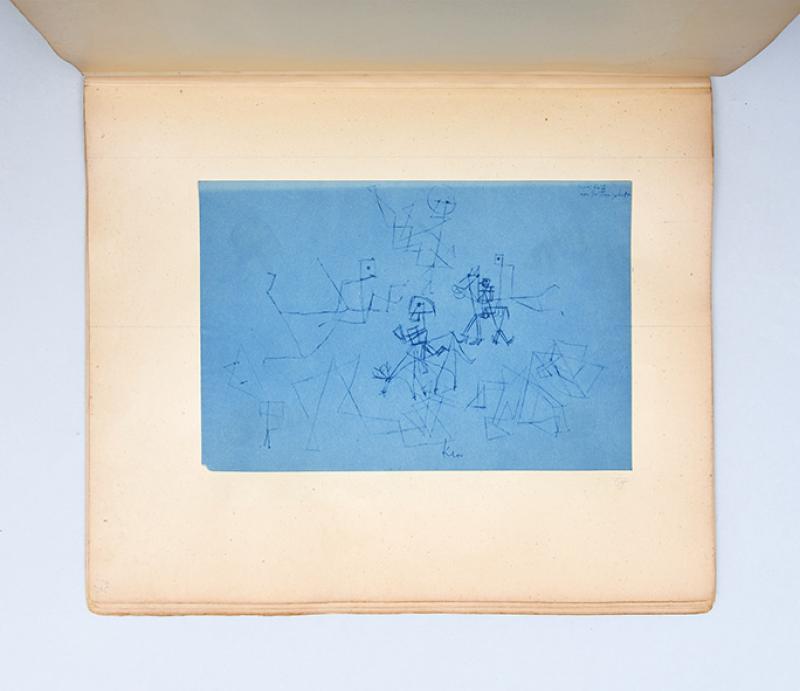
Maquette for Handzeichnungen 1921-1930. Düsseldorf: 1934. ¶ Maquette: Quarto. Original hand-bound black card covers (28.1 x 24.2 cm). With 69 cyanotypes of different sizes mounted on card after original drawings by Klee. Book: Quarto. Original yellow boards, spine and front cover lettered in black, illustration after Klee on front cover in black. With 72 full-page illustrations after original drawings printed on heavy card with perforation to the inner margin. Housed in a black cloth flat-back box by the Chelsea Bindery. Maquette: covers and most pages disbound with small loss to corners and edges, lacking pages 16, 26, and 27. Book: small loss to joints of spine, otherwise clean and bright, a very good copy. ¶ Original maquette for the first volume of Klee's Handzeichnungen, accompanied by a first edition of the book, number 33 of 525 copies. Most of the edition was later confiscated by the Nazis. The maquette is signed by the art critic Will Grohmann, author of the introduction, and both maquette and book were owned by two expressionist dancers associated with the 1936 Berlin Olympics. ¶ Grohmann planned a three-volume catalogue raisonné of Klee’s work, despite mounting criticism from the Nazi Party. In 1933 Klee was dismissed from his teaching post in Düsseldorf and fled to Switzerland. The first volume appeared in October 1934; by spring 1935 the remaining copies were seized by Nazi officials, and Grohmann was forced to suspend publication of the projected second and third volumes. In 1937 Klee’s work was included in the Nazi exhibition of so-called “degenerate art”. The first edition bears the ownership inscription of the dancer and choreographer Mary Wigman, together with a presentation inscription in Grohmann’s hand: “Mary Wigman, Im Alter treu ist Freundschaft ("loyal friendship in old age"), 13 Nov. 1934”. Wigman was a pioneering figure of expressionist dance and a cultural icon of Weimar Germany. She later collaborated with the Nazi regime, accepting a commission for the 1936 Olympics; although privately sympathetic to Jewish students, she complied with orders to dismiss Jewish dancers from her company. The maquette was presented to the dancer Mathilde Thiele (b. 1907), who typed Grohmann’s introduction. Thiele studied under Gret Palucca, later taught Dore Hoyer, and in the 1960s joined the staff of Wigman’s school. When Palucca was summoned to dance for Hitler at the 1936 Olympics, Thiele accompanied her as rehearsal director. Thiele later recalled the dinner with Hitler, noting the mortal danger had Palucca’s Jewish background been known. "After dinner, Palucca and I were so relieved we drank a whole bottle of wine in our room. We considered that Herr Goering might help Palucca escape if needed. We had word that he helped artists (even Jews) through an underground operation, despite his close relationship to Hitler" (Fraleigh). ¶ Grohmann 2226 & others. Sondra Fraleigh, “Mathilde Thiele, A Life in Dance and War”, 2021.

Sachgebiete: Handzeichnungen, Deutschland, Moderne Kunst, Politik, Weltkrieg

28.07.2026 - 20:11

60000,- EUR

Peter Harrington

...

KEATS, John.

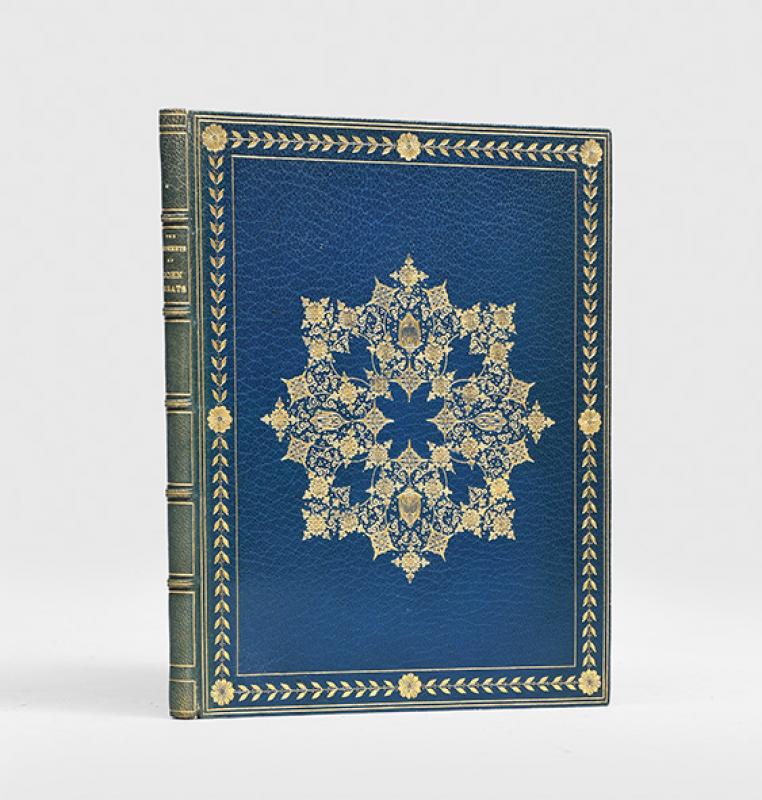
Sonnets. [c.1900]. ¶ Quarto (215 x 175 mm). Title within wood-engraved border, wood-engraved initials throughout. Contemporary bright blue crushed morocco, spine lettered in gilt, compartments framed with single gilt fillet, boards with double gilt fillet enclosing broad border of leafy stems interspersed with floral tool, framing large central flower-shaped medallions elaborately tooled with two different lozenge tools, two stylized bulb tools, and fine single dot curlicues, gilt-ruled turn-ins with floral tool and single dot details at corners, top edges gilt, fore and bottom edges uncut. Spine sunned, flyleaves toned from turn-ins, a couple of spots of foxing to edges, still a fine copy. ¶ A consummate example of British provincial fine binding: this elegantly printed selection of Keats’s verse was bound by the renowned Staffordshire firm of Bagguley. The bindery employed some of the generation’s best finishers; the quality of their work is clear here from the filigree-like medallions, carefully built up with many different tools. ¶ The bookseller George Thomas Bagguley (b.1860) established himself in Newcastle-under-Lyme in 1890. Some of the top finishers in Britain moved from urban centres to practise in the bindery arm of the business, which, unusually, hired external designers. It flourished briefly but spectacularly around the turn of the century. “Quite how a small market-town... could support a bindery producing a work of this quality is not clear” but, as it was, Bagguley bindings featured in some of the 20th century’s finest collections (The Wormsley Library catalogue, p. 87). This binding has the bookplates of W. A. Foyle (1885-1963), the founder of the famous Charing Cross Road bookshop, and the distinguished bookseller and collector Robin de Beaumont (1926-2023). The volume bears no imprint or date, but the endpapers are watermarked 1900. We have traced another copy of this edition in a Bagguley binding. ¶ The Wormsley Library: a personal selection by Sir Paul Getty, Catalogue of an exhibition held at The Pierpont Morgan Library, New York, 27 January - 2 May 1999.

Sachgebiete: Einbände, Literatur bis ca. 1900, Großbritannien

28.07.2026 - 20:07

5700,- EUR

Peter Harrington

...

KAZANTZAKIS, Nikos.

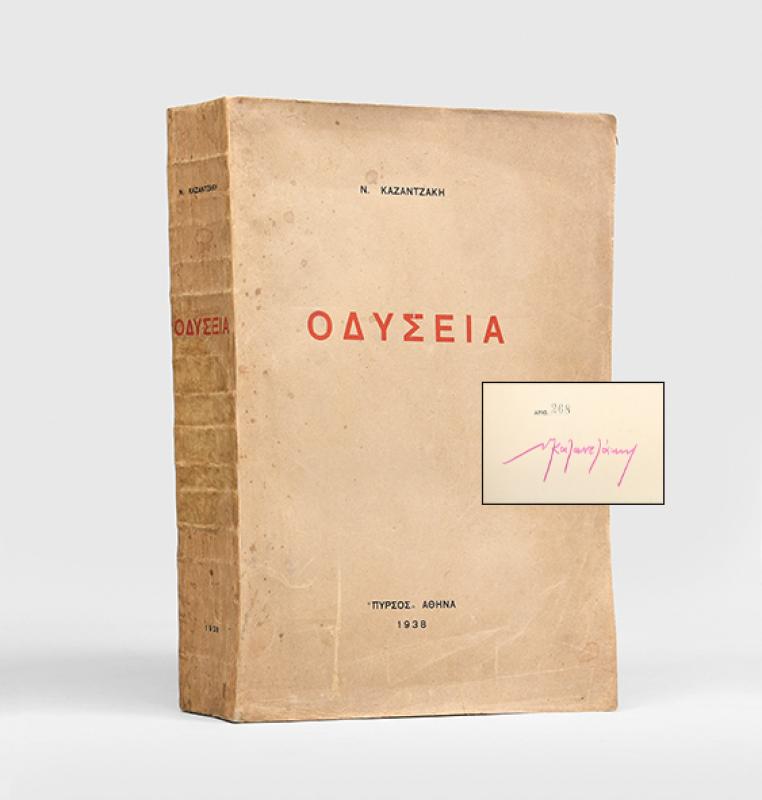
Odyseia. Athens: Pyrsos, 1938. ¶ Folio. Original buff wrappers, spine and front cover lettered in red and black, gatherings unopened. Spine and extremities restored, with a couple of letters retouched, a little spotting and marks on sides, slight foxing to edges, small hole at foot of initial blank. A very good copy. ¶ First edition, number 268 of 277 copies numbered in Roman numerals and signed by the author, from a total edition of 301 copies. Kazantzakis’s major work is an ambitious sequel to Homer’s Odyssey and one of the “very first monuments of European Modernism” (Gonzáles-Vaquerizo, p. 104). This is the only copy in wrappers that we have traced on the market and in auction records. Kazantzakis (1883-1957) began writing Odyseia in 1924, during a period of intense personal turmoil after he returned to his native island of Crete. The poem is deeply autobiographical, with many characters inspired by people he met in real life. It was published after fourteen years of revisions and seven rewritings. The text mirrors the structure of Homer’s Odyssey, divided into 24 rhapsodies, but is roughly twice as long and employs an experimental style marked by abundant neologisms and intricate syntax. The plot follows Odysseus after his return to Ithaca: restless in domestic life and driven by an insatiable desire for freedom, he embarks on a series of new journeys culminating in his arrival in Antarctica. ¶ Helena Gonzáles-Vaquerizo, “Kazantzakis Odyssey as a Cretan and Modernist Masterpiece”, in Liana Giannakopoulou & E. Kostas Skordyles, eds, Culture and Society in Crete, From Kornaros to Kazantzakis, 2017.

Sachgebiete: Griechenland, Literatur ab ca. 1900

28.07.2026 - 20:03

11500,- EUR

Peter Harrington

...

HEARTFIELD, John.

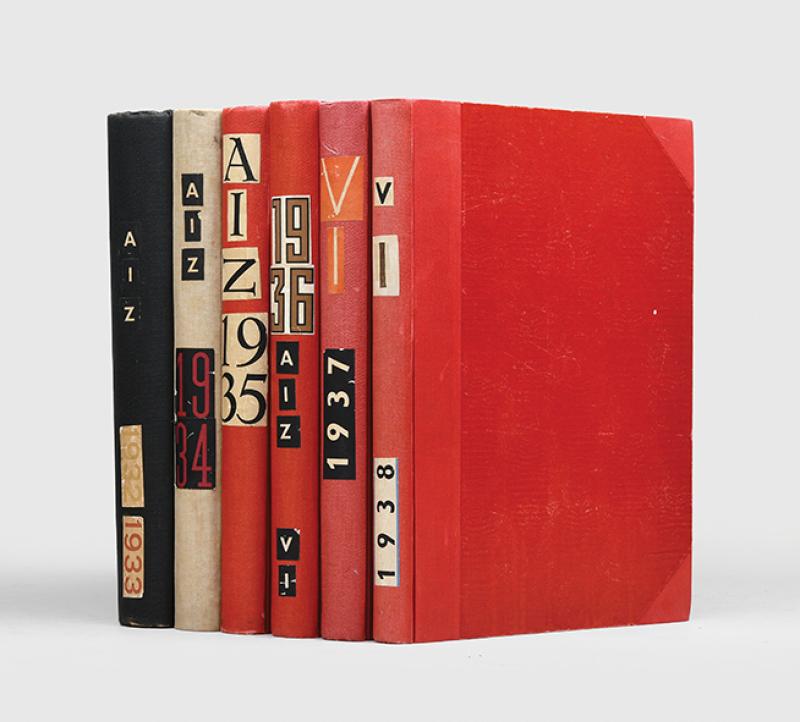
Arbeiter Illustrierte Zeitung & Die Volks-Illustrierte. Berlin: Neuer Deutscher Verlag, & Prague, P. Prokop, 1932-38. ¶ Together, 314 issues bound in 6 vols, folio (375 x 265 mm). With photographic illustrations throughout. Contemporary black, red, or white quarter cloth, paper-covered boards, printed paper labels to spines; each volume with manuscript half-title and title in German, vols. I and II with manuscript German table of contents. Contemporary label of the Dutch Communist Party to front free endpapers of vols. I & II. Light browning due to paper quality, very occasionally slightly trimmed (with minor loss of letters), a few pages creased, and occasional small tears; 3 leaves with longer tears and 2 with minor loss. Still, a very good set.¶ An exceptional run of one of the main organs of political opposition to the Nazi Party, illustrated with photographs throughout. It includes over 200 of John Heartfield’s iconic photomontages, pioneering works of graphic design and illustration which were extraordinarily influential.¶ The Arbeiter Illustrierte Zeitung, renamed Die Volks-Illustrierte in 1936, was a socialist photographic weekly magazine. Founded in Berlin in 1921, it took a leading role in opposing the growing Nazi movement. After the Nazis came to power, its publishing operation fled to Prague, where it was distributed across Europe to opponents of the new regime and to émigrés, as well as being smuggled into Germany. As the German occupation of Prague loomed, the magazine ceased publication. This set comprises the full run from 1932 through to the magazine’s closure in 1938, with the exception of a single issue in 1935 that was suppressed, and the few issues of the aborted attempt to revive the magazine in Strasbourg in 1939. It has the label of the Dutch Communist Party, which was itself later suppressed under Nazi occupation. The 314 issues contain several thousand photographs illustrating inter-war Europe and the Nazi movement and regime. Its journalism is a crucial record of Nazi repression at a time when the domestic press was rigidly controlled by Goebbels’s propaganda apparatus. There are also articles for children, sports coverage, caricatures, fiction, and essays about art and technology. Heartfield’s illustrations have secured the magazine’s lasting fame. “In the search for new forms to express a new conviction, Heartfield and his friends discovered photomontage. Originally, it seems that the soldiers on the Western Front, unable to get their reports of butchery past the censors, turned to pasting together photographs and cutouts from illustrated papers to tell their tale of horror to their families and friends back home. Using this ingenious technique, as well as the collage of the cubists, Heartfield and his close friend, George Grosz, invented the new technique” (Selz, p. 310). The rise of National Socialism gave Heartfield his defining subject, and his work for the Arbeiter Illustrierte Zeitung and Die Volks-Illustrierte includes many of his most famous images. ¶ Peter Selz, “John Heartfield’s ‘Photomontages’”, in The Massachusetts Review, Vol. 4, No. 2, 1963.

Sachgebiete: Deutschland, Militaria, Photographie, Weltkrieg

28.07.2026 - 19:48

45000,- EUR

Peter Harrington

...

ESQUEMELIN, Alexandre Olivier.

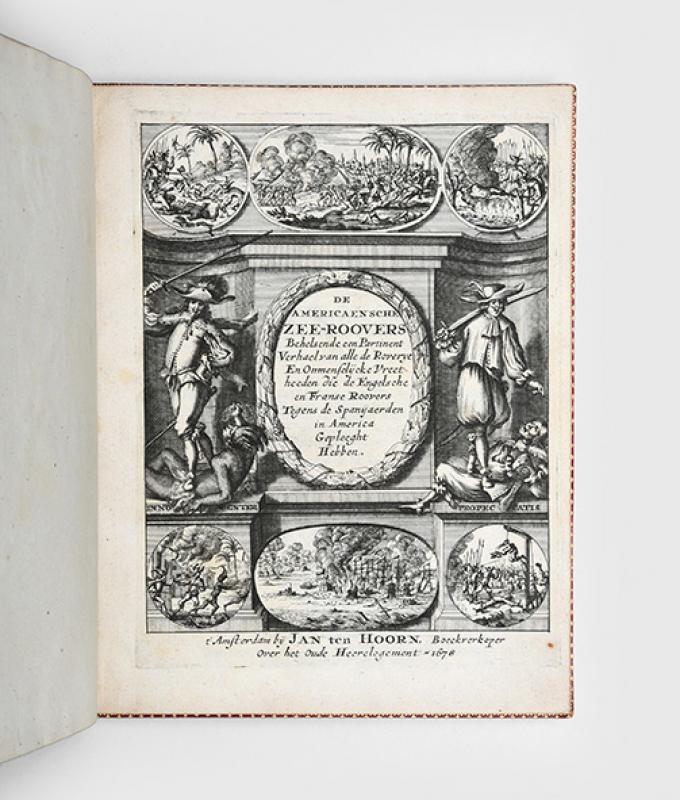
De Americaensche Zee-Roovers. Behelsende een pertinente en waerachtige Beschrijving van alle de voornaemste Roveryen, en onmenschelijcke wreedheden, die de Engelse en Franse Rovers, tegens de Spanjaerden in America, gepleeght hebben (Containing a pertinent and truthful description of all the most important robberies and inhuman cruelties committed by the English and French robbers against the Spaniards in America). Amsterdam: Jan ten Hoorn, 1678. ¶ Small quarto (196 x 153 mm), pp. [vi], 186, [2] adverts. Additional engraved title page, 12 engraved plates (4 double-page). Nineteenth-century red morocco by Rivière, spine gilt, sides panelled in gilt, marbled endpapers, gilt inner dentelles, gilt edges. Custom red morocco clamshell box, felt-lined, richly gilt. Collector’s leather book label of Charles George Milnes Gaskell (1842-1919), MP for Morley. Extremities and front joint repaired, light toning to text leaves and occasional offsetting from plates, some leaves washed, a very good copy.¶ Rare first edition of the original account of swashbuckling pirate exploits in the Caribbean. Known in English as the Buccaneers of America, the book has 12 engravings that bring the fearsome pirate captains to life, and unflinching descriptions of the violence and plunder that both horrified and fascinated readers.¶ Perhaps the most notorious figure in the book is the privateer Henry Morgan (1635-1688). As Morgan's confidante and barber-surgeon, the author Alexandre Olivier Esquemelin (c.1645-1707, also spelled Exquemelin, Esquemeling, Exquemeling, or Oexmelin) had an onboard view of some of the most audacious raids in pirate history, including Morgan’s sack of Maracaibo in 1669 and the daring assault on Panama in 1671 (both depicted in the plates). Esquemelin paints a complex portrait of Morgan - as a brilliant tactician and fearless leader, but also a man capable of great cruelty. Following the publication of the English translation in 1684, which accused Morgan of torture and the use of nuns and monks as a human shield, Morgan took steps to discredit the book and successfully brought a libel suit against the book's English publishers William Crooke and Thomas Malthus.¶ "Perhaps no book in any other language was ever the parent of so many imitations" (Sabin) and it became the cornerstone of pirate literature for centuries to come, Esquemelin's vivid prose and intimate knowledge of buccaneer life captivating readers across Europe. From this edition, it was translated into German (1679), Spanish (1681), English (1684), and French (1686). First editions are of "extreme rarity" (Sabin); we have traced no other complete copy at auction since 1894 (Bangs, 25 April 1894, lot 301), with an earlier record in 1884 (Leavitt & Co., 3 March 1884, 909a). Only six copies have been traced in institutions (USTC). ¶ Howgego E39; Sabin 23468; USTC 1814458.

Sachgebiete: Amerika, Geschichte, Illustrierte Bücher, Literatur bis ca. 1900, Reisen/Reiseliteratur

28.07.2026 - 19:28

150000,- EUR

Peter Harrington