Muhammad
A431) Quran
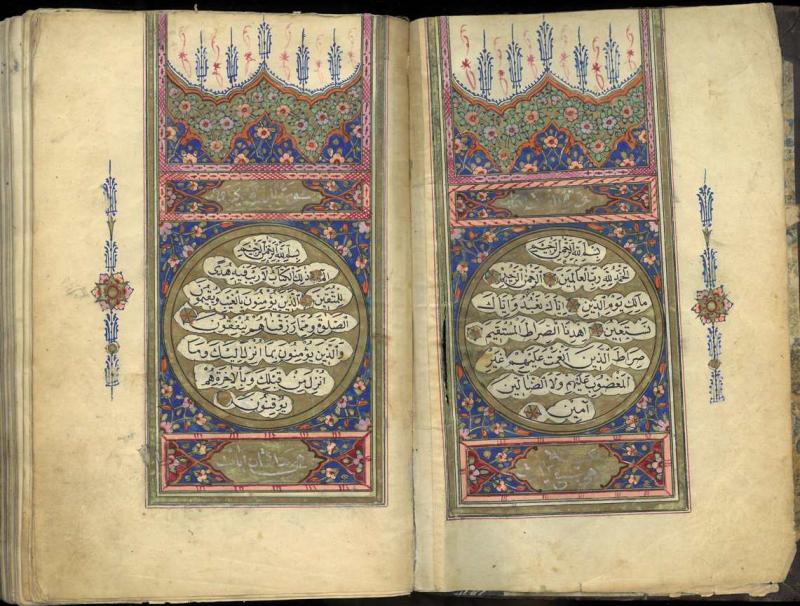
Illuminated manuscript on paper, in Arabic, Ottoman Empire, undated but late 18th century. Size of the sheet 215 x 145 mm, writing surface 145 x 80 mm. Text in Naskh calligraphy on a single column of 15 lines in black ink. Composed of 310 cards, complete. The decoration includes a double illuminated frontispiece in gold and colors and numerous gold and blue flowers on the margins. All the sheets are bordered by a triple gold and black fillet. At the beginning of each Sura there is a gold cartouche with a title in white ink. Probably contemporary leather binding with flap, blind-stamped and gold decorated, with abrasions and signs of use. Good condition of conservation, clean copy with wide margins.
The Arabic word Koran (< ar. Qur'ān) means ‘recitation’, ‘reading aloud’, ‘proclamation’.
The Koran is of course the one and only sacred text of the Islamic religion. As a book, it is divided into 114 chapters called Surahs, each of them subdivided in verses called ‘ayāt (sing. ‘aya). Except for the first one, called ‘the opening Surah’ (< ar. Sūrat al-Fātiḥa), the Koranic Surahs are loosely ordered according to their decreasing length: the longest one at the beginning (namely the Surah n. 2), and the shortest one towards the end of the holy book. The ‘official’ division into verses is not everywhere accepted, as there are cases in the numbering of Surahs’ verses that show some slight variations. Each Surah is always preceded by its title, usually consisting in a single word taken from a supposedly significant term contained in the text of the Surah itself, though often the word chosen for the title reveals to be quite inconsistent with the Surah’s more general content. All the Surahs but the 9th one start with an invocation formula called basmala (the Arabic noun for the famous noun phrase b-ismi’l-Lāh, ar-Raḥman, ar-Raḥīm: ‘In the name of God, the Merciful, the Compassionate’). The basmala is commonplace in the everyday conversation of the Muslim faithful, and they use it very often at the beginning of a sentence in order to emphasize their sincerity, piety, commitment, truthfulness and so on.
Sachgebiete: Buchmalerei, Islam, Koran, Religion, Theologie
31.07.2026 - 14:56
2800,- EUR
Giuseppe Solmi Studio Bibliografico
, Gerhart Hauptmann, um 1912_01.jpg)