Rare Books Berlin - Internationale Messe für Bücher und Graphik

...

MORE, Sir Thomas; DESIDERIUS ERASMUS. MORE, Sir Thomas. De optimo reip. statu deque nova insula Utopia ... Epigrammata [with:] DESIDERIUS ERASMUS. Epigrammata.

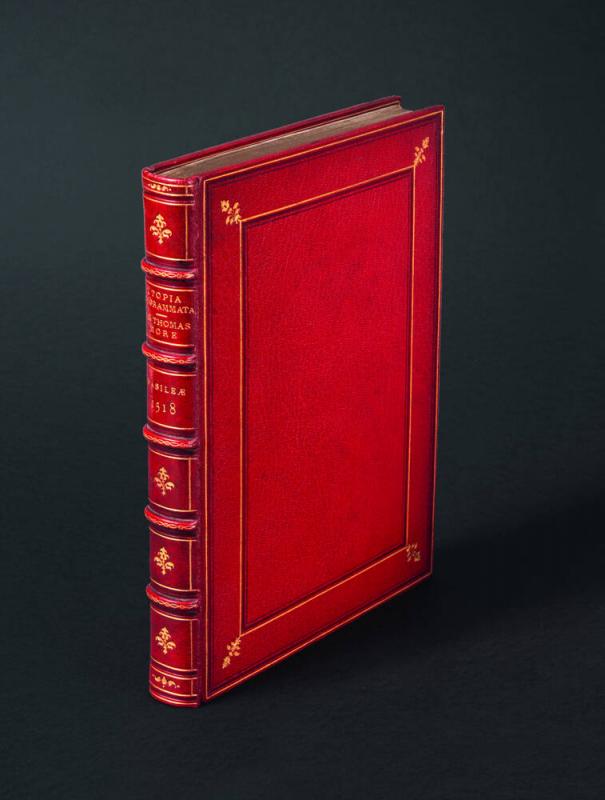
Basel: Johann Froben, March 1518 Quarto (213 x 155 mm.), three parts in one volume. Roman, Greek and 'Utopian' types. Woodcut historiated border to title of each part and to preface, the first by Ambrosius Holbein, the others by Hans Holbein, full- page woodcut of Utopia and half-page woodcut of Clement, Hythlodaye, More and Gillies, by Ambrosius Holbein, a different woodcut printer's device at end of each part, woodcut historiated initials by A. and H. Holbein. A very fine copy in nineteenth century red crushed morocco by Francis Bedford, spine gilt in compartments with gilt title, gilt edges; from the library of Cardiff Castle (ex libris) and Livio Ambrogio (ex libris). The important third edition of Utopia with the author's revisions, including the first edition of More's Epigrammata, not present in the first 1516 Louvain publication by Peter Gillies and the following Parisian reprint by Gourmont in 1517. This early edition of More's Epigrammata includes verses that were removed from following printings, particularly those pertaining to Germain de Brie (c. 1490-1538). This is the first edition printed by Johann Froben, which was followed by an identical issue in November/December of the same year. Froben's editions have been described as ‘'the most complete and most correct published in [More's] lifetime'' (Fairfax Murray, p. 494). This revised impression was arranged by Erasmus and it also contains his own Epigrammata, originally printed in Paris in 1506 in conjunction with the fourth edition of his Adagia. The title page is contained within a woodcut border showing Lucretia and Sextus Tarquinius, with additional separate title pages for each of the three works, as well as printers' devices. These works are often found separate, however it is rare to find them together as published. Utopia's architectural border is populated by Cherubs and signed by Hans Holbein. More's Epigrammata is set within a border also signed by Hans Holbein, the lower part occupied by scenes of the life of Gaius Mucius Cordus. The border for Erasmus' Epigrammata depicts St. John the Baptist and Salome. Utopia opens with a full-page woodcut map of the island, executed by Ambrose Holbein, depicting Raphael Hythlodaeus on the bottom left corner pointing towards it while speaking to More and Gillis. The opposite leaf contains the Utopian alphabet and several verses. An additional woodcut vignette is included at the beginning of the first section, showing Clement, More, Hythlodaeus, and Gillies. More's Utopia is presented as a imaginary dialogue between the author and the fictitious traveller Raphael Hythlodaeus, allegedly part of Amerigo Vespucci's crew. The first part is reserved for Hythlodaeus' critiques of European societies, particularly their greed, corruption, and inequality, blaming private property, harsh punishments, and class oppression. Conversely, the second part describes the island of Utopia that houses a society organized around communal property and rational governance. Utopians work only six hours a day, share resources, are not bound by materialism and practice religious tolerance. Their simple laws and elected leadership ensure fairness, while war and overpopulation are avoided, and slavery serves as punishment for criminals and prisoners of war. While on the surface Utopia appears idyllic, the work is infused with irony, leaving the reader to question whether such a society is attainable or a critique of human nature. "Utopia is not, as often imagined, More's ideal state: it exemplifies only the virtues of wisdom, fortitude, temperance and justice. It reflects the moral poverty of the states which More knew […] But an ideal state is what it has come to mean […] Utopia has become a fairy-tale. More, who was knighted in 1521, was later Speaker of the House of Commons, High Steward of Cambridge University, and Lord Chancellor. In 1535 he was executed for high treason. He is a saint to the Catholic, and a predecessor of Marx to the Communist. His manifesto is and will be required reading for both, and for all shades of opinion between.'' (PMM p.28).

Sachgebiete: Einbände, Humanismus, Niederlande , Renaissance , Schweiz

21.07.2026 - 16:58

50000,- EUR

Meda Riquier Rare Books LTD

...

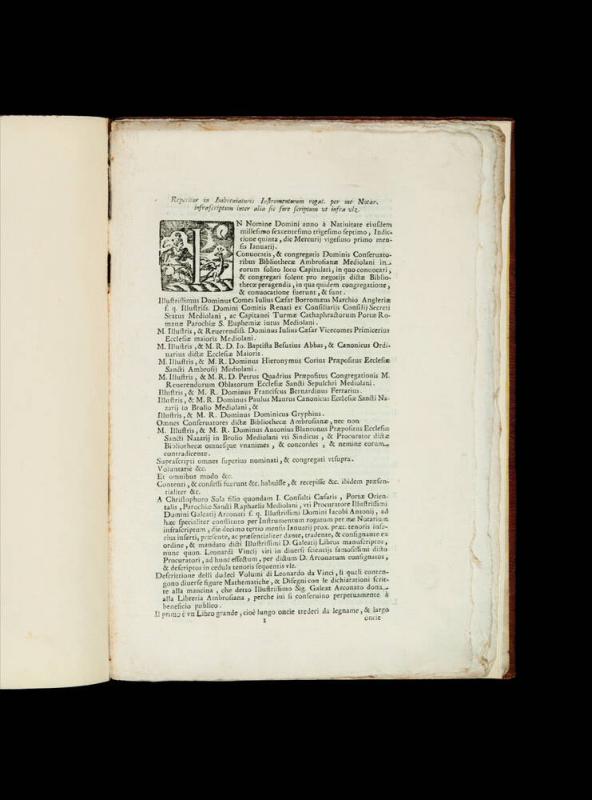
[LEONARDO DA VINCI]. [Istrumento della donazione di dodici volumi di Leonardo da Vinci fatta alla Biblioteca Ambrosiana di Milano da Galeazzo Arconati a mezzo del suo procuratore Cristoforo Sola in data 21 gennaio 1637].

N.p. [Milan?]: n.d. [first quarter of the XVIII century]. Quarto (310×211mm). [6] leaves, the last blank. Historiated woodcut initial on the first page. A fine copy with wide margins and untrimmed edges bound in nineteenth-century brown morocco. Very rare printed edition of two notarial deeds concerning the donation of Leonardo da Vinci's manuscripts to the Biblioteca Ambrosiana of Milan. The documents include a description of all twelve notebooks, featuring the first ever mention of Leonardo's Codex Atlanticus, and a transcription of the plaque placed inside the Biblioteca Ambrosiana, to commemorate the donor, Galeazzo Arconati. Only nine copies of the four known issues are present in public libraries, which only one in the US (Washington, National Gallery of Art Library). According to Gustavo Uzielli, first to discover and publish the text of the Instrumento, in 1884, the present copy is a third edition, likely dating from the time of Giuseppe Antonio Arconati Visconti (1698–1763), a great-grandson of Galeazzo. Based on paper quality, we also believe that it dates to the early XVIII century. When Leonardo died in Amboise in 1519, his friend and pupil Francesco Melzi inherited all the notes and drawings his teacher had produced throughout his entire life. Melzi took them to his villa in Vaprio d'Adda, near Milan, where at his death in 1570 they passed to his son, Orazio Melzi. Orazio took so little interest in his inheritance that he even allowed several manuscripts to be stolen by the family's tutor. After the manuscripts were recovered, Pompeo Leoni (1537–1608), a sculptor at the Spanish court, purchased the entire collection and took it to Madrid. It was there that Leoni compiled the Codex Atlanticus by arbitrarily mounting 1,750 fragments of Leonardo's notebooks onto a large book (65×44cm), "making no attempt to classify them according to their content or date" (Pedretti, pp. 7–8). Leoni's heirs then dispersed Leonardo's manuscripts in different directions: some remained in Madrid, some were sent to England (now the British Museum's Codex Arundel and the drawings in Windsor Castle), and some, including the Codex Atlanticus, were sold to Count Galeazzo Arconati (1580–1649). Arconati, patron of the arts and an art collector, was also the cousin of Cardinal Federico Borromeo, founder of the Biblioteca Ambrosiana. Our document maintains that the king of England offered Arconati 1,000 golden coins for the Codex Atlanticus, but he refused the offer and instead donated it, along with all the other manuscripts, to the Ambrosiana, one of Italy's earliest public libraries. The first deed was drafted on 13 January 1637, and the second one, with the same provisions, was drafted a week later on 21 January, the day of the public donation ceremony. These were originally intended for the attendees of the ceremony. The twelve volumes remained in Milan until 1796, when Napoleon ordered they to be brought to Paris. The Codex Atlanticus only was returned to the Ambrosiana after the Congress of Vienna in 1815, while the rest of the collection has remained in the Institut de France ever since.

Sachgebiete: Geschichte, Italien, Renaissance

21.07.2026 - 16:55

16000,- EUR

Meda Riquier Rare Books LTD

...

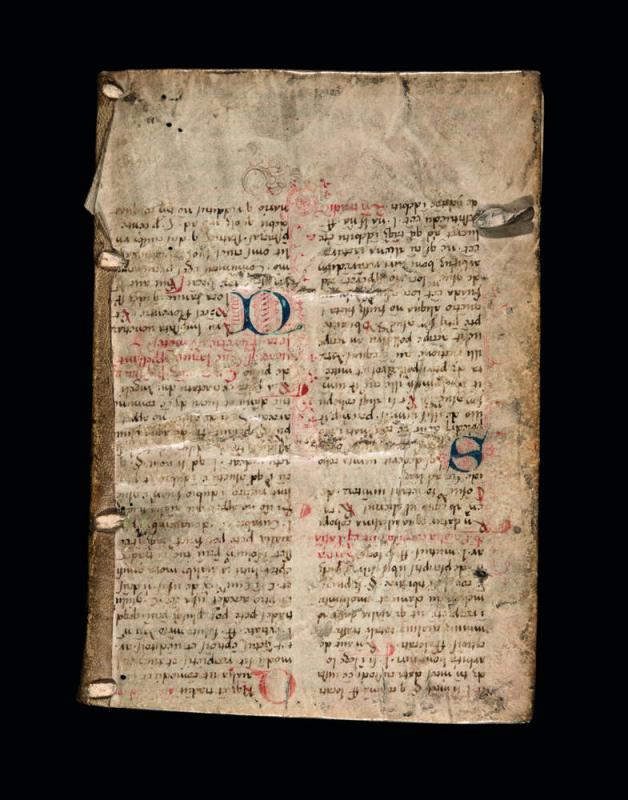
ST. FRANCIS OF ASSISI. Fiorecti di Sancto Francesco.

Florence: [Bartolommeo di Libri] for L.R., 26 May 1489. Quarto (175 x 122 mm.), [128] leaves, the first leaf, blank except for the title, is an old facsimile on ancient paper; Gothic type 3:114G, 27 lines per page with L.R. device at the end. A few spots, short upper margin, but a very fine copy bound with a contemporary vellum manuscript page, spine renewed, manuscript title on spine, from the library of the famous British explorer Apsley Cherry Garrard (1886-1959). Modern half morocco box. Exceedingly rare edition of Saint Francis's Fioretti. “Little Flowers of Francis of Assisi is the name given to a classic collection of popular legends about the life of St. Francis of Assisi and his early companions as they appeared to the Italian people at the beginning of the fourteenth century. Such a work, […], can hardly be said to have one author; it is the product rather of gradual growth and must, […], remain in a certain sense anonymous, because it is national. There has been some doubt as to whether the Fioretti were written in Italian in the first instance, […], or were translated from a Latin original […]. The latter seems altogether more probable, and modern critics generally believe that a larger Latin collection of legends, which has come down to us under the name of the Actus B. Francisci et Sociorum Ejus, represents an approximation to the text now lost of the original Floretum, of which the Fioretti is a translation. A striking difference is noticeable between the earlier chapters of the Fioretti, which refer to St. Francis and his companions, and the later ones which deal with the friars in the province of the March of Ancona. The first half of the collection is, no doubt, merely a new form given to traditions that go back to the early days of the order; the other is believed to be substantially the work of a certain Fra Ugolino da Monte Giorgio of the noble family of Brunforte, who, at the time of his death in 1348, was provincial of the Friars Minor in the March. Living as he did a century after the death of St. Francis, Ugolino was dependent on hearsay for much of his information; part of it he is said to have learned from Fra Giacomo da Massa who had been well known and esteemed by the companions of the saint, and who had lived on terms of intimacy with Fra Leone, his confessor and secretary. Whatever may have been the sources from which Ugolino derived his materials, the fifty-three chapters which constitute the Latin work in question seem to have been written before 1328. The four appendixes on the Stigmata of St. Francis, the life of Fra Ginepro, and the life and the sayings of the Fra Egidio, which occupy nearly one half of the printed text of the Fioretti, as we now have it, form no part of the original collection and were probably added by later compilers. Unfortunately the name of the fourteenth-century Franciscan friar who translated into Italian fifty-three of the seventy-six chapters found in the Actus B. Francisci and in translating immortalized them as the Fioretti, remains unknown. The attribution of this work to Giovanni di San Lorenzo rests wholly upon conjecture. It has been surmised that the translator was a Florentine. However this may be, the vernacular version is written in the most limpid Tuscan and is reckoned among the masterpieces of Italian literature. The Fioretti have been described as “the most exquisite expression of the religious life of the Middle Ages.” That perhaps which gives these legends such a peculiar charm, is what may be called their atmosphere; they breathe all the delicious fragrance of the early Franciscan spirit. Nowhere can there be found a more childlike faith, a livelier sense of the supernatural, or a simpler literalness in the following Christ than in the pages of the Fioretti, which more than any other work transport us to the scenes amid which St. Francis and his first followers live, and enable us to see them as they saw themselves. These legends, moreover, bear precious witness to the vitality and enthusiasm with which the memory of the life and teaching of the Poverello was preserved […]. In Italy the Fioretti have always enjoyed an extraordinary popularity; indeed, this liber aureus is said to have been more widely read there than any book, not excepting even the Bible or the Divine Comedy. Certain it is that the Fioretti have exercised an immense influence forming in the popular conception of St. Francis and his companions. The earliest known manuscript of the Fioretti, now preserved at Berlin , is dated 1390; the work was first printed at Vicenza in 1476.” (Catholic Encyclopedia on-line) After that first appearance, the Fioretti were reprinted other eleven times during the fifteenth-century; all these editions, including ours which is the first printed in Florence, are extremely rare and most of the surviving copies are imperfect.

Sachgebiete: Einbände, Humanismus, Inkunabeln, Italien, Religionsgeschichte

21.07.2026 - 16:49

39000,- EUR

Meda Riquier Rare Books LTD

...

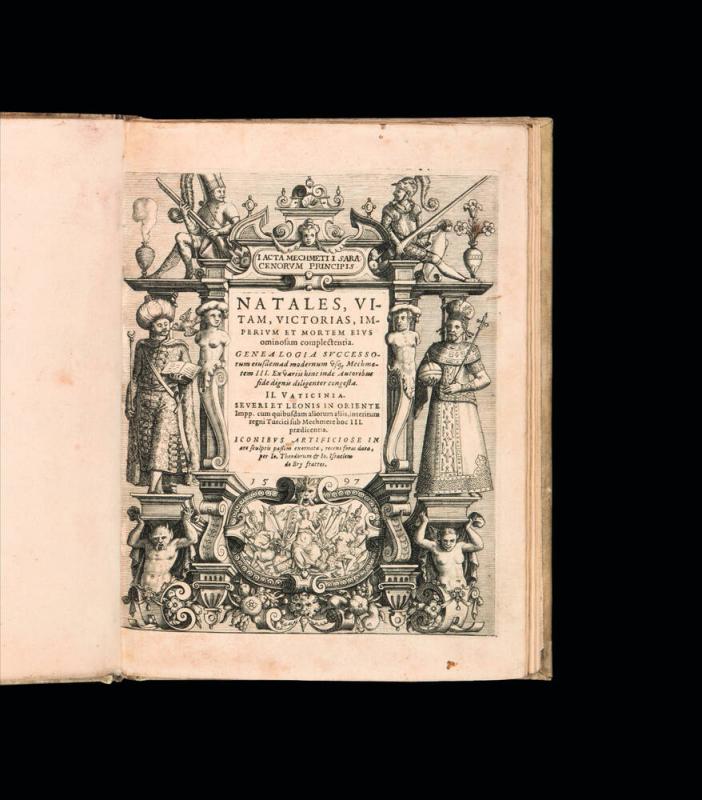
[DE BRY, Johann Theodor & Johann Israel]. I. Acta Mechmeti I Saracenorum principis

[Frankfurt]: per Io. Theodorum & Io. Israelem de Bry fratres, 1597. Quarto (199×146mm), 2 parts in one volume. I: [4] leaves, pages 1–58, [1] leaf; II: pages 59–96, [3] leaves. Engraved title-page within architectural border, the Prophet Muhammad and a Byzantine emperor at the sides. Twenty- six engravings, various historiated initials and typographical ornaments throughout. Contemporary stiff vellum binding, remounted. Rather browned, especially in quires D and N, some minor spotting and foxing, else a very good copy. First edition of "the first printed Western book to illustrate the life of the Prophet Muhammad" (Ilg, p. 241). The book's editors, the brothers Johann Theodor and Johann Israel de Bry, worked in Frankfurt and are best known for their illustrated editions of travel accounts from Asia and the Americas. Although the author of this volume is anonymous, they are most likely to be identified as Jean-Jacques Boissard, a scholar and humanist who frequently collaborated with the de Bry printing house until his death in 1602. Boissard had previously written a collection of biographies of Ottoman sultans, printed in 1596, and it seems apparent that the Acta Mechmeti could be a complement to this earlier work. Boissard also provided the drawings on which the engravings for his editions were based; therefore, it is probable that the twenty-six illustrations in this volume were also based on his drawings. The first part of the book contains not only a biography of Muhammad, but also a presentation of the basic principles of Islam, a brief history of the Arabic caliphates up to the year 1300, a summary of the customs of the Armenians and the Georgians, and finally a history of the Ottoman sultans from 1300 to 1595. The second part of the book is a collection of prophecies about the decline of the Ottoman Empire that were popularly attributed to the Byzantine emperor Leo VI. "The nine engravings that accompany the life of Muhammad — the only section of the Acts to receive illustrations — give the textual arguments a dramatic turn: the engravings always represent the most spectacular, climactic moment of each of the narrated episodes. Muhammad is, for example, caught groping his mistress or tumbling down due to an epileptic fit. Certainly, these engravings illustrate only the most salient points of the Christian criticism of Muhammad and of his doctrines. Hence, his ignoble family origin, his lecherous behavior, and the fact that he was a trickster who cheated people by fabricating false miracles were highlighted. However, the illustrator did not give Muhammad the aspect of a demoniac, deformed, or harmed creature, as frequently had been the case in Western art. Instead, the characters who appear in these engravings have been treated in a matter-of- fact way: the illustrator considered the costume figures published in 1567 by the French royal geographer Nicolas de Nicolay in his travel report from the Ottoman Empire (Navigations et peregrinations orientales) as the best available approximations of the true appearance of the historic Muhammad and his contemporaries. The young Muhammad is therefore — due to a misunderstanding of the prototypal image — dressed in the hood and cloak of de Nicolay's Turkish girl" (ibid., p. 252). "The decision to represent Muhammad and his contemporaries as if they were sixteenth-century Ottomans may seem anachronistic today. The sixteenth-century reader of the Acts, however, must have had a quite different point of view. During the first half of the century, the image of the Turk had become instrumental in the polemics between the Protestant and Catholic denominations. Innumerable Reformation broadsheets had depicted a Turk as personification of heresy and false doctrine next to either the pope or a Lutheran preacher. By conferring to his Muhammad the appearance of an Ottoman, the illustrator of the Acts used this established iconographic tradition to characterize Muhammad even more effectively as a pseudo- prophet. Further, the curious "ottomanization" of Muhammad was a result of the opinion, expressed not only in the Acts, that Muhammad was succeeded as "rex" by a series of Saracen rulers and finally by the Ottoman sultans. The Ottomans were therefore widely considered to be Muhammad's heirs, Islam became the "Turkish religion" and the content of the Qur'an the "Turkish law" (Ilg, p. 258). The second part of the volume contains the Vaticinium Severi et Leonis imperatorum ("The Prophecy of the Emperors Leo and Severus"). It is a prophetic forgery that was attributed to Leo VI the Wise, emperor of Byzantium from 886 to 912, and to the Roman emperor Antoninus Severus, better known as Caracalla (211–217). It consists of sixteen poems, each paired with an allegorical illustration and followed by an explanation, which foretell the imminent fall of the Ottoman rule. The Oracles of Leo the Wise were widely read throughout the late Middle Ages and early modern period, and they were routinely reinterpreted in light of the current political context. Their first printed edition appeared in Brescia in 1596, containing Latin and Italian text; the present edition reprints the Latin text of this first edition and almost exactly replicates its sixteen engravings.

Sachgebiete: Alte Drucke 16. Jahrhundert , Arabistik, Deutschland, Islam, Religionsgeschichte

21.07.2026 - 16:46

11000,- EUR

Meda Riquier Rare Books LTD

...

CAESAR, Gaius Julius. [The Commentaries.]

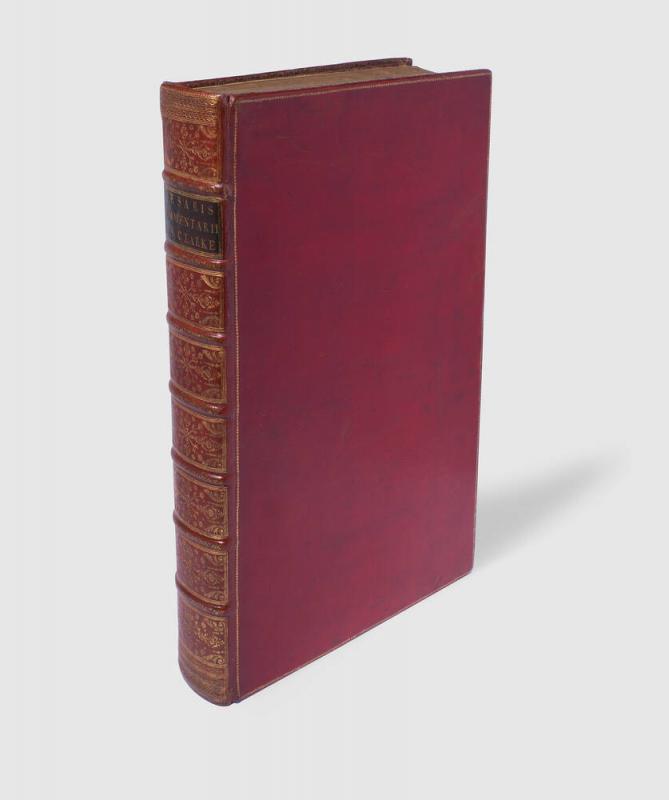
London: Jacob Tonson, 1712. Folio (465 x 288mm). 87 engraved plates, comprising: engraved double-page additional title, 61 double-page plates, many by C. Huijberts after Mantegna, including a famous image of a bison, 25 full-page plates including a folding portrait of the Duke of Marlborough by George Vertue (1684-1756); numerous engraved headpieces and vignettes in the text, initials. Faint even browning throughout but a very fine copy in contemporary red morocco, spine richly gilt in 8 compartments, dark-green morocco gilt lettering-piece in second, the others with foliate tools and volute cornerpieces, marbled endpapers, gilt turn-ins and edges. Provenance: 'L' (small circular stamp dated 1910 on rear free endpaper). First edition.‘The most sumptuous classical work which this country has produced' (Lowndes) bound in contemporary red morocco with 87 attractive engravings by various artists, including the famous image of a bison that is sometimes missing or damaged. The Tonson's Caesar received contemporary praise from Joseph Addison as ‘a Work that does honour to the English Press', having ‘passed thro' the Hands of one of the most accurate, learned and judicious Writers this Age has produced. The Beauty of the Paper, of the Character, and of the several Cuts with which this noble Work is illustrated, makes it the finest Book that I have ever seen; and is a true Instance of the English Genius' (The Spectator no. 367, May 1712). The work is annotated by Samuel Clarke (1675-1729), a major English philosopher, especially renowned for his theories on the existence of God and the immortality of the soul. He also corresponded with Leibnitz and in 1706 translated Newton's Optiks into latin. Among his philological works is also an edition of the first 12 books of the Iliad. For the present edition, he chose Caesar's accounts of his campaigns in Gaul and Britain (58-50BC) and of his participation in the Roman Civil War (49-48BC) along with the remaining works on his military campaigns in Alexandria and Asia, Africa, and the Iberian peninsula. The volume is ‘dedicated to John Churchill, 1st Duke of Marlborough, the victorious English general at the Battle of Blenheim (1704) and instrumental to the military successes of the Grand Alliance more generally, this monumental volume establishes by a secular typology that Marlborough is the new Julius Caesar of Europe. Strange as that may seem from the long view of history, Samuel Clarke's cloying dedication to the Duke as the “noblest, wisest, and strongest” of men (“Nobilissimo, Sapientissimo, & Fortissimo”) says as much from its opening paragraph, describing the ancient commander as “outdone only by YOU [Marlborough] in glory and success, and in every part of the character of a consummate general” (“TUA solius armorum gloria & felicitate & laude omni superatum”).10 Understandably, then, Marlborough's portrait (by George Vertue after Godfrey Kneller), complete with a cartouche proclaiming him “Illustrissimus, Potentissimus, et Excellentissimus,” occupies pride of place as the frontispiece of the volume.' (Michael F. Suarez, Hard Cases: Confronting Bibliographical Difficulty in Eighteenth-Century Texts. pbsa 111:1 (2017): 1–30 © 2017 Bibliographical Society of America.)

Sachgebiete: Antike, Einbände, Chroniken, Altphilologie, Völkerkunde/Ethnographie

21.07.2026 - 16:37

20000,- EUR

Meda Riquier Rare Books LTD

...

BARBERINI, Maffeo. [POPE URBAN VIII].. Poemata. Poesie toscane.

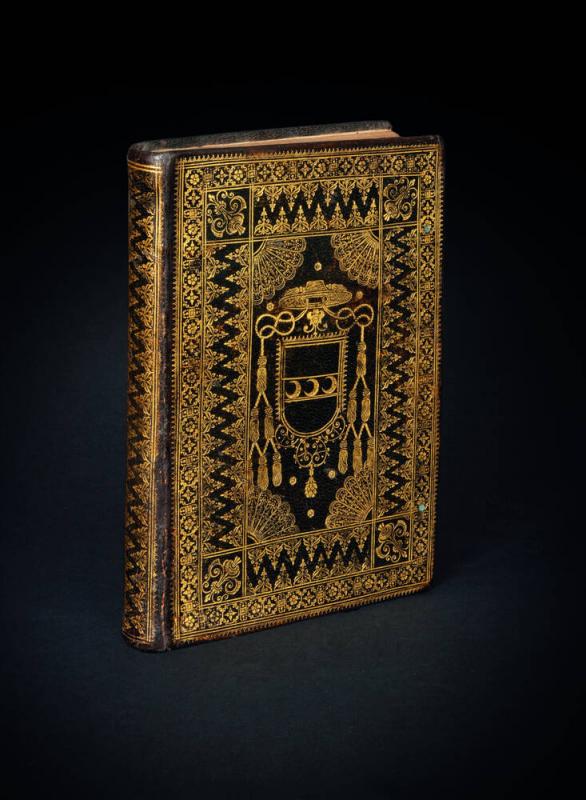
Rome: ex typographia reverendae camerae Apostolicae, 1637. Quarto (211×145mm), two works bound together. I: [10] leaves, 231; [1 errata] pages. II: [7] leaves; 106 pages, [1] errata leaf. Title-pages with engraved arms of Pope Urban VIII. Engraved headpieces and tailpieces throughout. Contemporary Roman black morocco binding by the Andreoli bindery: two concentric borders separated by double fillets, the outer border with roll of stylised flowers and leafy branches and the broader, internal border with alternating triangular tools and with arabesque tools in the corners; alternating triangular tools on spine; central panel with four fan corner-pieces and the arms of Leone Strozzi (1637–1703), Bishop of Pistoia and Prato and, from 1700, Archbishop of Florence. In a modern box. Early annotations on endpapers, few spots. A very good copy from the library of Francesco Riccardi del Vernaccia (1794–1863), chamberlain of the Grand Duke of Tuscany Ferdinand III (ex-libris). Two rare collections of poetry by Pope Urban VIII, born Maffeo Barberini (1568–1644). The first collected edition of Barberini's poems was printed in Paris in 1621. Despite him being elected pope in 1623, "it took till 1631 before the first Roman edition appeared, with the Vatican Press. […] In the same year, a smaller, and therefore supposedly cheaper but yet identical version was published by the press attached to the Apostolic Chamber; this, of course, was the press that usually catered to the people of Rome and of the Papal States and therefore could be instrumental in distributing the book to those teachers who expressed an interest in using it in their classes." (Rietbergen, p. 113) "In a papal brief titled Poesis probis et piis ornata documentis primaevo decori restituenda, that would precede the text of all subsequent Roman editions, he […] maintained […] that poetry should be restored to its pristine quality, turning its back on pagan themes and images and instead inciting to Christian virtues. Still, sometimes it might be necessary to use classical elements to direct the reader to biblical texts and their messages, or to moral examples. […] Not only was the official Roman edition constantly re-issued, it also was constantly enlarged, as the Pope's poetic vein continued to flow. Indeed, almost each new edition contained additional, mostly Latin poems […]. From 1635 onwards, the Roman editions of Urban's Latin poems mostly were followed by editions of his Italian verses as well […]. The purpose of the poems now published was manifestly didactic, since most are provided with explanatory captions. All Urban's favourite themes recur: the moral education of the members of his family—various Latin poems for the Pope's brothers and nephews […]—the cult of poverty, expressed in a sonnet [II, 69] on St. Francis, and the prayer- like meditations." (ibid., pp. 114, 115) "As the years went by, the number of printed editions of the papal poems increased. Obviously, the two main presses of Rome, that of the Vatican and of the Apostolic Chamber, re-issued their editions, quite probably on express papal orders but also because a genuine demand for them must have sprung up all over the Roman Catholic world." (ibid., p. 118) "Maffeo Barberini was born on April 5, 1568 as the youngest of the six sons of Antonio Barberini and Camilla Barbadori, who were citizens of Florence. Young Maffeo was first sent to school with the Florentine Jesuits and then, in 1584, moved to Rome to live under the tutelage of his uncle Francesco. In Rome, too, he was schooled in the humanistic curriculum of the Jesuits, in their famous Collegio Romano. Despite his obvious cultural interests, the career mapped out for a young man of his social background demanded that he go on to university to study for a law degree. This he did, at Pisa, where he spent several years. Though he wanted to marry, nothing came of the match arranged for him by his mother. Therefore he returned to Rome in 1588, to seek a career in the Church. With the initial aid of his uncle he soon succeeded, gaining one position after the other and thus moving upwards in the hierarchy of the Curia. The life he had started in 1588 found its culmination in 1623, with his election to the papacy.” (ibid., pp. 97–98) Urban VIII was the longest-reigning pope of the XVII century, ruling until his death in July 1644. His papacy was marked by the Galileo affair, with the Florentine scientist being condemned by the Roman Inquisition in 1632, as well as his patronage of major Baroque artists such as Gian Lorenzo Bernini, Francesco Borromini and Pietro da Cortona. It is interesting to note that "poetry may well have been Maffeo Barberini's first and most important inclination." (ibid., p. 96) "Maffeo Barberini […] was a poet before he could even think to aspire after the papacy. As pope, he continued to be a poet. Rather than, only, expressing a personal aesthetic in his poetry, he used it as the powerful means it was precisely to propagate his deepest convictions and feelings." (ibid., p. 136). "Maffeo's poetic compositions […] can and should be read as a running commentary on many of the issues he had to confront, on many of the actions he did take; they even seem to suggest a unity of thought that may help to give meaning to a number of his deeds and, moreover, point to a surprising consistency and continuity in his policy." (ibid., p. 97)

Sachgebiete: Barock, Einbände, Kirchengeschichte, Italien, Religionsgeschichte

21.07.2026 - 16:28

7000,- EUR

Meda Riquier Rare Books LTD
...

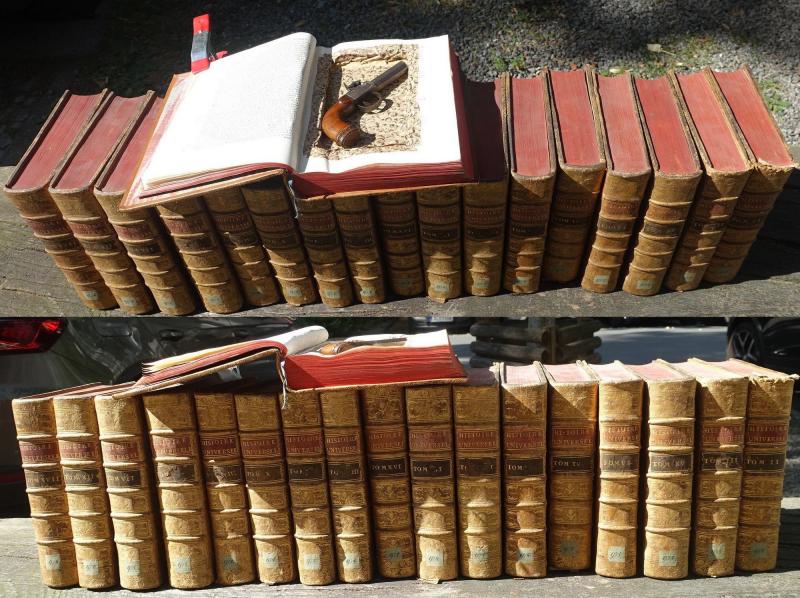
Geheimfach mit Pistole - Histoire Universelle, Sacrée et profane, depuis le commencement du monde jusqu'a nos jours' von Augustin Calmet, erschienen 1735-1771 in 17 Bänden vollständig, dabei Histoire Universelle' von 1753,

Zustand: Gut bis sehr gut. Geheimfach mit Pistole - Histoire Universelle, Sacrée et profane, depuis le commencement du monde jusqu'a nos jours' von Augustin Calmet, erschienen 1735-1771 in 17 Bänden vollständig, dabei Histoire Universelle' von 1753, mit Geheimfach und Steinschloßpistole aus der Zeit. Zusammen in 18 Bänden, wobei der Titel mit dem Geheimfach kaum merklich im Rücken unterschiedlich gebunden ist. Das Geheimfach wurde durch Einschnitt angelegt zwischen den Seiten 57 und 312 des Werks ‚Histoire Universelle, depuis le commencement du monde jus qu'a present', Tome Quatorzieme (Band 14), Amsterdam und Leipzig, Arkstée et Merkus 1753. --- Beiliegend die ganze Reihe (17 Bände) des ähnlichen Werks mit sehr ähnlicher Aufmachung (jeweils mit Rückentitel ‚Histoire Universelle, Tome . . .'): ‚Histoire Universelle, Sacrée et profane, depuis le commencement du monde jusqu'a nos jours' von Augustin Calmet, erschienen 1735-1771, zuerst in Strasbourg bei Jean Renauld Doulsseck, ab Band 12 dann in Nancy bei Claude-Sigisbert Lamort. --- Alle 18 Bände mit Ganzleder-Einband, dreiseitigem Rotschnitt, geprägtem Rücken und gleichem Rückentitel (bis auf die Angabe der Bandnummer). Strasbourg, Nancy, Amsterdam und Leipzig 1735-1771 Das Tarnbuch im Format 26 x 21 x 5 cm; das Geheimfach misst 18 x 11 x 1,5 cm. Die Pistole im Format 16,5 x 8 cm (Länge des Metalllaufs 10 cm). Die Bände der beiliegenden Reihe (mit über 10.000 Seiten) im Format von ca. 25,5 x 20 x 5,5 cm. Im Bücherregal nebeneinandergestellt ergibt sich eine Länge von etwas über einem Meter. Das Tarnbuch mit Kupferstich-Landkarte ‚Carte de la retraite des dix mille'. --- Zustand: gut.


21.07.2026 - 16:26

2400,- EUR

Antiquariat Thomas Mertens