Rare Books Berlin - Internationale Messe für Bücher und Graphik

...

ARCHIMEDES. Archimedis opera non nulla à Federico Commandino urbinate nuper in latinum conversa, et commentariis illustrata.

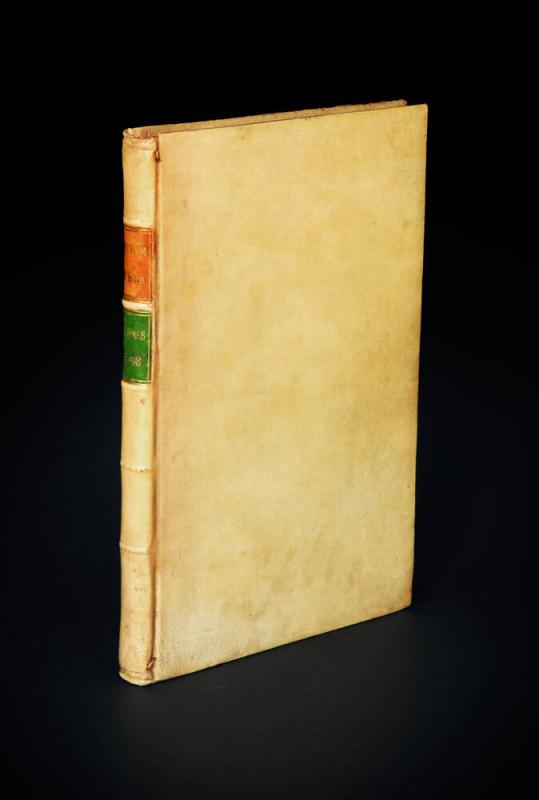
Venice: apud Paulum Manutium Aldi f., 1558. Folio (300×203mm), 2 parts in one volume with separate titles. I: [4], 55, [1] leaves; II: [1], 63, [1] leaves. Printer's device on title-page and last leaf of both parts. Numerous diagrams in text. Light marginal spotting, a manuscript monogram on title-page, overall a very fine copy in XVIII century stiff vellum, spine in compartments with two morocco lettering pieces, title lettered in manuscript on lower edge. First edition of Federico Commandino's translation of Archimedes. This edition not only marked a pivotal moment in the rediscovery of Archimedes, whose writings were almost entirely forgotten during the Middle Ages, but also contributed to the development of mathematical studies in the XVI and XVII centuries, directly influencing Galileo and Kepler. Federico Commandino (1509–1575) studied Latin and Greek in Urbino, then moved to Padua in 1534 to study philosophy, medicine and mathematics. In the 1550s, he came under the patronage of the young Cardinal Ranuccio Farnese, who appointed him as court physician and mathematician. While in Rome with Cardinal Farnese, Commandino met Cardinal Marcello Cervini, the head librarian of the Vatican Library and future Pope Marcellus II. Cervini had a keen interest in Greek mathematics and had already conceived the idea of printing important Greek and Latin mathematical writings based on the manuscripts of the Vatican Library and other Italian libraries. Thanks to Farnese's encouragement and Cervini's requests, Commandino could devote the rest of his life to his greatest passion: restoring and producing Latin editions of classical Greek mathematical texts. In this role, Commandino had access to important manuscripts in Italian libraries and was in contact with the most prominent humanists of his time. The most notable works he edited and published were those of Archimedes, Ptolemy, Apollonius, Euclid and Pappus. "Archimedes, the greatest mathematician and engineer of antiquity, studied at Alexandria and lived most of his life at Syracuse. He was killed at the capture of Syracuse by the Romans under Marcellus in 212 by a Roman soldier whom he rebuked for trampling on a diagram he had drawn in the sand. [He] was above all a great mathematician, developing further many ideas of Eudoxus and Euclid. […] Archimedes — together with Newton and Gauss — is generally regarded as one of the greatest mathematicians the world has ever known, and if his influence had not been overshadowed at first by Aristotle, Euclid and Plato, the progress to modern mathematics might have been much faster. As it was, his influence began to take full effect only after the publication of [the] first printed edition which enabled Descartes, Galileo and Newton in particular to build on what he had begun" (PMM). Although the first appearance of any of Archimedes's works in print dates back only to 1503, the editio princeps of the Greek texts of seven of his works was not published until 1544 by Thomas Gechauff Venatorius, in Basel. However, Commandino found this edition entirely unsatisfactory: despite the translation, commentary and diagrams, many of the Archimedean demonstrations still remained obscure. Commandino's main motivations for translating Archimedes's books again from scratch were his desire to fully understand the mathematics they conveyed, and his wish to provide commentary that would clarify points less clear in the Basel edition. He began working on this new translation when, during a visit to Venice in 1553, he borrowed a Greek manuscript containing the writings of Archimedes with Eutocius's commentary from the Biblioteca Marciana. This manuscript was itself a copy of an older one dating back to the IX or X century, and it originally came from Cardinal Bessarion's library. In 1558, his new edition of five Archimedean writings was printed in Venice, containing five treatises: De Circuli dimensio, De lineis spiralibus, Quadratura paraboles, De conoidibus et sphaeroidibus, De numero arenae. These are followed, in the second part of the volume, by Commandino's commentary. Commandino's Archimedis opera non nulla is a significant achievement of mathematical humanism for its mathematical commentary and philological explanations, and served as an invaluable reference both for the subsequent editions of Archimedes's works as well as for XVI- and XVII-century mathematicians. Galileo Galilei owned a copy as it was the only available guide to understanding De lineis spiralibus, from which he drew inspiration for his observations on uniform motion published in Discorsi e dimostrazioni matematiche intorno a due nuove scienze (1638). In his Astronomia nova (1609), Johannes Kepler used Commandino's commentary on De conoidibus et sphaeroidibus to demonstrate the elliptical orbit of Mars. Kepler also explicitly referenced this edition in Ad Vitellionem Paralipomena (1604), quoting Commandino's commentary on De numero arenae. These references testify to the importance of Commandino's Archimedis for the rebirth of mathematical studies in Italy and abroad.

Sachgebiete: Alte Drucke 16. Jahrhundert , Altphilologie, Wissenschaftsgeschichte, Mathematik, Renaissance

21.07.2026 - 17:09

15000,- EUR

Meda Riquier Rare Books LTD

...

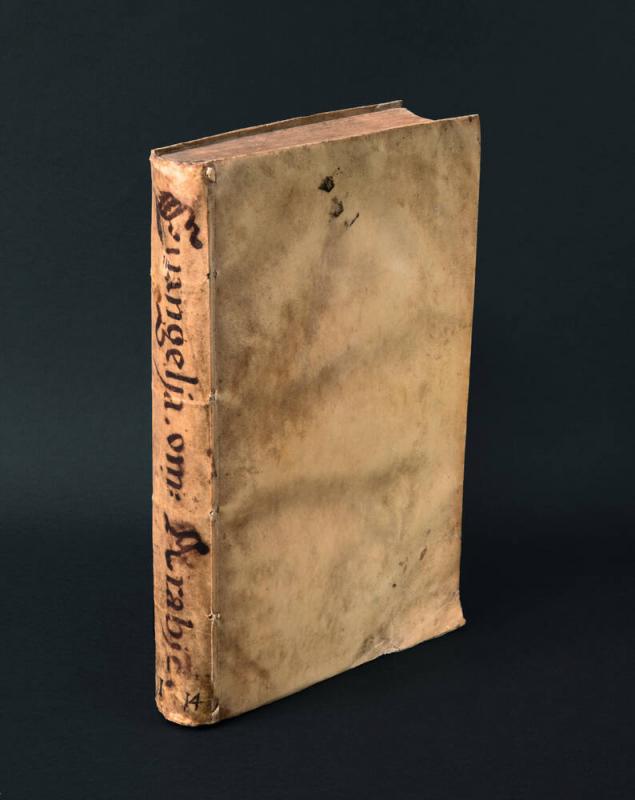
[BIBLIA ARABICA]. Evangelium Iesu Christi quemadmodum scripsit Mar Mattheus unus ex duodecim discipulis eius.

Rome: Typographia Medicea, 1591. Folio (329 x 217 mm.), 9 - 462 pages, as issued without title and preliminaries. “Double-rule border on each page of text. One hundred forty-nine woodcuts, by repetition of sixty-seven blocks, approximately 100 x 125 mm. Fourteen of these blocks are signed with the monograms of Antonio Tempesta as designer and Leonardo Parasole as cutter, and four other blocks have Parasole's signature alone. An early attribution of the “LP” monogram to Luca Penni is incorrect. […] The Arabic types are those designed by Robert Granjon for Domenico Basa, and Granjon was employed by the Typographia as type designer in the last years of his life.” (Mortimer). Occasional light spotting, some browning; a good copy in contemporary limp vellum with manuscript title on spine. First printing of the Gospels in the interlinear Arabic and Latin version, printed by the Typographia Medicea at the same time of the publication of the Gospels in Arabic only. The Arabic text, printed in Robert Granjon's famous large font, regarded as the earliest satisfactory Arabic type, is based on the Alexandrian Vulgate and is edited by Giovanni Battista Raimondi; the Latin version is by Leonardo Sionita. The book begins at page 9 without a title-page or any preliminary matters: “the reason for the apparent omission of pages of preliminaries is explained by Schnurrer quoting Bandini (C.F. de Schnurrer, Biblioteca Arabica, Amsterdam, 1968); G.B. Raimondi hoped to dedicate the volume to some great person, but failed to do so. In casting off the pagination, therefore, pp. 5-8 were omitted. The book was printed in Rome, but the unsold sheets went to Florence sometime about 1610, and any copy sold after that was sold in Florence. In the reissue of 1619 the gap in the pagination was seized upon and Schnurrer says that it has a leaf with dedication to Cardinal Madruzzi and a portrait together with the leaf "Typographus lectori" separately printed, without the colophon and with a different ornament. In all this makes four leaves, i.e. [8] pages. However it is clear that copies were made up on a very ad hoc basis. The sheets were again reissued in 1774.” (Sotheby's The Library of the Earls of Macclesfield Part VII: Bibles 1477-1739. 2006) This is the second book issued by the Typographia Medicea established in 1584 by Cardinal Ferdinando de' Medici, later gran duke of Tuscany from 1587, supported by Pope Gregory XIII and directed by the Orientalist and mathematician Giovanni Battista Raimondi (1536?-1614). The ultimate purpose of the Typographia Medicea was, in the Pope's mind, the printing of sacred and religious texts in Oriental languages that were to be disseminated throughout the Mediterranean and the Near East. Antonio Tempesta (1555 - 1630), Italian painter and engraver of the early Baroque era, was the author of the illustrations of both editions of the Gospel in Arabic printed by the Typoraphia Medicea.

Sachgebiete: Alte Drucke 16. Jahrhundert , Arabistik, Bibeln, Typographie, Holzschnitt

21.07.2026 - 17:07

11000,- EUR

Meda Riquier Rare Books LTD

...

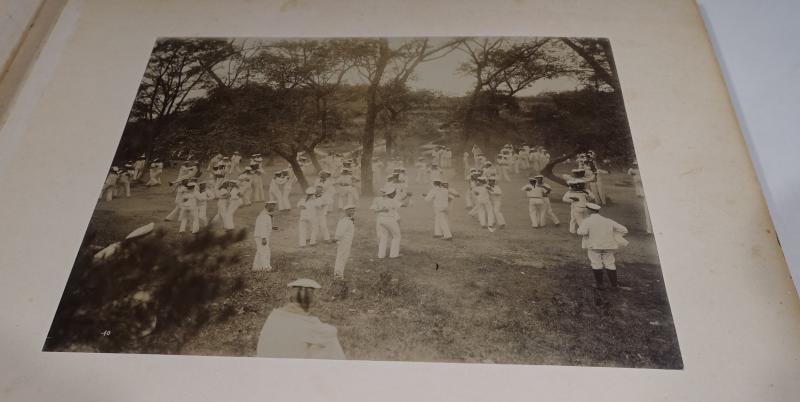
Tsingtau - Großes Fotoalbum (China) um 1910, deutsche Matrosen-Artillerie, Marine, 118 Fotos

Fotos Tsingtau (Deutsche Kolonie Kiautschou), Lackalbum --- Vollständiges, beeindruckendes Fotoalbum eines deutschen Soldaten in einer Matrosenartillerie-Kompanie in Tsingtau; mit Datierungen von 1909 bis 1911. Der Albumhalter (Wilhelm Schütterle in Kehl) ist später als Mitglied der "Vereinigung ehemaliger Tsingtauer" nachweisbar. Fest auf die 25 Papp-Albumblätter montiert sind insgesamt 118 Fotos (ohne Fehlstellen, es wurden also keine Bilder entfernt), davon 24 großformatige (ca. 17,3 x 22,5 cm) und 94 kleinerformatige (ca. 10,5 x 15 cm). Auf vier Fotos sind handgeschriebene Schilder zu erkennen: "Ein Mittagsstündchen in den Tropen 1908-11 noch 220 Tage"; "Erste Ostern im Fernen Osten 1909"; "Alte Knochen beim letzten Ostern in Tsingtau 08-11" und "Letzte Ostern in Tsingtau 1910." --- Motive sind sehr häufig die deutschen Soldaten in ihrer weißen Matrosen-Uniform (Mützen mit Aufschrift "Matrosenartillerie"), aber auch die einheimische Bevölkerung (Zivil und Soldaten). Mehrere Aufnahmen stammen aus dem Gebirge, einige wurden auf einem Schiff gemacht. Es gibt auch Außenaufnahmen von Schiffen, einige Fotos von Häusern (ein Haus mit Firmen-Aufschrift der Tsingtauer Schlosserei Schierwagen & Scheithauer), einem gestrandeten Kleinwal, Schießübungen etc. --- Sehr beeindruckende Motive; scharfe Fotos. Tsingtau um 1910 Originales Lackalbum (27 x 35,5 x 5,5 cm) mit Deckelillustration (Drache) und Lederrücken. Umfang: 25 Papp-Albumblätter mit ins. 118 montierten Fotos. Mit Besitzerstempel des Soldaten Wilhelm Schütterle aus Kehl. --- Zustand: Fotos in gutem bis sehr gutem Zustand. Die Albumblätter teils fleckig, die Deckel mit oberflächlichen Rissen, der Rücken ist berieben.


21.07.2026 - 17:01

1800,- EUR

Antiquariat Thomas Mertens

...

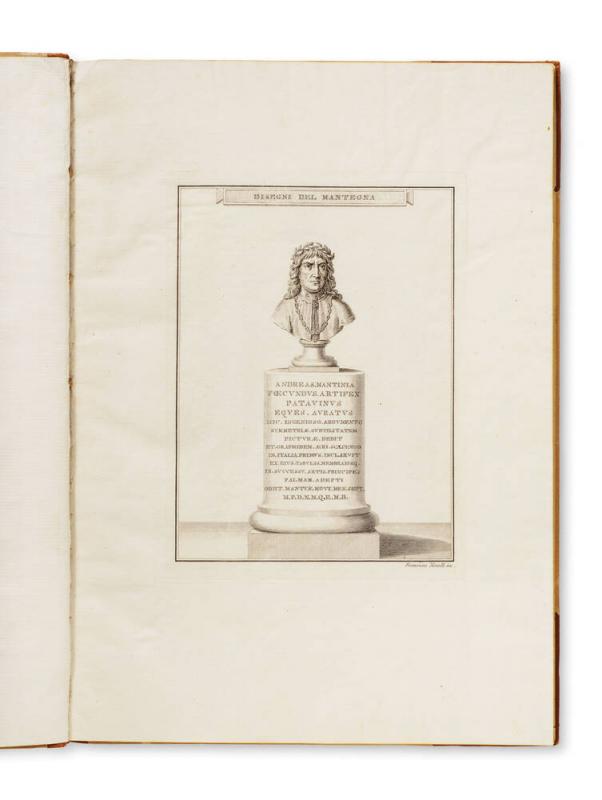
NOVELLI, Francesco. Disegni del Mantegna.

Venice: 1796-1799 circa. Folio (386 x 277 mm.), engraved title-page with the bust of Mantegna on a pedestral, engraved dedication printed on two leaves anf fourty-four engraved plates. Contemporary half calf, gilt spine in compartments with red morocco lettering-piece. Spine very lightly rubbed, overall very fine. ‘A rare suite of prints reproducing drawings of putti playing of fighting, all'antica heads, and studies of the Virgin and Child, once attributed to Andrea Mantegna, now recognized as works of Marco Zoppo (1432/3-1478). The prints are dedicated by the printmaker Francesco Novelli to Giambattista de Rubeis, and all but the last two reproduce drawings executed in pen and ink and wash on vellum in an album that De Rubeis had given to the printmaker's father, the Venetian painter Pietro Antonio Novelli. The album passed subsequently through the hands of Samuel Woodburn, Sir Alexander Barker, Baron Mayer de Rothschild, to Archibald Philip Primrose, fifth Earl of Rosebery (1847-1929), who in 1920 presented it to the British Museum. The function of the album has been much debated, with some reading ita s apattern book, others as an adjunct to a literary text – perhaps Petrarch's De viris illustribus – or as a luxury picture book commissioned by a patron in Venice or Padua; its date, too, is uncertain, with arguments ranging from the mid-1460s. The elusive meaning of some of the drawings and discret homosexual imagery in others “suggest a commission where the patron had a hand in providing some of the subject matter, the significance of which may have been understood only by a small circle of friends” (Chapman, Padua in the 1450s: Marco Zoppo and his contemporaries, exhibition catalogue by Hugo Chapman, British Museum, Departments of Prints and Drawings, London 1998, pp.38, 40) […] In the dedicatory letter, Novelli recounts the discovery of the album in 1765 in Padua by Giambattista de Rubeis (1743-1819), a painter and a dilettante from Udine. He tells us that various experts of Padua, recognizing ita s an important work of art derived from Squarcione, decided that the drawings must be by his most illustrious pupil, Mantegna, basing this attribution on a resenblance, in their opinion, to the so-called Tarocchi del Mantegna. In the letter, Novelli attemps to support the attribution, by finding affinities with the Triumphs of Caesar and other authentic works of Mantegna. The album consists of twenty-six vellum leaves, of which twenty-four are drawn on both sides and two are blank on one side, so the total number of drawings is fifty. Novelli's plan was to engrave all fifty drawings and issue his prints serialy, in group of eight, to subrcribers. […] In a letter of December 1796 to Abate Mauro Boni, Novelli writes that he had become apprehnsive about publishing prints of two drawings, because he considered them licentious, and thus likely to lose his subscribers, as incorrect in drawing. We learn from another letter that Francesco Novelli had acquired from Abate Pietro Bini, sometime before 27 May 1796, a double-sided drawing (on paper) showing eight studies of the Virgin and Child in a variety of pose. Novelli belived this sheet to be also by Mantegna – despite receiving from the Venetian connosseur Giovanni Maria Sasso the correct attribution to Zoppo – and he etched both sides as substitute for two rami licenziosi recording the different provenance directly on the plates: Il disegno fu regalato all'incisore dall'Egregio Pittore Sigr. Abre. Pietro Bini. […] The project was brought to a close in 1799, […]. In an undated Avviso [in our copy pasted onto the front pastedawn], Novelli explained that the work would terminate with forty-four prints, however the two prints of the Virgin anc Child (each with four studies) would be counted as eight, thereby fulfilling his promise to supply 50 disegni originali di Andrea Mantegna. The majority of surviving copies are comprised of forty-seven or forty-eight prints: the title-print (often supplied in two versions, one with and the other without lettering); two leaves of engraved dedication and forty-four numbered plates.' (Robin Halwas)

Sachgebiete: Kupferstich, Handzeichnungen, Illustrierte Bücher, Renaissance

21.07.2026 - 17:00

9000,- EUR

Meda Riquier Rare Books LTD

...

MORE, Sir Thomas; DESIDERIUS ERASMUS. MORE, Sir Thomas. De optimo reip. statu deque nova insula Utopia ... Epigrammata [with:] DESIDERIUS ERASMUS. Epigrammata.

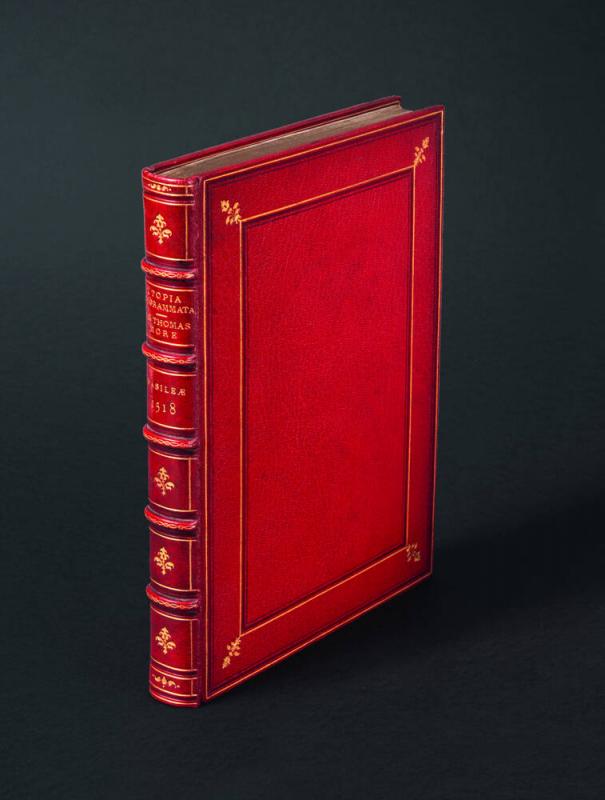
Basel: Johann Froben, March 1518 Quarto (213 x 155 mm.), three parts in one volume. Roman, Greek and 'Utopian' types. Woodcut historiated border to title of each part and to preface, the first by Ambrosius Holbein, the others by Hans Holbein, full- page woodcut of Utopia and half-page woodcut of Clement, Hythlodaye, More and Gillies, by Ambrosius Holbein, a different woodcut printer's device at end of each part, woodcut historiated initials by A. and H. Holbein. A very fine copy in nineteenth century red crushed morocco by Francis Bedford, spine gilt in compartments with gilt title, gilt edges; from the library of Cardiff Castle (ex libris) and Livio Ambrogio (ex libris). The important third edition of Utopia with the author's revisions, including the first edition of More's Epigrammata, not present in the first 1516 Louvain publication by Peter Gillies and the following Parisian reprint by Gourmont in 1517. This early edition of More's Epigrammata includes verses that were removed from following printings, particularly those pertaining to Germain de Brie (c. 1490-1538). This is the first edition printed by Johann Froben, which was followed by an identical issue in November/December of the same year. Froben's editions have been described as ‘'the most complete and most correct published in [More's] lifetime'' (Fairfax Murray, p. 494). This revised impression was arranged by Erasmus and it also contains his own Epigrammata, originally printed in Paris in 1506 in conjunction with the fourth edition of his Adagia. The title page is contained within a woodcut border showing Lucretia and Sextus Tarquinius, with additional separate title pages for each of the three works, as well as printers' devices. These works are often found separate, however it is rare to find them together as published. Utopia's architectural border is populated by Cherubs and signed by Hans Holbein. More's Epigrammata is set within a border also signed by Hans Holbein, the lower part occupied by scenes of the life of Gaius Mucius Cordus. The border for Erasmus' Epigrammata depicts St. John the Baptist and Salome. Utopia opens with a full-page woodcut map of the island, executed by Ambrose Holbein, depicting Raphael Hythlodaeus on the bottom left corner pointing towards it while speaking to More and Gillis. The opposite leaf contains the Utopian alphabet and several verses. An additional woodcut vignette is included at the beginning of the first section, showing Clement, More, Hythlodaeus, and Gillies. More's Utopia is presented as a imaginary dialogue between the author and the fictitious traveller Raphael Hythlodaeus, allegedly part of Amerigo Vespucci's crew. The first part is reserved for Hythlodaeus' critiques of European societies, particularly their greed, corruption, and inequality, blaming private property, harsh punishments, and class oppression. Conversely, the second part describes the island of Utopia that houses a society organized around communal property and rational governance. Utopians work only six hours a day, share resources, are not bound by materialism and practice religious tolerance. Their simple laws and elected leadership ensure fairness, while war and overpopulation are avoided, and slavery serves as punishment for criminals and prisoners of war. While on the surface Utopia appears idyllic, the work is infused with irony, leaving the reader to question whether such a society is attainable or a critique of human nature. "Utopia is not, as often imagined, More's ideal state: it exemplifies only the virtues of wisdom, fortitude, temperance and justice. It reflects the moral poverty of the states which More knew […] But an ideal state is what it has come to mean […] Utopia has become a fairy-tale. More, who was knighted in 1521, was later Speaker of the House of Commons, High Steward of Cambridge University, and Lord Chancellor. In 1535 he was executed for high treason. He is a saint to the Catholic, and a predecessor of Marx to the Communist. His manifesto is and will be required reading for both, and for all shades of opinion between.'' (PMM p.28).

Sachgebiete: Einbände, Humanismus, Niederlande , Renaissance , Schweiz

21.07.2026 - 16:58

50000,- EUR

Meda Riquier Rare Books LTD
...

[LEONARDO DA VINCI]. [Istrumento della donazione di dodici volumi di Leonardo da Vinci fatta alla Biblioteca Ambrosiana di Milano da Galeazzo Arconati a mezzo del suo procuratore Cristoforo Sola in data 21 gennaio 1637].

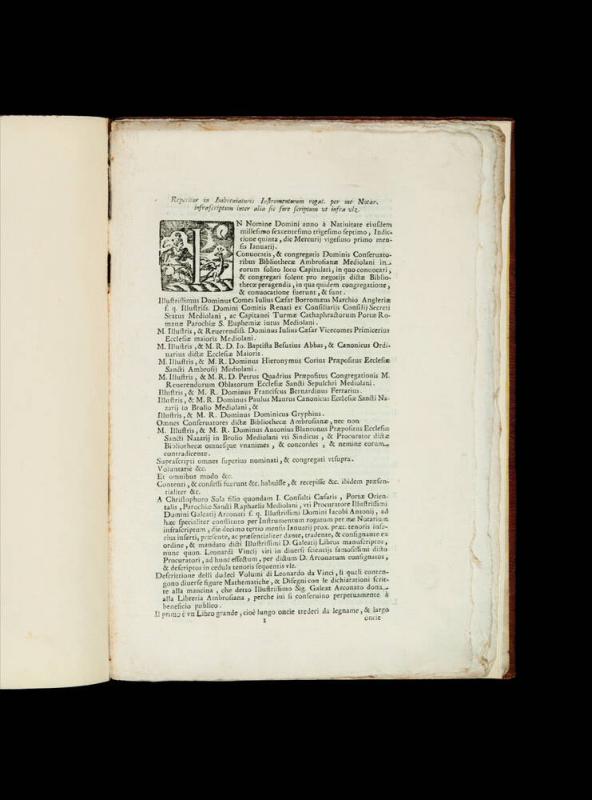
N.p. [Milan?]: n.d. [first quarter of the XVIII century]. Quarto (310×211mm). [6] leaves, the last blank. Historiated woodcut initial on the first page. A fine copy with wide margins and untrimmed edges bound in nineteenth-century brown morocco. Very rare printed edition of two notarial deeds concerning the donation of Leonardo da Vinci's manuscripts to the Biblioteca Ambrosiana of Milan. The documents include a description of all twelve notebooks, featuring the first ever mention of Leonardo's Codex Atlanticus, and a transcription of the plaque placed inside the Biblioteca Ambrosiana, to commemorate the donor, Galeazzo Arconati. Only nine copies of the four known issues are present in public libraries, which only one in the US (Washington, National Gallery of Art Library). According to Gustavo Uzielli, first to discover and publish the text of the Instrumento, in 1884, the present copy is a third edition, likely dating from the time of Giuseppe Antonio Arconati Visconti (1698–1763), a great-grandson of Galeazzo. Based on paper quality, we also believe that it dates to the early XVIII century. When Leonardo died in Amboise in 1519, his friend and pupil Francesco Melzi inherited all the notes and drawings his teacher had produced throughout his entire life. Melzi took them to his villa in Vaprio d'Adda, near Milan, where at his death in 1570 they passed to his son, Orazio Melzi. Orazio took so little interest in his inheritance that he even allowed several manuscripts to be stolen by the family's tutor. After the manuscripts were recovered, Pompeo Leoni (1537–1608), a sculptor at the Spanish court, purchased the entire collection and took it to Madrid. It was there that Leoni compiled the Codex Atlanticus by arbitrarily mounting 1,750 fragments of Leonardo's notebooks onto a large book (65×44cm), "making no attempt to classify them according to their content or date" (Pedretti, pp. 7–8). Leoni's heirs then dispersed Leonardo's manuscripts in different directions: some remained in Madrid, some were sent to England (now the British Museum's Codex Arundel and the drawings in Windsor Castle), and some, including the Codex Atlanticus, were sold to Count Galeazzo Arconati (1580–1649). Arconati, patron of the arts and an art collector, was also the cousin of Cardinal Federico Borromeo, founder of the Biblioteca Ambrosiana. Our document maintains that the king of England offered Arconati 1,000 golden coins for the Codex Atlanticus, but he refused the offer and instead donated it, along with all the other manuscripts, to the Ambrosiana, one of Italy's earliest public libraries. The first deed was drafted on 13 January 1637, and the second one, with the same provisions, was drafted a week later on 21 January, the day of the public donation ceremony. These were originally intended for the attendees of the ceremony. The twelve volumes remained in Milan until 1796, when Napoleon ordered they to be brought to Paris. The Codex Atlanticus only was returned to the Ambrosiana after the Congress of Vienna in 1815, while the rest of the collection has remained in the Institut de France ever since.

Sachgebiete: Geschichte, Italien, Renaissance

21.07.2026 - 16:55

16000,- EUR

Meda Riquier Rare Books LTD